Local Logic and Elm Street Bring Neighborhood Insights to IDX Broker Agent Websites
Partnerships
| 06 Oct 2026
Ask any SFR operator what drives their best lease renewal rates, and you’ll hear a version of the same answer: tenants who know what they’re getting into. Besides knowing the specifications of a unit, these tenants also understood what living in the neighborhood would be like. They had a real sense of the commute before they signed. They knew where the nearest grocery store was, how the schools ranked, and what the streets felt like on a weekday. When tenants have a clear picture of where they’re moving, they’re more likely to stay.
The inverse holds just as consistently. Early lease breaks are rarely about the unit itself. They’re about unmet expectations, and those expectations were set (or left unset) during the research stage when a prospective tenant was trying to figure out if a location actually fit their lifestyle and couldn’t find a clear enough answer. The gap between what they imagined and what they found is where retention problems begin. The good news is that it’s also where they’re easiest to prevent. By giving prospective tenants the neighborhood context they’re looking for before they ever have to ask, operators can improve the tenant experience and see stronger renewal rates.
Before submitting an inquiry, prospective tenants are already running through a mental checklist:
These questions aren’t mere afterthoughts. They’re deciding factors that home seekers consider before signing a lease. Operators who answer those questions proactively, rather than leaving tenants to piece it together from online searches and Reddit threads, keep prospective tenants engaged on their own platform and naturally filter for the residents most likely to be a good fit.
When that context is available upfront, the process becomes self-selecting. Tenants who aren’t a good fit recognize it early and move on. Those who proceed have already done the hard work of deciding, and a tenant who deliberately chose their neighborhood, with reliable information, is the one who renews when the time comes.
The retention payoff builds over time, but there’s a more immediate effect worth noting. Prospective tenants who’ve already found the answers to their neighborhood-related questions don’t linger at the top of the funnel. Instead, they move faster, book tours sooner, and require far less hand-holding between first inquiry and signed lease. For leasing teams managing large portfolios, that reduction in back-and-forth adds up to a meaningful amount of time and energy recovered.
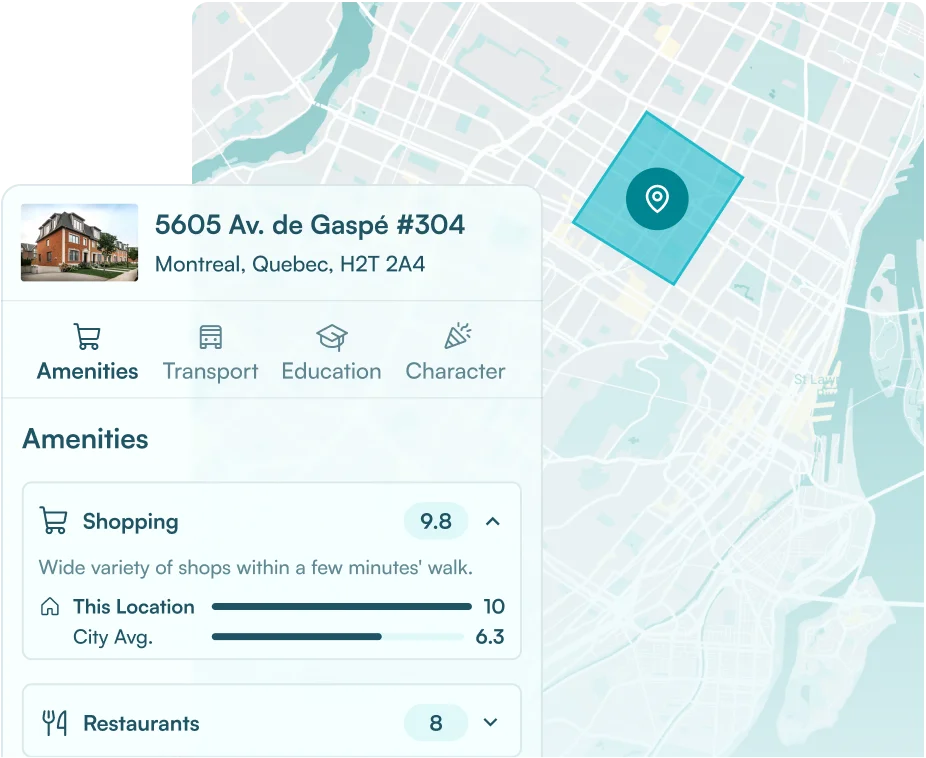
The practical solution is to make neighborhood context a standard part of the inquiry response rather than something that depends on an individual agent’s initiative. For example, building a link to Local Logic’s Neighborhood Reports directly into the inquiry workflow means every prospective tenant gets the same quality of information from the start, without any additional lift for the team. The hours that used to go into fielding location questions one by one get redirected toward the parts of leasing that actually need a human in the loop.
On most aggregator platforms, SFR listings are nearly indistinguishable from one another. By featuring floor plans, finishes, monthly rent, and a map, most operators in the market are working with the same template. Neighborhood context is one of the few things that can make a listing genuinely more useful, giving a prospective tenant a real reason to stop scrolling and reach out.
For operators running their own community or property pages, the advantages go further. Pages enriched with structured location data, such as school information, points of interest, or transit access, tend to rank for the neighborhood-level searches tenants run at the very start of their rental journey, often before they’ve found any specific listing or even settled on a particular area. That top-of-funnel visibility helps bring in prospective tenants directly to the operator’s own platform rather than through a third-party aggregator.
Manually written neighborhood content doesn’t scale. Area descriptions drafted by the leasing team can be inconsistent across properties and go stale whenever conditions change (e.g., a school’s rating shifts, a new transit line opens, a neighborhood’s amenity mix evolves). As a portfolio grows, keeping that content accurate isn’t just tedious; it becomes impossible to maintain without dedicating real resources to it.
A live data layer solves that problem in the long run. Rather than relying on content that was only accurate when someone wrote it, neighborhood information, such as walkability scores, school ratings, and points of interest, updates automatically. For operators managing hundreds of units across multiple markets, that kind of reliability is the difference between location intelligence that actually gets used and content that quietly goes stale in the background.
Strong renewal rates don’t come from what happens at move-in. They come from the quality of information a prospective tenant had when they were still deciding.
➡️ Book a meeting with Josh Partridge (Director of Strategic Partnerships) at SFR East 2026 to see how Local Logic delivers neighborhood intelligence across the SFR leasing and portfolio management workflow.