Local Logic and Elm Street Bring Neighborhood Insights to IDX Broker Agent Websites
Partnerships
| 06 Oct 2026
The 2026 NAR data makes it plain: buyers know exactly what kind of neighborhood they want. The platforms winning search are the ones that can actually show it to them.
The 2026 NAR Home Buyers and Sellers Generational Trends Report is worth reading carefully if you build real estate search products. Read it for market share breakdowns, and you’ll get useful generational snapshots. Read it as a product document, and something more instructive emerges: a detailed account of what buyers are actually trying to evaluate, where the current search experience helps them do that, and where it falls short.
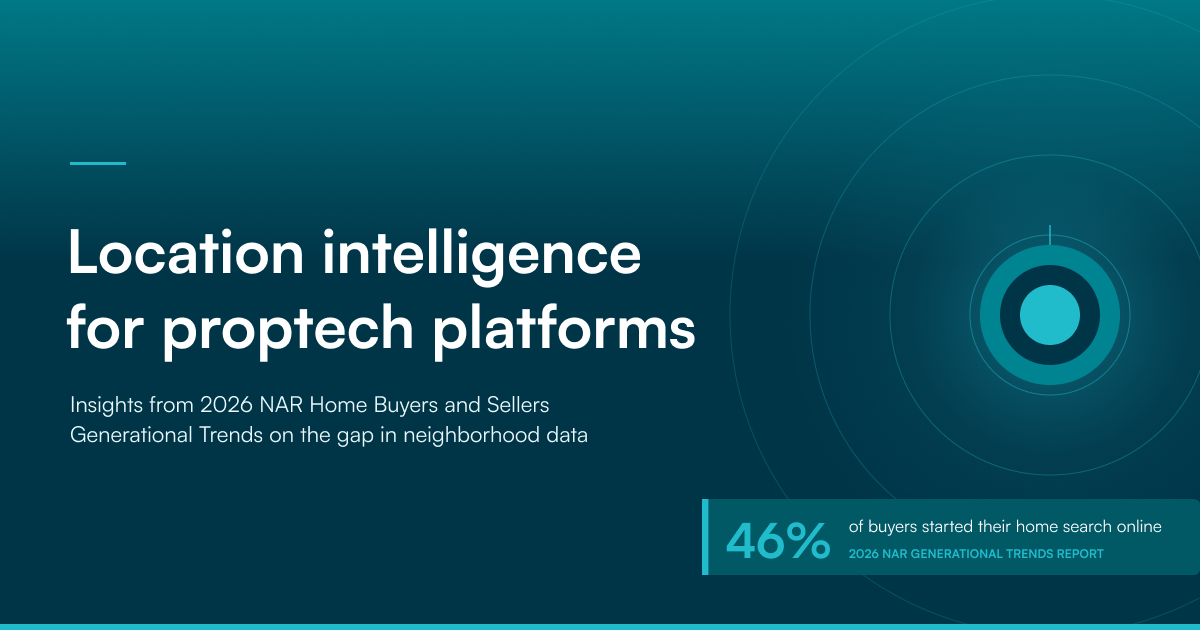
The core finding runs through every chapter. 52% of buyers found the home they purchased through an online channel, and 46% named looking online as their very first step. At the same time, 59% cited quality of the neighborhood as a top factor in their purchase decision, with commute time, school proximity, and community character following close behind. These are the variables that determine whether a specific property is the right fit, and they’re precisely the variables that most search platforms don’t provide with depth.
Buyers are spending a median of 10 weeks in that search with 56% of them identifying the property-finding stage as the most difficult part of the entire process. The opportunity for platforms willing to close that gap is significant and, based on this data, clearly not yet saturated.
Location intelligence isn’t an enhancement layer to add once a platform has matured. It’s the underlying data that makes a digitally native search experience worth using. It is the difference between a platform that shows buyers what a property costs and one that helps them understand whether a neighborhood will suit their life. Local Logic’s suite of APIs and home consumer engagement solutions was built to deliver that context at scale, and the 2026 NAR data makes the case for why it matters.
of buyers started their home search by looking online, so the data layer under your platform shapes the experience from the very first session
said finding the right property was the hardest part of the process, pointing to a fit problem that better location data is well-positioned to solve
of buyers found the home they purchased online, so platforms that surface location context well are in a strong position to convert that intent
of buyers rated neighborhood information as "very useful" on real estate websites, which is one of the highest-rated content types in the entire report
Six distinct buyer cohorts are active in this market, each optimizing for a different set of location signals. Platforms with the data depth to serve those differences are in a meaningfully stronger position than those relying on generic proximity data.
The 2026 report is a useful corrective to any assumption that buyer behavior is converging. Baby Boomers represent 42% of all recent purchases, and their location priorities (i.e., proximity to family, access to health services, community character) have almost nothing in common with those of Younger Millennials, who make up 11% of the market and are navigating student debt, commute trade-offs, and first-home affordability at the same time. First-time buyers have dropped to a record-low 21%, which means the majority of active buyers are experienced and specific about what they want. Serving them well requires data that meets the specificity of those expectations.
Search platforms have made it straightforward to filter properties by price, size, and location radius. The harder question, whether a specific neighborhood matches a buyer’s actual priorities, remains largely unanswered by most of them.
According to the 2026 NAR Generational Trends Report, buyers searched a median of 10 weeks before purchasing. That sustained engagement reflects genuine intent, not uncertainty about whether to buy.
What it reflects is the effort required to answer a question most platforms aren’t designed to answer: Does this neighborhood work for my specific life? Commute to a particular office. Schools in a given district. Access to aging parents. Walkability for a household that doesn’t own a car. These aren’t abstract preferences; they’re the criteria buyers are applying to every property they look at, whether or not the platform gives them a structured way to do it.
The 34% of buyers who rated neighborhood information as “very useful” on real estate websites, which is one of the highest-rated content types in the report, is a clear signal about where buyer attention goes when it’s available. Platforms that provide this context well are giving buyers something they’ve already indicated they value. The gap isn’t a buyer education problem. It’s a data availability problem, and one that’s addressable.
Younger Millennials were the cohort most likely to begin their home search by looking up neighborhood information specifically, including schools, local amenities, parks, and transit. 5% started there, compared to 2% of buyers overall. For platforms serving this segment, the neighborhood exploration experience is often the first meaningful interaction, well before a listing detail page.
For teams building AI-assisted search, there’s an additional consideration worth being direct about: the quality of AI-generated recommendations is bounded by the quality of the underlying data. A model drawing on incomplete or unnormalized neighborhood data will produce inconsistent outputs regardless of its sophistication. Clean, structured, proprietary location data becomes more valuable as AI plays a larger role in the search experience. The data layer is where product quality is established, not where it’s applied.
unique data points aggregated across the U.S. and Canada
unique insights per address, verified and normalized
addresses covered, enabling platform scale from day one
Local Logic aggregates over 100 billion data points across 250 million addresses, producing 250+ normalized insights per address, spanning walkability, commute time, school data, demographics, climate risk, and more, that integrate directly into search, listing, and lead capture experiences.
What makes that scale genuinely useful is the normalization work underneath it. A walkability score in Phoenix reflects the same underlying methodology as one in Portland. Commute-time data is address-level and current. School proximity and ratings are structured for filtering, not just display.
Across 22 million monthly users and 12,000+ real estate websites, that consistency is what makes comparison-based search reliable across geographies, which is exactly what buyers are trying to do when they’re evaluating neighborhoods in markets they may not know well.
The suite of APIs maps directly to what the NAR data shows buyers are evaluating.
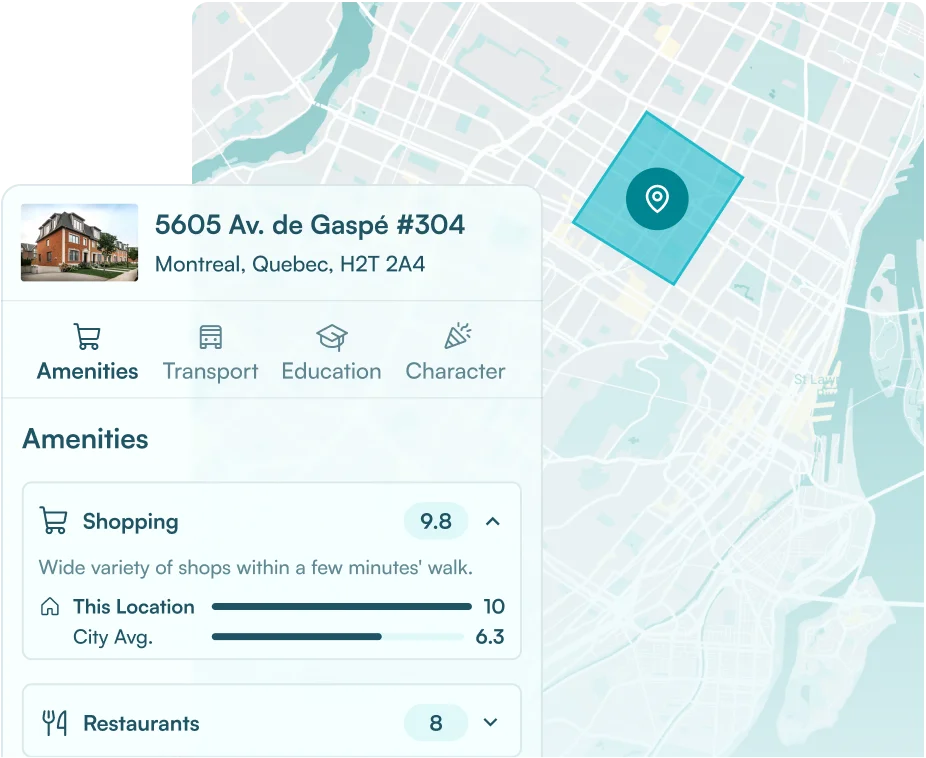
In terms of home consumer engagement solutions, Local Content and NeighborhoodWrap bring location intelligence directly to listing and community pages as embeddable components, providing the neighborhood context that buyers have already said they find valuable when they’re evaluating a specific property. Local Search enables searching by lifestyle criteria, so buyers can discover listings based on neighborhood fit rather than proximity alone. Lead Capture ties contextual lead generation to neighborhood content, making the location exploration moment a natural conversion point.
Platforms built on repackaged public data face increasing exposure as AI models become more capable of synthesizing generic information independently. Local Logic’s data asset is differentiated, normalized, and explainable, meaning it becomes more valuable as AI plays a larger role in the stack. Product teams building AI-native search experiences on top of a proprietary, address-level data layer are working with a durable competitive advantage.

Building location intelligence at scale isn’t just about data aggregation; it’s, more importantly, about normalization. Getting a walkability score to mean the same thing in Phoenix as it does in Portland, across hundreds of millions of addresses, is what makes the data trustworthy enough to build product decisions on. That consistency becomes more valuable as AI amplifies every signal in your stack.
CPO & Co-Founder, Local Logic
The 2026 NAR data shows that buyers are already doing the majority of their property search online and that they place neighborhood quality above every other purchase factor. Platforms that surface location context with depth and accuracy are directly positioned to serve both of those realities.
According to the report, buyers entering the search process have well-defined location priorities and have significant time to spend evaluating them. They’re not short on intent or options. The median 10-week search and the 56% who named property-finding as the hardest step both point to the same underlying dynamic: the evaluation work buyers need to do is real, and platforms that make it easier are the ones that retain their attention and earn their transactions.
The platforms that have made meaningful progress here have done so by integrating a normalized, scalable data layer rather than attempting to build one. According to the 2026 NAR Generational Trends Report, 59% of buyers named neighborhood quality as a top purchase factor, yet 56% still found the process of identifying the right property difficult. Closing that gap is a solvable problem, and the infrastructure to do it is available. For product and technology teams evaluating where to invest, the NAR data is a reasonably clear guide to where buyer expectations are concentrated and where platforms that meet them stand to benefit.
Explore how Local Logic’s location APIs and home consumer engagement solutions integrate into your platform
Whether you’re evaluating the APIs for a new search experience, enriching an existing listing product, or building AI-native property discovery, the right starting point is a conversation about your specific architecture and use case.