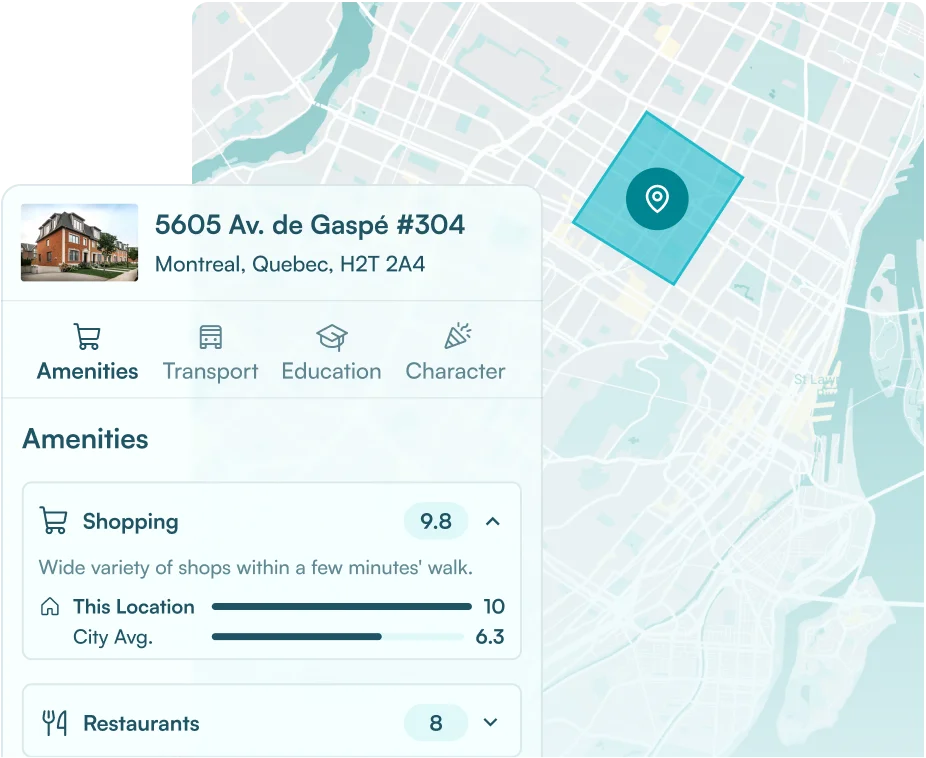



A grounded assistant gives every agent instant, defensible local expertise: real school ratings, live prices, and genuinely comparable neighborhoods, all sourced from the Local Logic MCP so nothing is invented.
Why an agent local-expert assistant is a worthy use case
An agent’s edge has always been local knowledge: which streets, which schools, which trade-offs. But no agent knows every neighborhood in a metro, and buyers now arrive having already asked a chatbot. When a client emails at 9pm asking, “How are the schools in Lincoln Park, and is there somewhere similar but more affordable?”, the agent who answers first and accurately wins the relationship. The agent who forwards a confident but wrong AI answer loses it.
A grounded assistant gives every agent instant, defensible local expertise. Instead of the agent scrambling across school-rating sites and old MLS notes, the assistant calls the Local Logic MCP and returns measured scores, named schools with ratings and distances, live market prices, and genuinely comparable neighborhoods, all in one place, all sourced. It makes a new agent sound like a twenty-year veteran and frees a veteran from busywork.
What good looks like
The assistant never invents a school, a rating, or a price. Every recommendation the agent forwards to a client is backed by a value the agent could defend on a call.
How to build it
- Connect the MCP to the agent’s workspaceWire the hosted MCP into the assistant your agents already use, or an internal tool built on the Anthropic or OpenAI APIs.
- Resolve the neighborhoodThe assistant calls
search_geographiesto pin “Lincoln Park, Chicago” to ageog_idso schools, scores, and prices all refer to the same area. - Assemble the local briefIt calls
get_schoolsfor named schools with ratings and distance,get_scoresfor livability, andget_market_statsfor current prices and pace. - Find the smart alternativeFor the “somewhere similar but cheaper” ask, it calls
get_similar_neighborhoods, which ranks comparable areas by a real similarity model and surfaces an affordability signal. - Hand the agent a client-ready answerThe assistant returns a short, sourced summary the agent can paste into an email or read on a call, with an honest note wherever data is thin.
See it in action
A relocating family, two school-age kids, is asking their agent about Lincoln Park. Here is the assistant’s answer: generic versus grounded on the Local Logic MCP. Every grounded figure is a live response.
Behind the scenes: MCP tool calls
✗ Generic model, ungrounded
“Lincoln Park has good schools like Lincoln Park Academy (rated 9/10) and homes typically sell for around $900K. A cheaper nearby option would be Wicker Park.”
The school name and rating are invented, the price is off by more than half for single-family homes, and the “similar” pick is a guess, not a comparison.
✓ Grounded on Local Logic MCP
“Strong schools: Lincoln Elementary (A+, 0.2 km), Alcott and Mayer (both A+), and Lincoln Park High (B+, AP). Single-family homes have a median sold price of $2.44M and move fast (~8 days on market, seller’s market); condos median $701K. For a similar feel at a lower price, look at Ravenswood — 75% similar and more affordable.”
Client-ready, and every figure is defensible.
The neighborhood at a glance
The alternative, quantified
The “somewhere more affordable” ask is where agents usually rely on gut feel. The assistant answers it with a model. get_similar_neighborhoods returns Ravenswood at a 0.75 similarity to Lincoln Park with a higher affordability index, followed by Old Town and Wrigleyville. The agent can now say, on a call, exactly how similar the alternative is and why, a level of specificity that reads as genuine expertise.
| Neighborhood | Similarity to Lincoln Park | Relative affordability |
|---|---|---|
| Ravenswood | 0.75 | More affordable |
| Old Town | 0.72 | Comparable |
| Wrigleyville | 0.71 | More affordable |
The payoff
A grounded assistant compresses hours of neighborhood research into one sourced answer and levels up every agent on the team. It protects the brokerage from the reputational risk of forwarding a confident-but-wrong AI reply, and it turns the agent, not a consumer chatbot, into the trusted local source the client comes back to.
Frequently asked questions
What is an agent local-expert assistant?
It is an assistant that answers agent and client questions about a neighborhood from measured Local Logic data, including schools, scores, prices and comparable areas.
Where does the school and price data come from?
From the Local Logic MCP: get_schools returns named schools with ratings and distance, and get_market_stats returns live median prices and days on market.
How does it find a more affordable similar neighborhood?
It calls get_similar_neighborhoods, which ranks comparable areas by a real similarity model and includes an affordability signal, so the recommendation is quantified rather than a guess.
Can we add this to our CRM or the tools agents already use?
Yes. The MCP is a hosted server that speaks the open Model Context Protocol, so it connects to a CRM copilot, an internal agent, or an existing chat assistant without building a data pipeline.
Will it invent a school or a price?
No. It answers only from returned data and flags where data is thin, so agents can defend every figure they forward to a client.
Ground this use case on your own market
Bring us your query mix. We will show you the grounded difference live, on the neighborhoods you care about.
At a glance
- Best forBrokerages
- WhoBrokerage & agent enablement teams
- CoverageUS & Canada
- SetupOne URL + MCP key
MCP tools used
search_geographies
get_schools
get_scores
get_market_stats
get_similar_neighborhoods