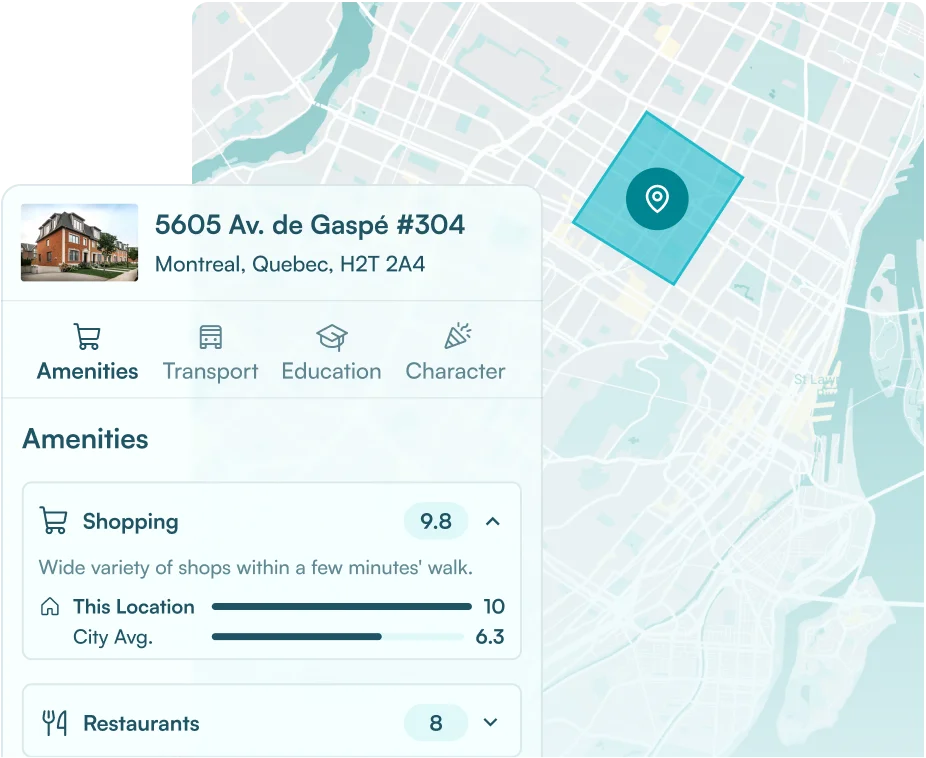



AI now writes most listing descriptions, and they come out either generic or full of Fair Housing red flags like safe, family-friendly, or great schools. Grounding the description in Local Logic data swaps that subjective language for named places, walk times, and address-level scores a buyer can verify, and keeps the copy on objective facts.
Everyone is writing listings with the same AI
Most listing copy is now written by AI. In NAR’s 2026 technology report, 75% of agents who use AI use it for listing descriptions, the single most common use. The upside is obvious: a solid draft in seconds. The problem is what comes with it.
Left to its own devices, AI writes listings that all sound the same, charming, close to everything, a vibrant community. And when it reaches for something more specific, it often reaches for exactly the language that gets flagged.
The real risk
Ask AI to make a listing more appealing and it will happily write perfect for young professionals, family-friendly, great schools, or a safe, up-and-coming area. Those phrases can imply protected characteristics, and MLSs flag them. If it is in your remarks, the liability is yours, not the AI’s.
The same listing, two ways
Same townhouse, same facts. One description is written from the model’s imagination. One is grounded in the real, address-level data for the property.
Ungrounded
Welcome to this charming 3-bed townhome in a highly sought-after, family-friendly neighborhood. Perfect for young professionals and families alike, close to everything, with great schools and a safe, vibrant community feel. Do not miss this gem in one of the best areas in the city.
Generic, unverifiable, and several of these phrases raise Fair Housing flags.
Grounded with Local Logic
Mornings can start with a doughnut from Beacon Doughnuts, a minute’s walk away. Oz Park is a short stroll for a walk or a workout, and Foxtrot Market is an easy walk for dinner ingredients. The Armitage Brown and Purple Line station is about four minutes away, which makes getting around without a car simple.
Named places, walk times, and real transit. Specific, verifiable, and focused on facts rather than buyer profiles.
What the data gave it
Enter the listing facts and the address. The description generator pins the location, pulls the scores and nearby places from Local Logic, then writes an MLS-ready description from what it finds.
get_enhanced_pois Beacon Doughnuts 1 min, Walgreens 1 min, Barry’s 2 min, Armitage station 4 min, Foxtrot Market 6 min
get_neighborhood_profile Lincoln Park character and context
This three-level Lincoln Park townhouse at 2000 N Halsted offers 1,900 square feet, three bedrooms and two and a half baths, all built in 2004. The open kitchen with its island flows toward a gas fireplace, and the primary suite comes with a walk-in closet. Up top, a private roof deck gives you a place of your own outdoors, and a private garage takes care of parking.
Mornings can start with a doughnut from Beacon Doughnuts, just a minute’s walk away. Later, Oz Park is a short stroll for a walk or a workout, and Foxtrot Market is an easy walk for dinner ingredients. When evenings come around, restaurants and bars are steps from the door. Heading downtown or across the city, the Armitage Brown and Purple Line station is about four minutes away, which makes getting around without a car simple.
Those highlighted phrases are the part the location data wrote. Every one is a named place, a walk time, or a measured score, and every one is address-level, specific to this listing rather than a blanket neighbourhood average.
Factual copy is safer copy
The reason the grounded version avoids Fair Housing trouble is not a filter bolted on at the end. It is that the description is built from objective, measured facts in the first place: a named cafe, a four-minute walk to transit, a walkability score. That is the opposite of the buyer-profile and neighbourhood-character language, perfect for young professionals, family-friendly, safe, that creates steering risk.
Keeping copy on verifiable physical and location facts is exactly what Fair Housing guidance recommends. A person should still review every description, and the agent is always responsible for what goes in the MLS, but starting from measured data means there is far less to clean up.
Being right is your differentiator
Every agent has the same AI writing the same first draft. The production is a commodity now. What is not a commodity is a description where the local details are specific, true, and safe to publish.
Everyone uses the same tools, the same AI, the same channels. Being right, through verifiable local insight, is the one thing that still sets you apart.
How to make one
- Pinpoint the addressDrop the listing address so the data is pulled for the exact property, not the general area.
- Pull the location dataThe Local Logic MCP returns the address-level scores, the named nearby places with walk times, and the neighbourhood profile.
- Write the description from the factsYour AI tool drafts an MLS-ready description from what the MCP returned, within your character limit, in the language you choose.
- Review and postGive it a human read, confirm it fits your MLS rules, and publish a description where every local claim is named and checkable.
Frequently asked questions
How is this different from asking a general AI to write the listing?
A general AI guesses the neighbourhood from memory, so it invents places and reaches for vague adjectives. This pulls the real, address-level data for the listing first, so every location detail is a named place, a walk time, or a measured score the buyer can check.
Does this help with Fair Housing compliance?
It keeps the copy on objective, measured facts and named places instead of the buyer-profile and neighbourhood-character language that creates steering risk, like perfect for young professionals, family-friendly, or safe. A person should still review every description, and the agent remains responsible for what goes in the MLS.
Are the scores for the exact address or the whole neighbourhood?
They are address-level. Local Logic scores are specific to the point, so they reflect the exact listing, which is why two homes a few blocks apart can read differently.
Will it fit MLS character limits?
Yes. You set a maximum length and the description is written to fit, so it is ready to paste into the MLS.
Do I need to be technical to use it?
No. The data comes from the Local Logic MCP, which any AI tool can connect to. You enter the listing facts and the address, and the description is written from the real data.
Ground this use case on your own market
Bring us your query mix. We will show you the grounded difference live, on the neighborhoods you care about.
At a glance
- Best forBrokerages
- WhoAgents and listing teams
- CoverageUS & Canada
- SetupOne URL + MCP key