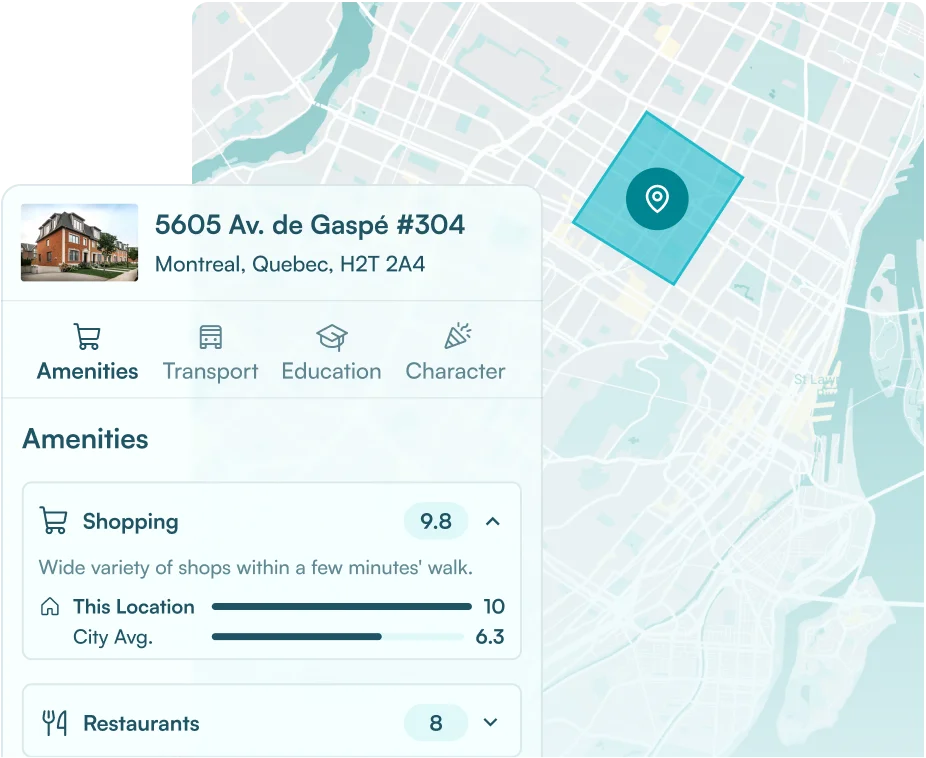



The Local Logic MCP is the retrieval layer that removes location hallucinations. Your model calls read-only tools for measured data, cites real places and transit, and returns an honest no-data at the edge of coverage.
Why killing local-fact hallucinations is a worthy use case
If you are building an AI product on top of real estate, location questions are your highest-risk surface. The facts that decide a home: what is nearby, which line the train is on, how walkable a block really is, are not reliably in any model’s training data, cannot be crawled cleanly, and get less accurate exactly in the long-tail neighborhoods where a large share of transactions happen. A model will still answer, fluently and with total confidence. That confidently wrong answer is the single fastest way to lose a user’s trust in your product.
The Local Logic MCP is the retrieval layer that removes that risk. It exposes measured location data as read-only tools your model calls mid-response, so it reads real values instead of reaching for them. For a proptech or AI team, it replaces the integration you would otherwise build and maintain, and it returns an honest “no data” at the edge of coverage instead of a plausible guess, which is exactly the behavior a production system needs.
What good looks like
Location claims in your product are traceable to a tool call. Hallucinated amenities, transit lines, and schools drop out, and the model declines gracefully where there is no data.
How to build it
- Add the MCP as a tool layerConnect the hosted server through the OpenAI Responses API, the Anthropic Messages API, or any MCP-compatible client. One URL, one key — no data pipeline to build.
- Route location intent to toolsWhen a prompt touches a place, have the model call
search_geographies, then the specific tools the question needs —get_scores,get_neighborhood_pois,get_neighborhood_profile. - Constrain the model to returned dataSystem-prompt the model to answer only from tool output and to say when a fact is not covered. This is what converts “sounds right” into “is right.”
- Evaluate the liftRun your own before/after eval on location prompts. Grounding is measurable: track verified facts per answer and the rate of materially wrong claims.
- Ship with graceful fallbacksTreat “no data” as a first-class response in your UX, so the product stays trustworthy at the edge of coverage.
See it in action
The clearest test of a hallucination fix is a specific, checkable question. Here a generic model is asked about amenities and transit in Capitol Hill, Seattle — and then the same model grounded on the Local Logic MCP. Every grounded detail is a live response.
Behind the scenes: MCP tool calls
✗ Generic model, ungrounded
“Capitol Hill has great coffee, like Hilltop Roasters and Broadway Bean, and is near Discovery Park. Transit is decent, mostly buses.”
Those two cafes do not exist, Discovery Park is across the city in Magnolia, and it misses the Link light rail entirely — four errors, zero hedging.
✓ Grounded on Local Logic MCP
“Coffee is a strength (cafes 10/10): Caffe Ladro, Victrola Coffee Roasters, and Fuel Coffee are all within walking distance. Green space scores 9.5/10 with Volunteer Park and Cal Anderson Park nearby. Transit is strong (8.7/10): the Capitol Hill Link light rail station plus 40+ bus lines.”
Real names, real places, real line.
The scores behind the answer
Why web search is not a substitute
The obvious question is why not just let the model search the web. We tested it. A dedicated live-retrieval product reached only 82% claim accuracy on the proprietary location categories — below every model grounded on Local Logic data. The moat is the data, not the retrieval: we build and calibrate location attributes that cannot be reconstructed from crawling. Across the full evaluation of 7 models on 490 questions in 46 neighborhoods, grounding delivered up to 2.3x more verified facts per answer and roughly halved the answers with serious errors.
The payoff
For an AI builder, grounding is the difference between a demo that impresses and a product that survives contact with real users. You ship location answers you can trace to a source, you cut the hallucinations that quietly erode trust, and you do it with one connection instead of a data-engineering project — getting the full breadth of Local Logic’s data rather than wiring up endpoints one at a time.
Frequently asked questions
How does the MCP reduce hallucinations?
The model calls read-only tools that return measured location data and is constrained to answer from that data, so invented amenities, transit lines and schools drop out.
Why not just use web search?
In testing, a dedicated live-retrieval product reached only 82% accuracy on proprietary location categories, below every model grounded on Local Logic data. The moat is calibrated data, not retrieval.
Which APIs and clients are supported?
Any MCP-compatible client, plus the OpenAI Responses API and the Anthropic Messages API. One URL and one key, covering the US and Canada.
Is the server safe to put in production?
Yes. It is read-only, does not train on your queries, scopes access to your entitlements, and returns an honest no-data at the edge of coverage.
How do I measure the improvement?
Run a before and after eval on location prompts. Grounding delivered up to 2.3x more verified facts per answer and roughly halved answers with serious errors in the Local Logic study.
Ground this use case on your own market
Bring us your query mix. We will show you the grounded difference live, on the neighborhoods you care about.
At a glance
- Best forProptech & AI builders
- WhoProptech & AI product teams
- CoverageUS & Canada
- SetupOne URL + MCP key
MCP tools used
search_geographies
get_neighborhood_pois
get_neighborhood_profile
get_scores