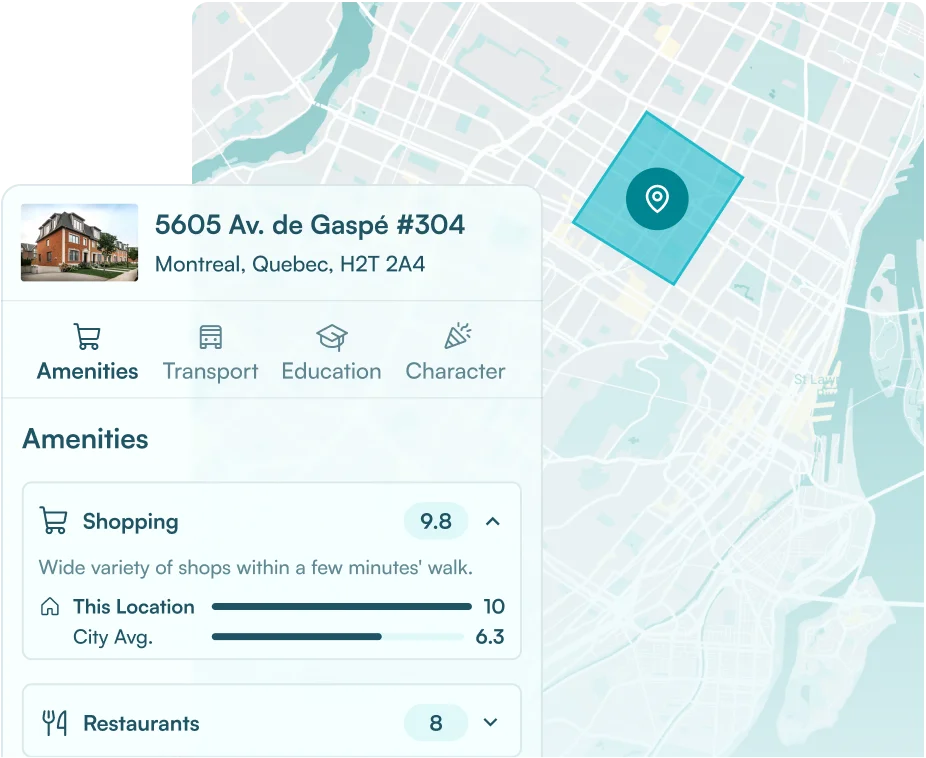



Ground your neighborhood search on the Local Logic MCP and any model answers location questions from measured data instead of memory. Buyers get accurate, specific answers on your own page, so they stay and engage more listings, and AI answer engines can cite you.
Why grounded neighborhood search is a worthy use case
Search is where portals win or lose the visit. A buyer who types “what is Williamsburg like to live in?” now expects a real answer on the page, not ten blue links to scroll. The moment portals hand that answer to a generic model, though, they inherit its biggest weakness: it sounds authoritative whether or not it is right. In our evaluation, ungrounded models invented transit lines, parks, and even schools that do not exist, and never hedged. On a listing site, a confident wrong answer is worse than no answer, because it erodes the trust the whole search experience is built on.
Grounding the search answer on the Local Logic MCP fixes this without changing the model you already use. When the question touches a place, the model calls read-only tools that return measured location data, and it answers from that data instead of from memory. The payoff for a portal is direct: the most accurate answer to a location question lives on your page, so users stay, engage more listings, and come back. It is an answer you can stand behind, and an honest “no data” when coverage runs out.
What good looks like
Every neighborhood claim on the page is backed by a measured score, a named amenity, or a real market figure — and anything outside coverage is omitted rather than guessed.
How to build it
- Connect the MCP to your assistantPoint your MCP-compatible client, agent framework, or the OpenAI Responses / Anthropic Messages API at the hosted server and authenticate with your MCP key. Nothing to install or host.
- Resolve the placeWhen a query names an area, the model calls
search_geographiesto turn “Williamsburg, Brooklyn” into a stablegeog_id, so every downstream number is calibrated to the whole neighborhood rather than one street corner. - Pull the facts that answer the questionFor a “what is it like” query the model calls
get_scores,get_neighborhood_profile, andget_neighborhood_pois. For price questions it addsget_market_stats. - Answer from the data, and only the dataInstruct the model to cite the returned values and to say when something is not covered. Render scores on your own 0–10 scale for consumers (the MCP returns 0–5, so double it).
- Show your workSurface the scores and named places inline so the answer is skimmable and verifiable — the data becomes on-page content that also helps you rank.
See it in action
Here is the exact same question answered two ways: a generic model working from memory, and the same model grounded on the Local Logic MCP. The neighborhood is Williamsburg, Brooklyn, and every figure in the grounded answer is a live MCP response.
Behind the scenes: MCP tool calls
✗ Generic model, ungrounded
“Williamsburg is a trendy, walkable Brooklyn neighborhood with lots of restaurants. It is served by the A and C subway lines and has a walk score around 88. You will find spots like The Brooklyn Cafe nearby.”
The A and C do not run through Williamsburg, the walk score is invented, and that cafe does not exist — all stated with full confidence.
✓ Grounded on Local Logic MCP
“Williamsburg is exceptionally walkable (10/10) with top transit access (10/10) — the L, G and J/M/Z lines plus about 20 bus routes and bike-share. Dining and cafes both score 10/10, with spots like Xixa and Traif within a few minutes’ walk. It is lively rather than quiet (quiet 3/10).”
Every claim maps to a measured value.
The scores behind the answer
And when the buyer asks about price
The same connection answers the follow-up. A get_market_stats call for Williamsburg returns, for condos and townhomes over the trailing 12 months, a median sold price of $1.525M at roughly $1,720 per square foot, a median 94 days on market, and a buyer’s market assessment across 131 sold homes. Instead of a hand-wavy “Williamsburg is expensive,” the buyer gets a number they can act on — and it updates daily, not whenever someone remembers to edit a page.
The payoff
For a portal, grounded search turns a location question into a reason to stay on your site rather than bounce to a chatbot. The answer is accurate enough to trust, specific enough to be useful, and it is your page that earned the click. In our research, grounding a small, inexpensive model on Local Logic data lifted claim accuracy to 97.6% — edging out a frontier model’s own 96.9% at roughly one-seventh of the cost per answer. You do not need the biggest model. You need the right data feeding it.
Frequently asked questions
What is grounded neighborhood search?
It is search where the AI answers location questions from measured Local Logic data through the MCP rather than from the model memory, so answers are accurate and specific.
Do I have to change the model I use?
No. The MCP works with any MCP-compatible client and with the OpenAI Responses and Anthropic Messages APIs. You keep your model and add grounded data.
Which tools power a search answer?
Typically search_geographies to resolve the area, then get_scores, get_neighborhood_profile and get_neighborhood_pois, plus get_market_stats for price questions.
How accurate is it?
In Local Logic testing, a small grounded model reached 97.6 percent claim accuracy on neighborhood questions, edging a frontier model at roughly one-seventh of the cost per answer.
What happens when there is no data?
The model returns an honest no-data response for that fact instead of guessing, which keeps the search experience trustworthy.
Ground this use case on your own market
Bring us your query mix. We will show you the grounded difference live, on the neighborhoods you care about.
At a glance
- Best forPortals
- WhoPortal product & search teams
- CoverageUS & Canada
- SetupOne URL + MCP key
MCP tools used
search_geographies
get_scores
get_neighborhood_profile
get_neighborhood_pois
get_market_stats