Local Logic and Elm Street Bring Neighborhood Insights to IDX Broker Agent Websites
Partnerships
| 06 Oct 2026
RealTrends redrew its own categories this year. For the 2026 program, it added an Enterprise tier for teams of 51 or more agents because the bracket above mega was no longer describing what was in it. Teams have gotten large enough, and structured enough, that the industry’s own scoreboard needed a new box.
That is the clearest signal yet of something most people in real estate already feel. The team stopped being a couple of agents sharing a sign and became an operating model.
Twenty-one percent of REALTORS now work as part of a team, and the typical team has about four members. But the distribution is wide. In the 2026 US national rankings, there were 14,891 small teams of two to five agents, 3,500 medium teams of six to ten, 1,383 large teams, 632 mega teams, and 191 in that new Enterprise tier. The same label covers a duo and a fifty-person organization.
At the upper end, the label changed too. The teamerage, a team that took on the functions a brokerage used to provide, is the fastest-growing shape in the business. Lead generation, training, transaction coordination, marketing, compliance, sometimes its own brand and its own P&L, all run inside the team. What a teamerage deliberately doesn’t do is become a brokerage. It keeps its independence and buys what it needs.
Start with staffing, because it is the least appreciated fact about teams. Ninety-one percent of teams employ at least one person who is not an agent, with a median of four support staff: transaction coordinators, listing assistants, marketing managers, inside sales associates, business managers. The team is not a group of agents. It is a company with a sales floor.
Then look at who buys the tools. NAR’s 2025 technology survey found brokerages cover the CRM for only 36% of members, transaction management for 39%, and eSignature for 37%, while agents personally pay for social media tools, cloud storage, virtual tours, and showing technology. Most of the stack is not the brokerage’s decision. On a team, it is usually the team leader’s, and that leader is running a budget.
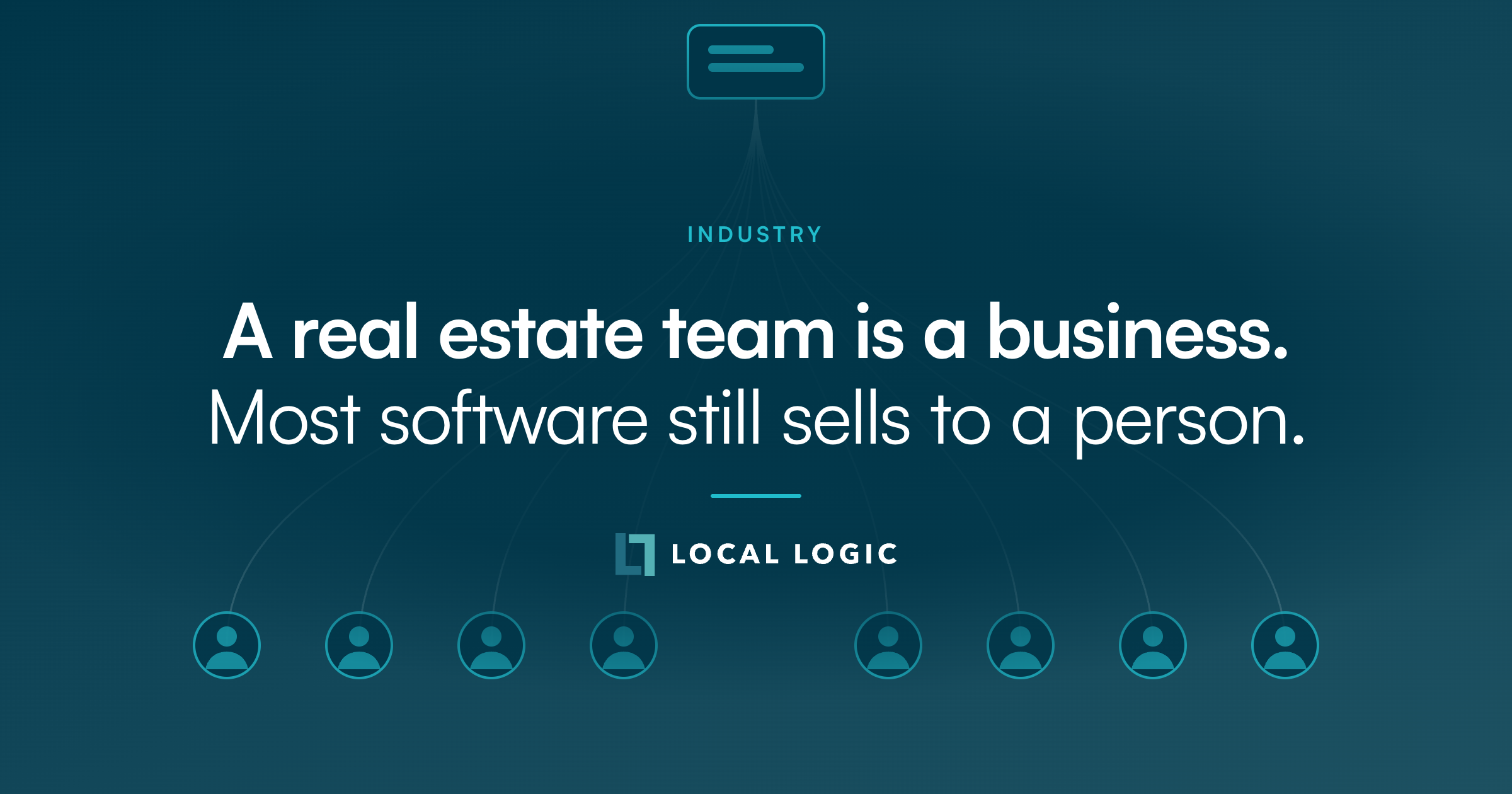
So a team looks like a business from the inside. From a software vendor’s order form, it does not exist. Tools are priced for an individual agent buying a seat, or for a brokerage negotiating company-wide with staff to run an integration. A team is neither of those, and the gap shows up in four specific places.
The team’s brand is the asset, and every agent puts it in writing. A team spends real money becoming a distinct business: a name, a logo, a website, a marketing budget. Then five agents buy five individual subscriptions, and the material clients actually read goes out branded to five different people. The team paid to build one brand, and the tooling carries five.
Growth happens by adding agents, and new agents do not know the market. This is the ramp problem, and it shows up in NAR’s own numbers: REALTORS with two years or less of experience report a median of 2 transaction sides, against 10 for those with 6 years or more. A team leader hiring for growth is buying a person who cannot yet speak with authority about the neighborhoods the team sells in. Every week of ramp is a week of the team’s brand being represented by someone still learning it.
The work runs through people who are not agents. With a median of four support staff, the person preparing client material often is not the agent whose name goes on it. An inside sales associate working on behalf of several agents is an ordinary team workflow and an impossible one for most per-seat software, which assumes the person logged in is the person being represented.
Rosters change. Agents join, agents leave, and when they leave, they leave with relationships. Access and brand both have to follow the roster rather than the individual. On a per-seat model, a departure means an orphaned subscription and material still circulating under a brand the team no longer controls.
None of that is a productivity problem. It is a coordination problem, and coordination is what a team is for.
Local knowledge is the single characteristic sellers rate most highly in an agent. In Zillow’s 2025 Consumer Housing Trends Report for Agents, 80% of sellers who used an agent said it was highly important that their agent had local market or neighborhood-specific knowledge, tied with a strong recent sales history as the top-rated quality overall.
It is also the thing being automated fastest. Zillow shipped an AI mode in March that answers prompts like “tell me what it’s like to live in this neighborhood” with nearby amenities, shops, and parks. The question that used to open a relationship now often gets answered before anyone picks up a phone.
We wanted to know how good those answers actually are, so in July we measured it. Across seven AI models, 490 neighborhood questions, and 46 neighborhoods, ungrounded models produced 1,861 claims that live data contradicts, including a Seattle transit line that does not exist and a Washington commute inflated to two or three times the real one. Connecting the same models to verified location data cut the invented claims sharply and roughly doubled the verified facts per answer. Read the study.
Which is why measured beats characterized, and why that matters more to a team than to a solo agent. Walkability as a score. Noise as a measurement. Commute time calculated from transit data. Amenities counted within a given distance. School boundaries and proximity rather than opinions about schools. For an individual agent that is a better answer. For a team leader, it is also governance: a floor under what every agent on the roster can say in writing, without reviewing each one.
We rebuilt how a team gets onto Neighborhood Reports.
Until recently a team account required single sign-on. That was the wrong requirement, and it excluded exactly the businesses described above. A four-person team does not have an identity provider. Neither, it turns out, do plenty of fifty-person teamerages, because the whole point of the model is that there is no corporate IT department upstream.
So the requirement is gone. We create the team account, build the team’s theme, and add the agents. Each agent gets an email, sets their own password, and generates their first report. Nothing to install, nothing to integrate, no security review, and no engineering time on either side. When the roster changes, we change it.
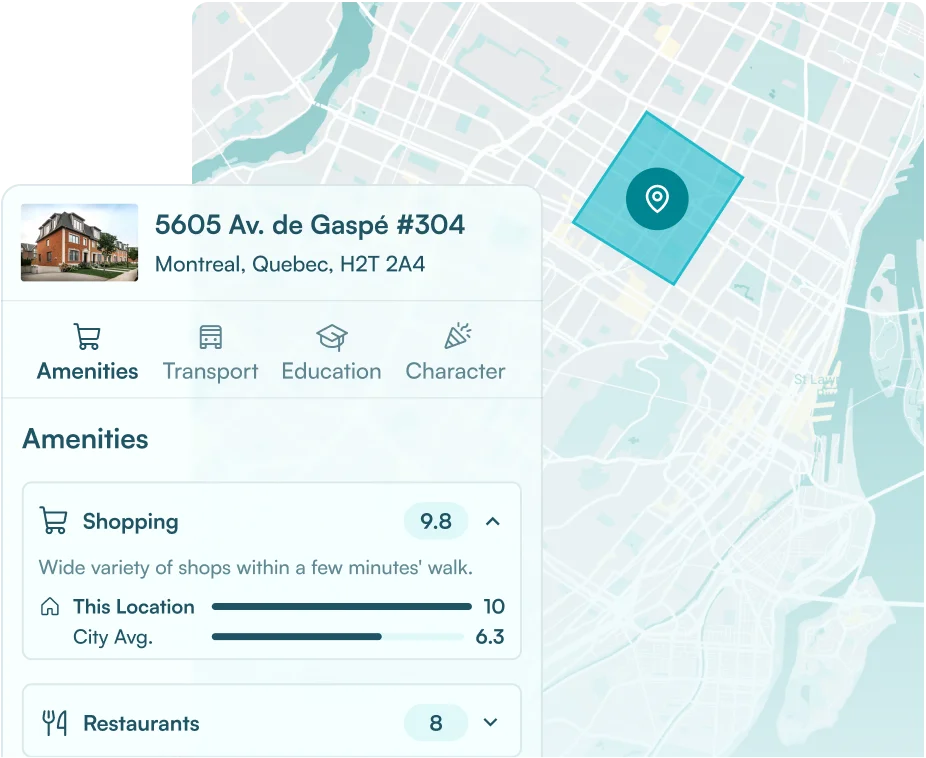
The reports carry the team’s brand rather than any individual agent’s. Lifestyle Reports describe what daily life is actually like at an address, anywhere in the US or Canada. Market Reports add median sale price, value trends, inventory and sales activity for US addresses, refreshed monthly. Reports are unlimited and they do not expire, so a report sent to a client last year is still live this year.
Underneath is the data that runs on more than 12,000 real estate websites and reaches over 22 million monthly users: 18 proprietary location scores across transportation, amenities, education, character, nature and wellness, 36 points-of-interest categories, more than 250 million addresses, and 486,187 named geographies across the US and Canada.
Reports cover the moments when an agent is in the conversation. A team’s expertise also gets tested where no agent is present at all: someone searching a neighborhood name at 11pm, a lead comparing two of your listings, a consumer who found your website long before they found any of you. Community pages on your own domain and neighborhood context on your listing pages cover those moments, and both have always been plug and play. All three run on the same data, so a neighborhood is not described one way on your website and another way in the report an agent hands over at an open house.
A teamerage is a real estate team that has taken on functions a brokerage traditionally provided, such as lead generation, training, transaction coordination, marketing and compliance, while remaining a team rather than becoming a brokerage itself. It typically has its own brand, its own profit and loss statement, and support staff who are not agents.
RealTrends Verified classifies teams by licensed agent count: small is 2 to 5, medium 6 to 10, large 11 to 20, mega 21 to 50, and enterprise 51 or more. Enterprise is new for the 2026 program. The 2026 US national rankings held 14,891 small teams, 3,500 medium, 1,383 large, 632 mega and 191 enterprise. Qualifying for the national list requires 40 sides or 16 million dollars in volume for a team, so these counts describe top producers rather than every team.
NAR’s 2026 Member Profile reports that 21 percent of REALTORS work as part of a team, with teams averaging about four members. There is no authoritative public count of the total number of US real estate teams; NAR does not publish one.
Yes, almost all of them. The 2024 Teams Report found 91 percent of teams employ at least one non-agent, with a median of four support staff in roles such as transaction coordination, marketing, inside sales and operations.
An individual subscription brands reports to one agent. A team account gives the whole team one shared brand identity, one managed roster and one invoice, so a report looks the same whichever agent sent it, and access follows the roster when someone joins or leaves. See what a team account includes.
No. Single sign-on is available for organizations that use it and is not required. We create the team account, build the theme and add the agents, and each agent activates their own account by email.
Days rather than weeks. There is nothing to install and nothing to integrate, so the timeline is however long it takes to confirm the roster and build the team’s theme.
A team is a business built to give clients more than one person could. Location is what shapes daily life, and it should not be the part that depends on which agent happened to pick up the phone.
See what a team account includes, or talk to us about setting one up.