
Local Logic and Elm Street Bring Neighborhood Insights to IDX Broker Agent Websites
Partnerships
| 06 Oct 2026
Ask a popular AI what a neighborhood is like to live in, and you will get a fluent, confident answer in seconds. Ask it something checkable and that confidence starts to cost you.
In our testing, one model told us Seattle’s Capitol Hill is served by the “L Line.” There is no L Line.
Another said the rush-hour drive out of Washington’s Adams Morgan can stretch to 25 or 35 minutes. Local Logic routing at 8:30 in the morning put it at 11.
A third claimed Philadelphia’s Northern Liberties clearly beats neighboring Fishtown for walkability. They score the same, a perfect 5 out of 5.
None of those answers hedged. They read like local expertise. Every one was wrong.
This is fixable, and we measured the fix. In a formal evaluation this July, connecting an AI to verified location data, a technique called grounding, sharply cut the invented facts and roughly doubled the verified ones. The rest of this post is what we found, why location trips up AI in particular, and what it means for anyone putting AI in front of a home consumer.
TL;DR
AI is not useless here. It is convincing, which is worse. Real estate has gone all in on it, and agents, portals, lenders, and their customers are now asking the same handful of models the same questions. The first one is almost always the oldest question in the business: what is it like to live here?
On the details that decide a purchase, the commute, what is nearby, the schools, how walkable a place really is, the model is often wrong, and it is wrong with the same confidence it is right. A buyer cannot tell a real answer from a fabricated one. Neither can the professional who passed it along. That is the trust problem underneath the AI rush, and it is measurable.
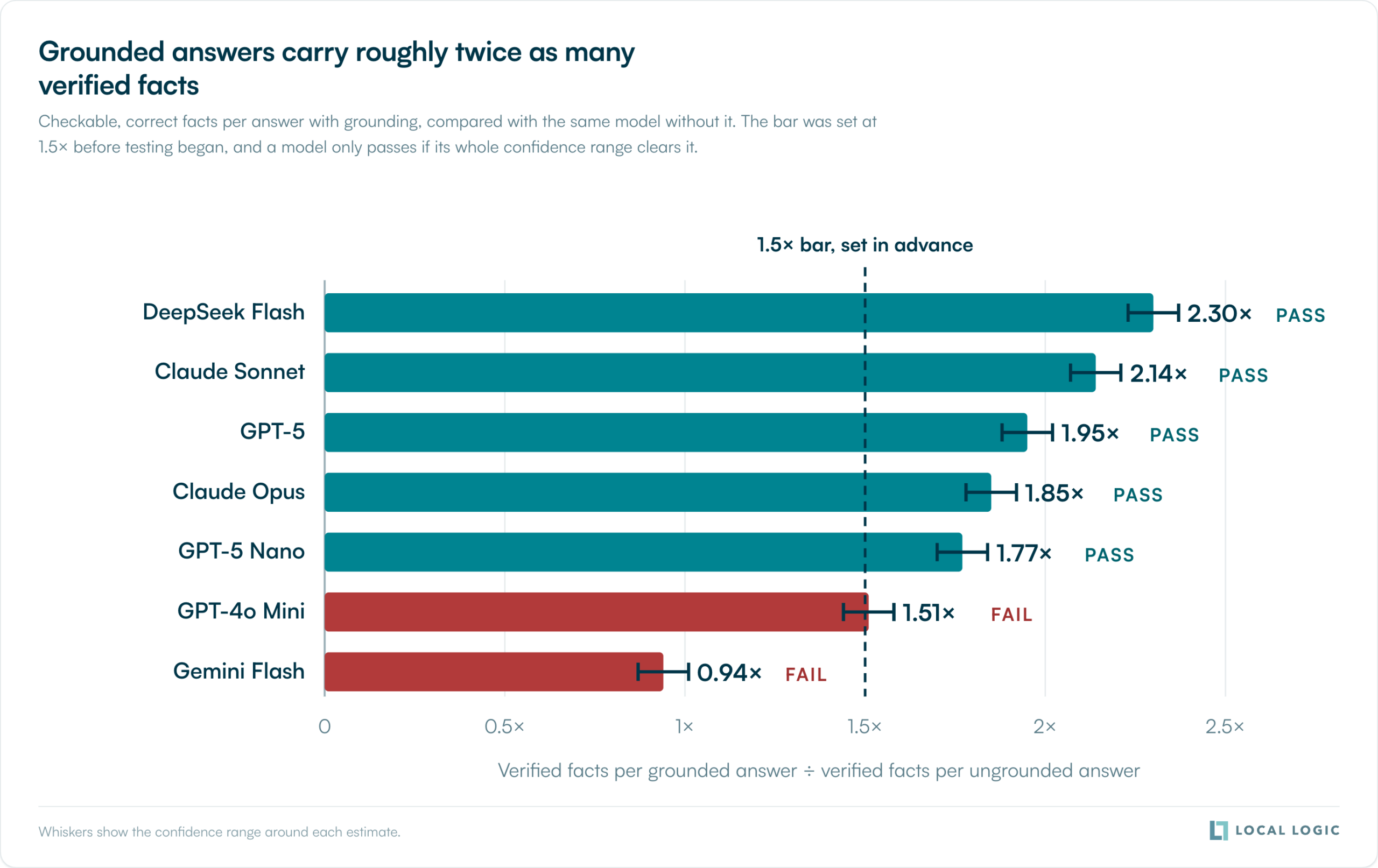
We ran a paired evaluation of seven AI models: GPT-5, GPT-5 nano, Claude Opus, Claude Sonnet, Gemini Flash, GPT-4o mini, and DeepSeek Flash. Each model answered the same 490 questions across 46 neighborhoods, twice. Once from memory alone, and once connected to Local Logic data. Then we fact-checked every single claim against live data, not against a pre-written answer key.
We fixed the pass marks before the run and report the conservative end of each result, so the numbers hold up under an audit instead of flattering us. We also chose the neighborhoods on purpose to span the famous and the obscure, from Williamsburg in Brooklyn to Butchertown in Louisville, because the obscure end is where the real test is.
Grounding means the AI answers from verified data handed to it at the moment of the question, instead of from patterns in its training. An ungrounded model answers from memory and fills the gaps by guessing. A grounded model looks up the verified fact first, then answers.
That is what our data does once it is connected to an AI. Same model, same question, except now it is reading real numbers instead of reaching for them.
Grounding in Local Logic data improved every model we tested, and the biggest gains went to the cheapest ones. Three results stood out.
The answers got richer. With Local Logic data connected, the models produced about twice as many verified facts per answer, and up to 2.2x as many on the strongest models. More real, checkable detail, not more filler. Much of that detail is the measured neighborhood characteristics a listing never describes.
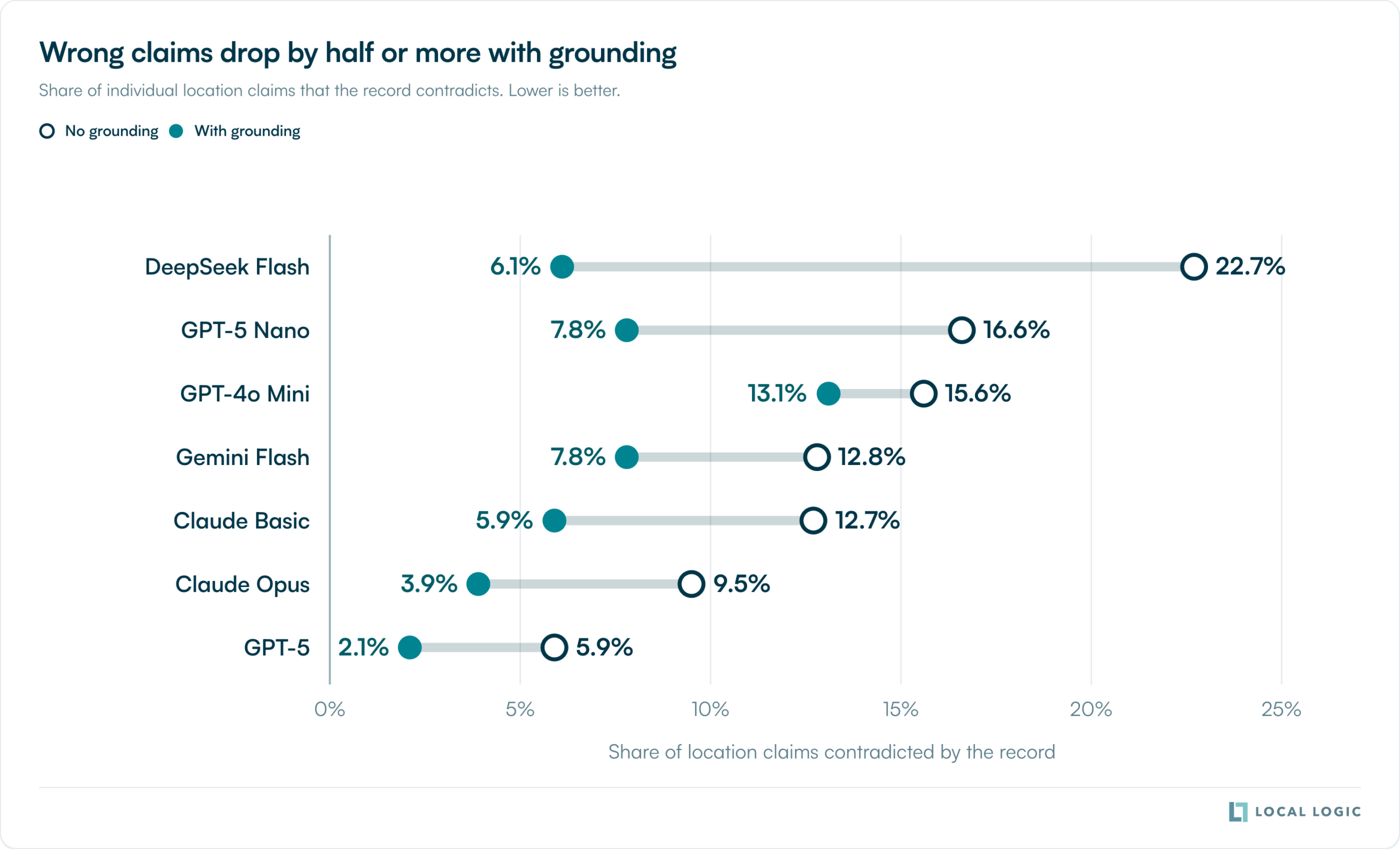
The made-up facts dropped sharply. Hallucinations fell by up to roughly five times on the cheaper models. DeepSeek Flash went from about 19% of its key claims being contradicted by live data down to about 4%. Across the whole study, ungrounded models made 1,861 claims that live data flatly contradicts.
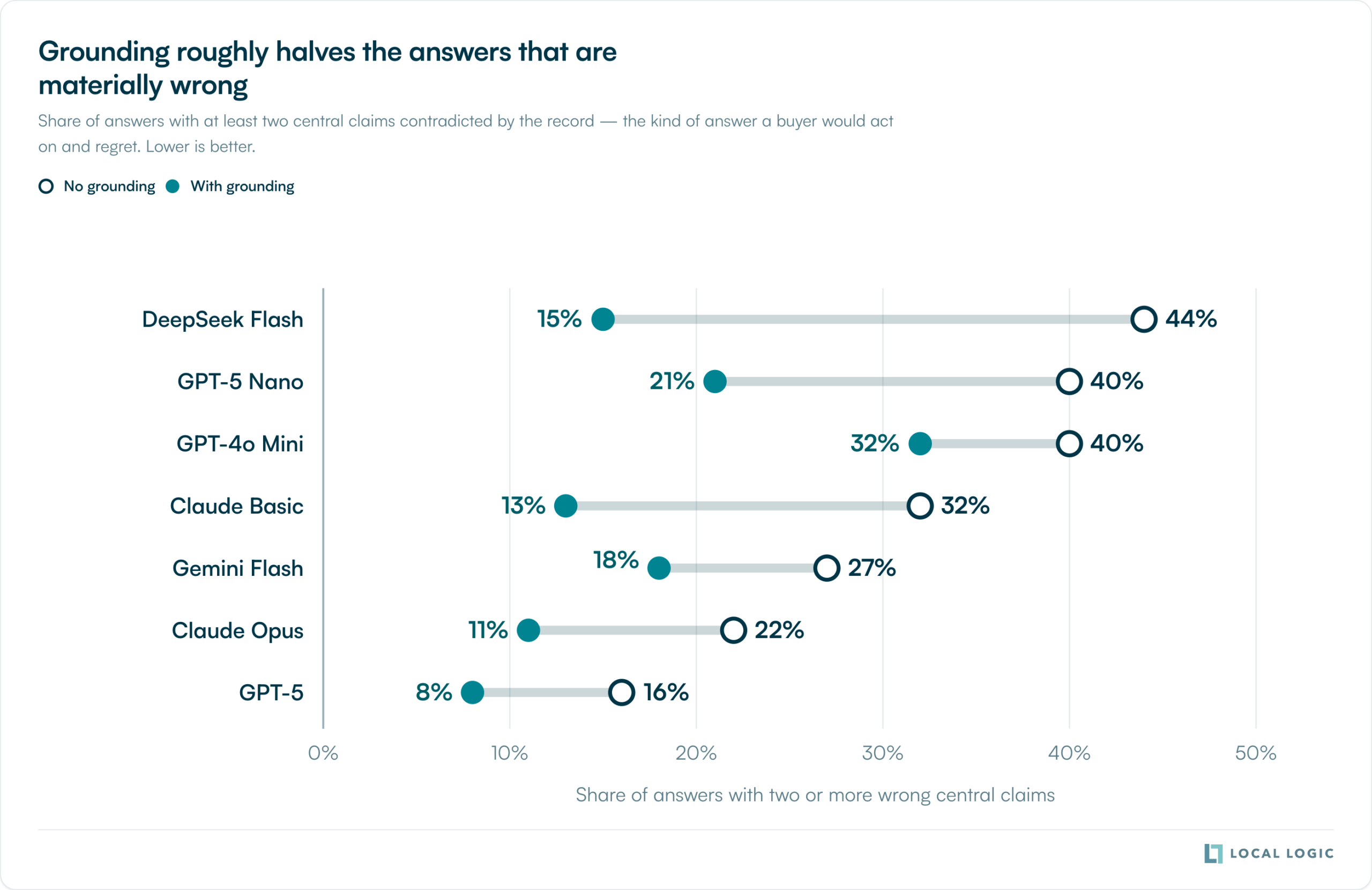
Cheap plus data beat expensive alone. This is the finding that reorders budgets. GPT-5 nano, a small and inexpensive model, reached 97.6% accuracy once it was grounded in Local Logic data, edging out full GPT-5’s own 96.9%, at roughly one-seventh the cost per answer. You do not need the biggest model. You need the right data feeding it.
Here is the whole story in one question. We asked how walkable Central West End in St. Louis is. From memory, a top model called it one of the most walkable neighborhoods in the city and cited a walk score up in the 90s. Both overstated it. Grounded in Local Logic data, the same model returned the real figure: a walkability of 8.6/10, meaning most day-to-day needs are within a few minutes’ walk. Solidly walkable, but not the outlier the model had invented. Every claim then checked out.
Neighborhoods trip up AI for reasons that will not resolve on their own. The facts that matter are not sitting in the training data in any reliable way. You cannot crawl your way to a calibrated walkability score. And a model can tell you a place feels lively without knowing how lively, on a scale you can actually compare. The same gap shows up in points of interest and schools: the model knows the category exists, then invents the specifics.
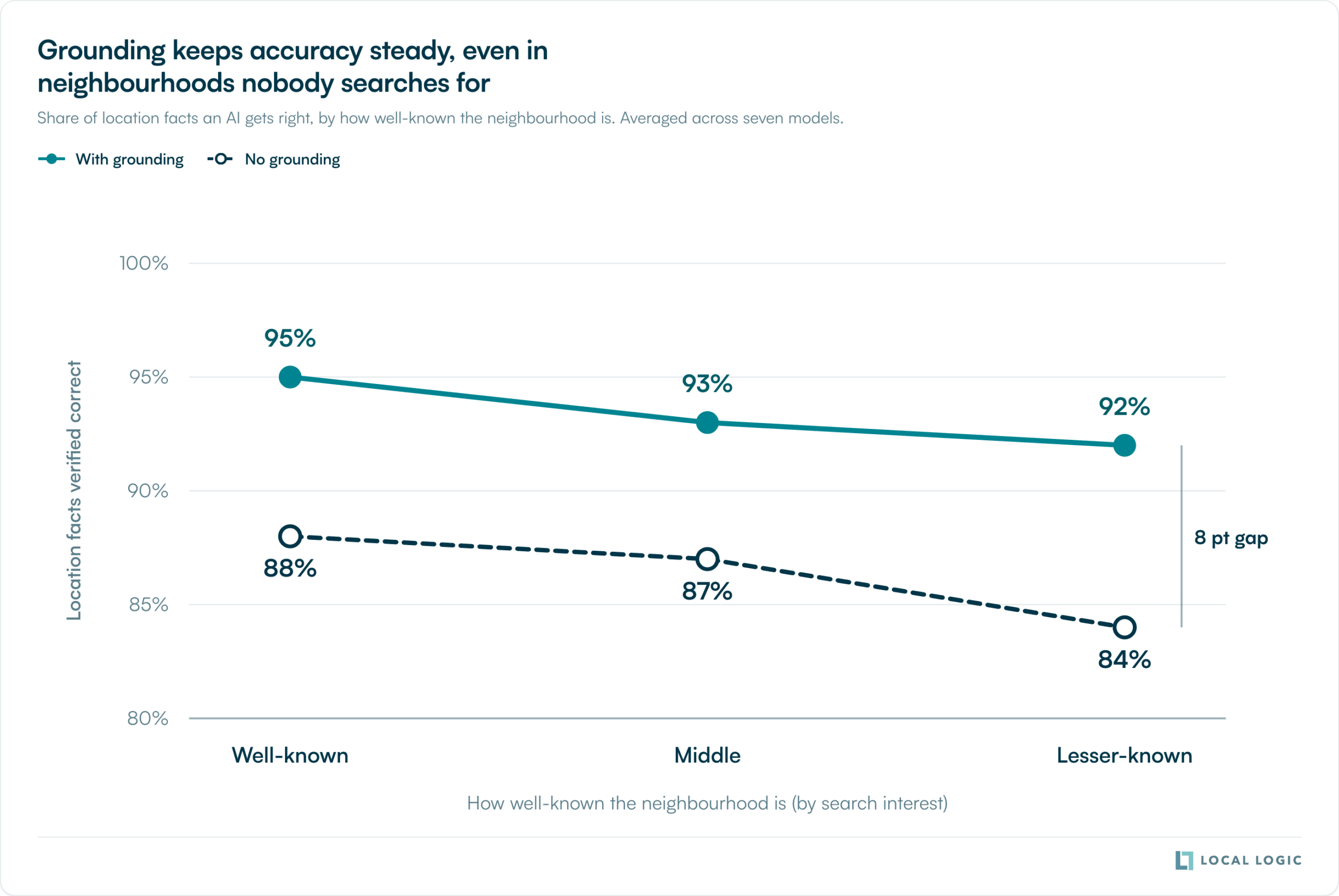
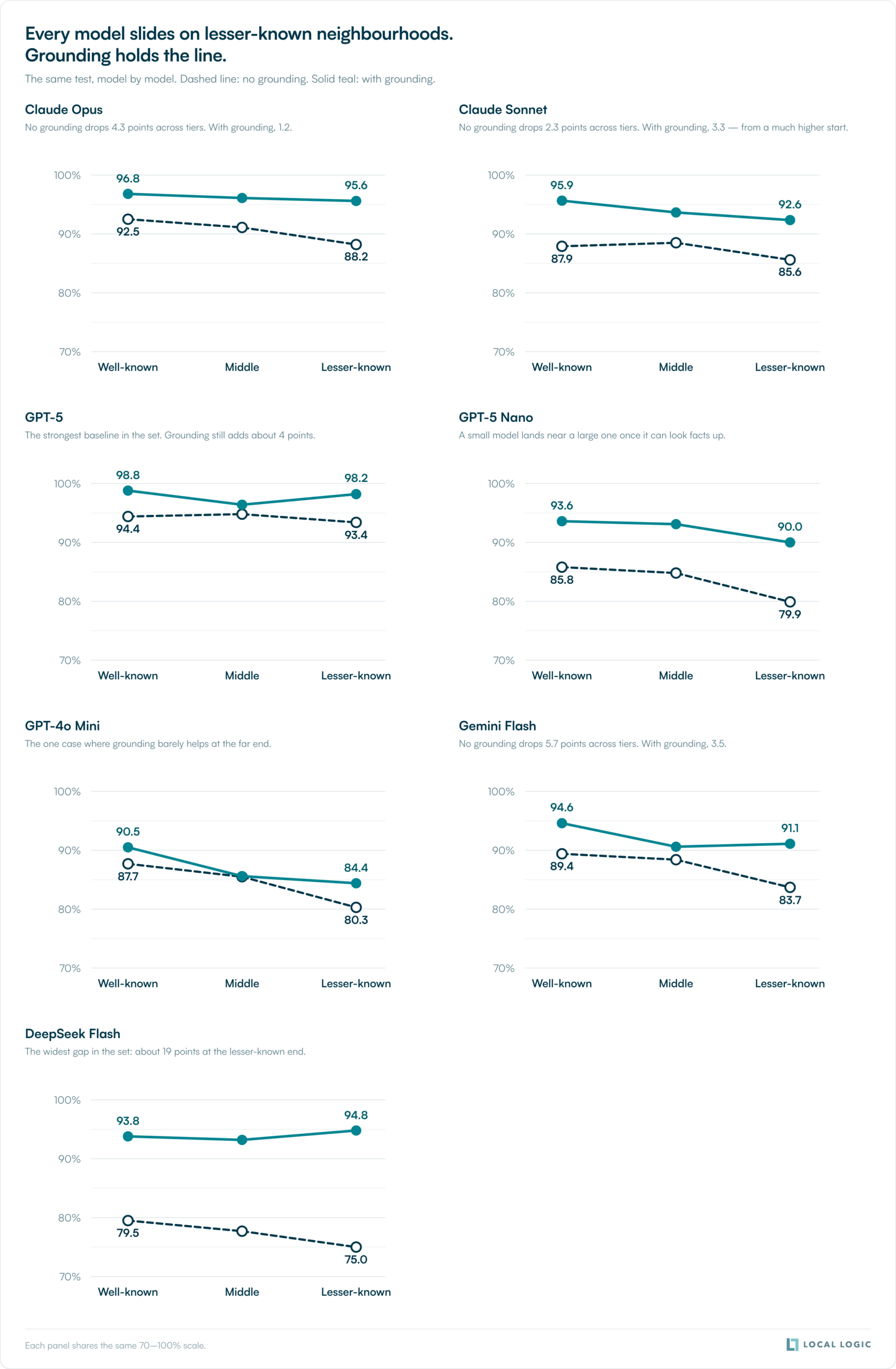
It also gets worse exactly where it matters most. In our test, accuracy from memory slid as neighborhoods got less famous, while the grounded answers stayed high across the board. The model is least reliable in the long tail of lesser-known neighborhoods, and that long tail is where a large share of real transactions happen.
That is the case for grounding in one line. The four walls are on every website. Everything outside them, measured and comparable, is the part a model cannot reproduce on its own.
Grounding means giving an AI verified external data to answer from at the moment of the question, instead of relying on patterns in its training. An ungrounded model answers from memory and guesses when memory runs out. A grounded model looks up the real fact first. In real estate, that means answering neighborhood questions from measured data rather than from recall.
Yes. In our July 2026 evaluation, ungrounded models made 1,861 claims that live data flatly contradicts, including a Seattle transit line that does not exist, a rush-hour commute inflated to double or triple the real one, and a walkability tie one model called a clear win. The answers sounded authoritative and were wrong.
In our testing, grounding models in Local Logic data cut contradicted claims sharply, by up to roughly five times on the cheaper models. DeepSeek Flash dropped from about 19% of its key claims contradicted to about 4%, and grounded answers carried about twice as many verified facts per answer.
Yes, when it is grounded. GPT-5 nano connected to Local Logic data reached 97.6% accuracy on our neighborhood questions, edging out full GPT-5’s own 96.9% at roughly one-seventh the cost per answer. The data matters more than the size of the model.
The facts are not reliably in the training data, they cannot be crawled (a calibrated walkability score is not on a page to read), and models get less accurate the more obscure a neighborhood is. That long tail of lesser-known neighborhoods is where a large share of real transactions happen.
The takeaway
We built this evaluation to answer one question honestly: when an AI model has authoritative data, in our case Local Logic data, on the other end of the line, does it use it, or does it keep guessing? It uses it. And the improvement is largest for the smaller, cheaper models that most teams can actually afford to run at scale.
Sounding like you know a neighborhood is easy now. Being right is the hard part, and it is the only part that earns trust. That is what grounding is for.