Local Logic and Elm Street Bring Neighborhood Insights to IDX Broker Agent Websites
Partnerships
| 06 Oct 2026
The best home search technologies in 2026 serve distinct needs:
The right choice depends on whether your priority is listing presentation, organic search performance, enterprise scalability, or helping buyers move from search to confident decision-making.
The way people search for homes has changed faster than most real estate platforms have kept up. With 48% of Gen Z reporting significant stress while buying their homes, today’s buyers arrive at listing search with more information, more anxiety, and more questions than any previous generation of home shoppers.
According to the 2026 NAR Home Buyers and Sellets Generational Trends Report, they want to know not just what a home looks like, but what it feels like to live in a neighborhood, with their top influencing factors being: quality of the neighborhoods, convenience to friends and family, overall affordability, convenience to job, accessibility to shopping options, walkability, access to parks/recreational facilities, and quality of the school district.
Yet the majority of brokerage websites, MLS portals, and listing search experiences still offer a filtered grid of photos and a price range. That gap between what buyers need to decide and what most platforms provide is where modern home search technology is now competing.
The platforms and solutions in this guide represent the leading approaches to closing that gap in 2026. Some focus on design quality and lead conversion. Others optimize for organic search or enterprise-scale listing management. And some take a fundamentally different approach: enriching the search experience itself with the contextual data that moves buyers from browsing to deciding.
This article is intended for brokerage leaders, MLS technology teams, portal product managers, and proptech evaluators who are actively assessing which home search technologies deserve a place in their stack.
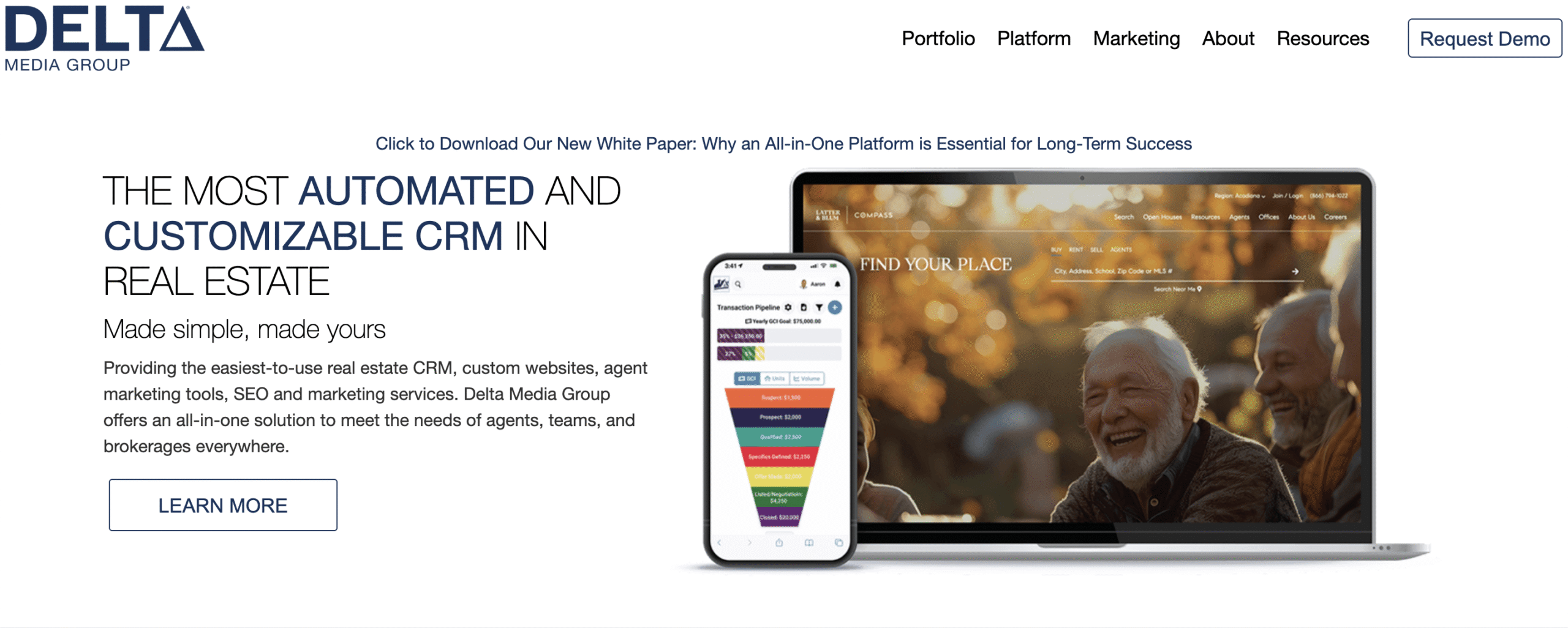
Delta Media Group provides a fully integrated real estate technology suite that covers IDX websites, a CRM, email marketing automation, social media tools, and market reports, all within a single broker-owned platform.
Key strengths: The defining characteristic of Delta Media Group is integration depth. Rather than assembling a stack of disconnected point solutions, brokerages can run websites, lead routing, agent communications, and market reporting through a single system. This reduces data fragmentation and administrative overhead, and gives brokerage owners more visibility into performance across agents and offices.
Best for: Mid-to-large independent brokerages and regional firms that want more control over their technology stack without managing multiple vendor relationships. Delta Media Group is particularly well-suited for brokerages that have struggled with data silos between their IDX and CRM.
Why it stands out: In a market where brokerages often juggle four to six technology vendors, Delta Media Group’s integrated stack is a genuine operational advantage, especially for operators seeking consistency across their agent roster.
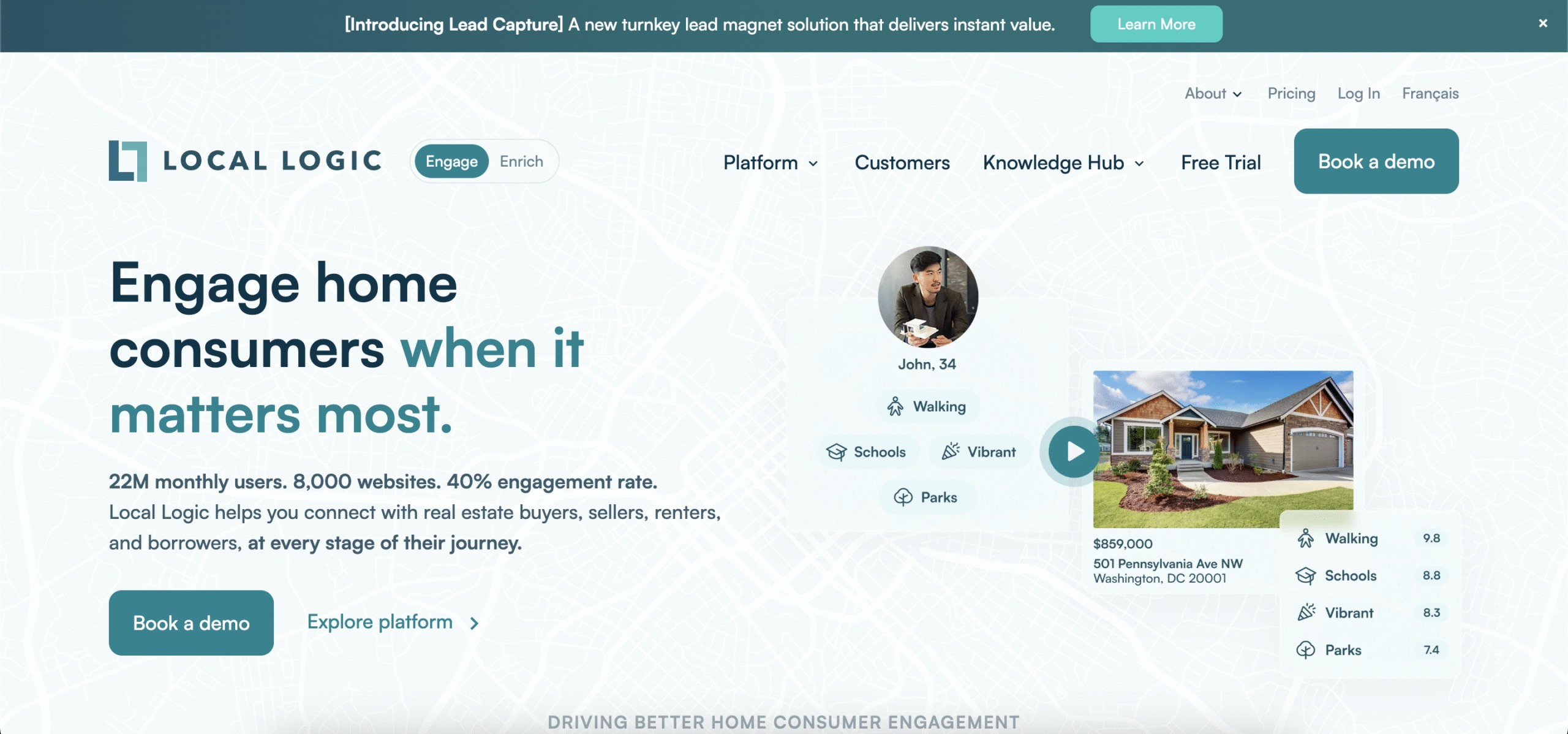
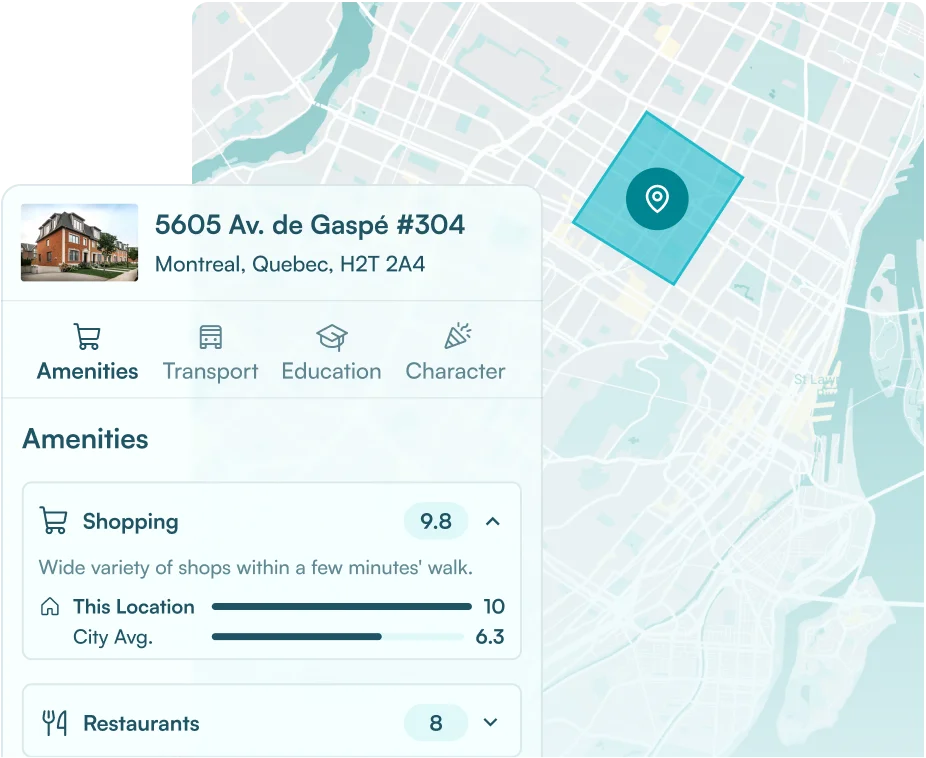
Local Logic provides lifestyle & market insights that can be embedded directly into home search platforms, listing pages, and portal experiences. Their home consumer engagement solutions layer contextual information, such as walkability, transit access, noise levels, nearby amenities, school access, and neighborhood character, on top of existing listing data.
Key strengths: The real estate industry has long operated on the premise that buyers evaluate properties. In practice, buyers evaluate places and choose a property partly because of where it sits. Local Logic addresses this directly by giving search platforms the ability to show buyers what it is actually like to live somewhere. Its data covers thousands of North American markets and is built to integrate into any existing platform, whether through APIs for custom builds or ready-to-deploy widgets that require minimal technical lift.
For MLSs and portals operating at scale, Local Logic’s location data adds a layer of search differentiation that increases time-on-site, improves listing engagement, and helps buyers progress through the consideration process more confidently. For brokerages, it enriches the on-site experience in a way that reinforces professional credibility by demonstrating that the brokerage understands buyers’ actual decision-making process, not just their filter preferences.
That engagement extends beyond the screen. Local Logic’s Location Reports give buyers a shareable, print-ready summary of neighborhood lifestyle and market data for any address. These reports function as a lead magnet that bridges the gap between digital search and real-world conversations with an agent. For real estate brands looking to convert listing page visitors into booked appointments, it’s a practical tool that creates a natural reason to reach out.
Best for: MLSs, real estate portals, brokerage platforms, and any operator looking to improve search-to-lead conversion by giving buyers more context at the moment of listing consideration. Particularly valuable for platforms serving buyers relocating from other markets who need to evaluate unfamiliar neighborhoods.
Why it stands out: Most home search technologies compete on how listings are displayed. Local Logic competes on what buyers understand. This is a fundamentally different value proposition and maps directly to the most common reason buyers stall in their decision process: not a lack of listings to look at, but a lack of confidence in the place they are considering calling home.
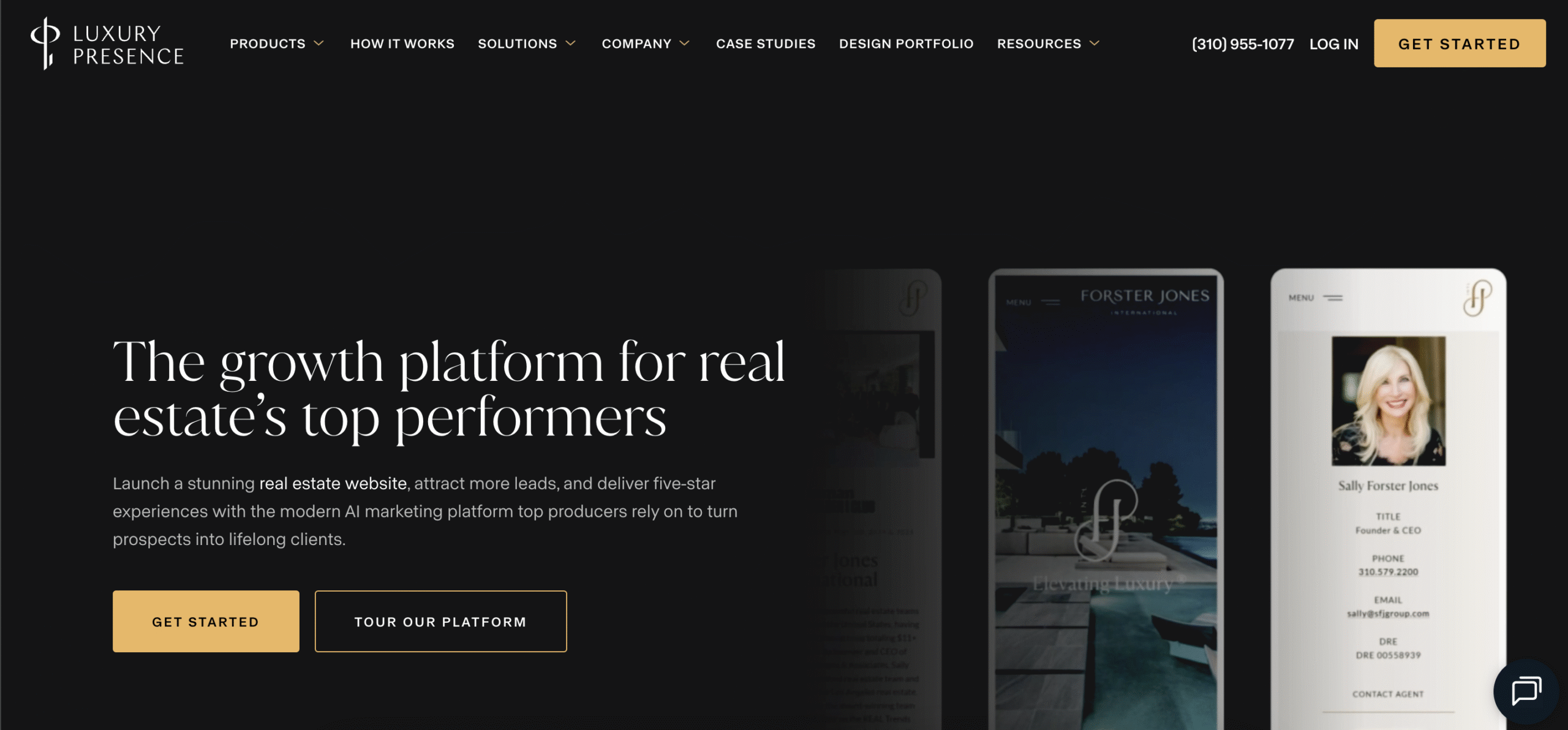
Luxury Presence builds and manages custom real estate websites for agents, teams, and brokerages, with a strong emphasis on design quality, brand identity, and conversion-oriented IDX search.
Key strengths: The platform is notable for bridging the gap between brand aesthetics and functional lead capture. Luxury Presence sites are built with visual storytelling in mind with high-resolution media, editorial-style layouts, and bespoke design, while still incorporating IDX search, market reports, and CRM integrations. For agents and brokerages competing on brand differentiation, this is a meaningful advantage over templated solutions.
Best for: Luxury brokerages, boutique teams, and individual top producers who prioritize how their brand looks and converts, particularly in markets where brand perception influences buyer and seller decisions.
Why it stands out: Few platforms in the real estate website space treat design as seriously as Luxury Presence. In a category where cookie-cutter templates remain the norm, the design differentiation is genuine, not just a marketing claim.

Reliance AI (formerly known as Reliance Network) builds high-performance real estate websites and IDX search experiences for enterprises, brokerages, and agents across North America, with a deliberate focus on organic search dominance. The platform integrates portal-caliber property search with AI-optimized SEO and AEO infrastructure that is engineered to drive record traffic, generate qualified leads, and produce measurable growth benchmarks.
Key strengths: The platform’s defining strength is the combination of search quality at the listing level with technical SEO and AEO infrastructure at the site architecture level. Portal-caliber search means the listing discovery experience (i.e., speed, filterability, mobile performance, data freshness) meets the standard buyers have been trained to expect by Zillow and Realtor.com. AI-optimized SEO/AEO means the underlying content structure, schema markup, semantic architecture, and answer-engine readiness are built in from the ground up, not bolted on afterward.
For enterprise operators and multi-office brokerages, this combination addresses one of the most persistent frustrations in real estate technology: Websites that look professional but produce thin organic results because their technical foundation was never built for search performance. Reliance AI positions itself as the solution for operators who have outgrown that problem and want a platform engineered to rank.
Best for: Enterprise brokerages, regional networks, and high-producing teams that treat organic search traffic as a primary business development channel and want a platform built to compete with portal-level search performance. Particularly relevant for operators in competitive markets where appearing in Google and AI-generated answers for neighborhood, community, and listing queries is a meaningful source of buyer relationships.
Why it stands out: Answer Engine Optimization is still an emerging discipline in real estate. Most website platforms have not yet caught up to what it takes to appear in AI-generated summaries rather than just Google’s blue links. A platform that is engineering for AEO as a first-class capability, alongside traditional SEO and portal-grade search UX, is building for where buyer search behavior is heading rather than where it has been. For enterprise operators with the scale to deploy it, that forward positioning is a genuine competitive advantage.
Best for SEO-Driven Listing Sites and Organic Search Performance
Union Street Media specializes in building real estate websites with a deliberate focus on search engine optimization, producing neighborhood-level and market-level content that drives organic traffic to listing searches.
Key strengths: Where many IDX platforms treat SEO as a checkbox feature, Union Street Media treats it as a primary product strategy. The company builds content architecture around the queries buyers actually type into search engines (e.g., neighborhood guides, school district pages, market condition articles) and integrates those into the IDX search experience. The result is organic search visibility that most brokerage websites simply cannot match with a standard template approach.
Best for: Brokerages and teams whose customer acquisition strategy depends heavily on organic search rather than paid media, and who recognize that appearing in Google for neighborhood-level queries is a long-term competitive asset.
Why it stands out: The focus on semantic content and on-page optimization is rare in the real estate website category. For brokerages that have tried templated SEO and gotten thin results, Union Street Media represents a meaningfully different approach.
The table below summarizes each platform’s primary positioning, core strength, ideal buyer, and most notable differentiator.
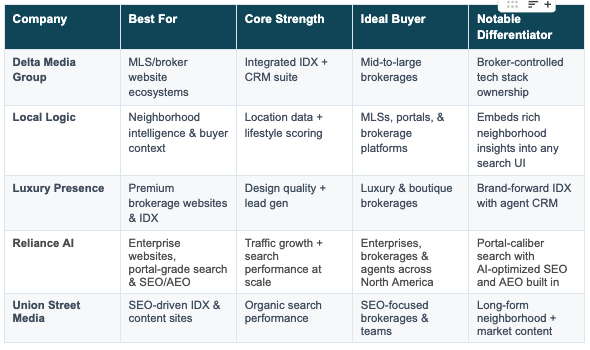
The right home search technology depends on three variables: your current stack, your buyer’s primary friction point, and your internal capacity for implementation.
Enterprise networks managing hundreds of agents across multiple offices need platforms built for that complexity. Reliance Network and Delta Media Group are designed for that environment. A boutique brokerage competing on brand reputation has different needs, and would likely find Luxury Presence a better fit than an enterprise stack.
Some of the highest-value home search improvements come not from replacing your entire platform but from enriching it. If you have an existing IDX solution that is working well operationally, adding a neighborhood data layer via Local Logic’s APIs may generate better buyer engagement outcomes than a full platform migration with far less implementation risk.
The home search experience doesn’t end at listing discovery.
Understanding where buyers stall will tell you which category of technology will generate the most return.
The consumer home search experience is the front door of every real estate business. Yet for most brokerages, portals, and MLSs, it has been underinvested relative to backend operations and paid marketing. That is changing, for several reasons.
First, buyer expectations have been reset by consumer technology experiences outside real estate. When a home buyer can check their Uber driver’s route in real-time or get a neighborhood walkability score in a lifestyle app, the bar for what constitutes a usable home search experience has risen considerably.
Second, organic search traffic for real estate queries remains among the most valuable in any category. Brokerages that invest in contextually rich, semantically structured listing and neighborhood content build durable assets that paid media cannot replicate.
Third, AI-generated answers in Google, ChatGPT, and Perplexity are already beginning to surface neighborhood and location information in response to home search queries. Platforms with rich, structured, accurate location data (and the editorial infrastructure to support it) are better positioned to appear in those answers and to retain buyers further into the search funnel.
Finally, the conversion gap between listing views and qualified leads is still primarily a confidence problem, not a quantity problem. Buyers have access to more listings than ever. What they lack is sufficient context to feel confident about the place. Home search platforms that provide that context (not just more listings, but a better understanding of what life in a given neighborhood actually looks like) will differentiate on the metric that matters most: buyer decisions made.
The home search experience is not a single problem with a single solution. It is a layered challenge involving design quality, search performance, contextual depth, platform scalability, buyer confidence, and different technologies that address different layers.
The platforms covered in this guide represent the current best-in-class approaches for each layer:
The organizations that will lead in home search over the next five years are those that stop thinking about their search experience as a listing display function and start thinking about it as a buyer confidence engine. The technology now exists to build that engine. The question is which operators will invest in it first.
For a mid-sized brokerage looking for an integrated approach, Delta Media Group offers a compelling combination of IDX search, CRM, and marketing automation in a single platform. Brokerages prioritizing brand differentiation in competitive markets may find Luxury Presence a better fit. If organic search performance is the primary goal, Union Street Media’s SEO-first architecture deserves serious consideration.
Yes. Local Logic is specifically designed to integrate via API into existing home search platforms, meaning you can add neighborhood intelligence, walkability scores, lifestyle data, and school information to your current listing experience without replacing your IDX system. This makes it an additive investment rather than a disruptive one.
Effective home search experiences do three things well: they make it easy to filter and find relevant listings, they give buyers enough contextual confidence to move forward, and they offer frictionless conversion paths at the right moments. Most platforms optimize well for the first and third. The middle layer (i.e., contextual confidence about a neighborhood, a commute, or a lifestyle fit) is where many home search experiences fall short, and where significant conversion lift remains available.
Organic search is one of the highest-return customer acquisition channels available to real estate businesses, particularly for neighborhood-level and market-condition queries. Buyers routinely search for ‘best neighborhoods in [city]’ or ‘[neighborhood] homes for sale’ before they identify a specific agent or brokerage. Investing in content architecture and on-page optimization gives brokerages visibility at the top of the funnel, before the buyer has a brand relationship with any agent.
Location intelligence refers to structured data that describes what it is actually like to live in a specific area, including walkability and transit scores, noise levels, nearby amenities, demographic character, school proximity, and lifestyle fit. This data matters for home search because buyers make location decisions based on lifestyle criteria, not just property features. Platforms that surface location intelligence at the listing level help buyers evaluate not just whether a home is right, but whether the area fits their life.
Reliance Network is among the most capable platforms for large multi-brand franchise operators, with the infrastructure to manage hundreds of agent sites and multiple branded domains under centralized control. Delta Media Group is also used by larger regional operators. For franchise networks that want to add a differentiated buyer experience layer without replacing their existing infrastructure, Local Logic’s APIs can be integrated at the platform level to enrich listing pages across the entire network.
AI-generated answers in tools like Perplexity, Google AI Overviews, and ChatGPT are increasingly surfacing location and neighborhood information in response to buyer queries. Platforms with well-structured, high-quality location data, and content that clearly answers buyer questions about neighborhoods and communities, are better positioned to appear in these AI summaries. This makes contextual data quality and editorial content architecture increasingly important components of a home search technology strategy.
Listing photos remain critical for generating initial buyer interest with 85% of buyers rating them as the most critical part of a listing. But the factors that drive final purchase decisions are different. According to NAR’s 2026 Home Buyers and SellersGenerational Trends Report, neighborhood quality, commute access, and walkability consistently rank among buyers’ top location priorities. And those are the criteria that determine whether they choose a place, not just click on it.
Want to see how neighborhood intelligence integrates into your platform?
Local Logic works with MLSs, portals, and brokerage platforms to add neighborhood data, lifestyle scoring, and location context directly to existing search experiences. If your buyers are searching but not deciding, the issue may not be your listings — it may be what surrounds them.
👉 Book a time to talk with our team to learn more about our data APIs and integration options