Local Logic and Elm Street Bring Neighborhood Insights to IDX Broker Agent Websites
Partnerships
| 06 Oct 2026
HouseQuest’s AI scored the same 486 Arizona homes twice: once without Local Logic’s neighborhood scores, and once with them. With the data, its average confidence in its own scores rose from 55 to 63 out of 100, about 14% higher.
That’s what happens when an AI stops guessing about the part of a home a listing can’t describe. Here’s what it looks like for a single house.
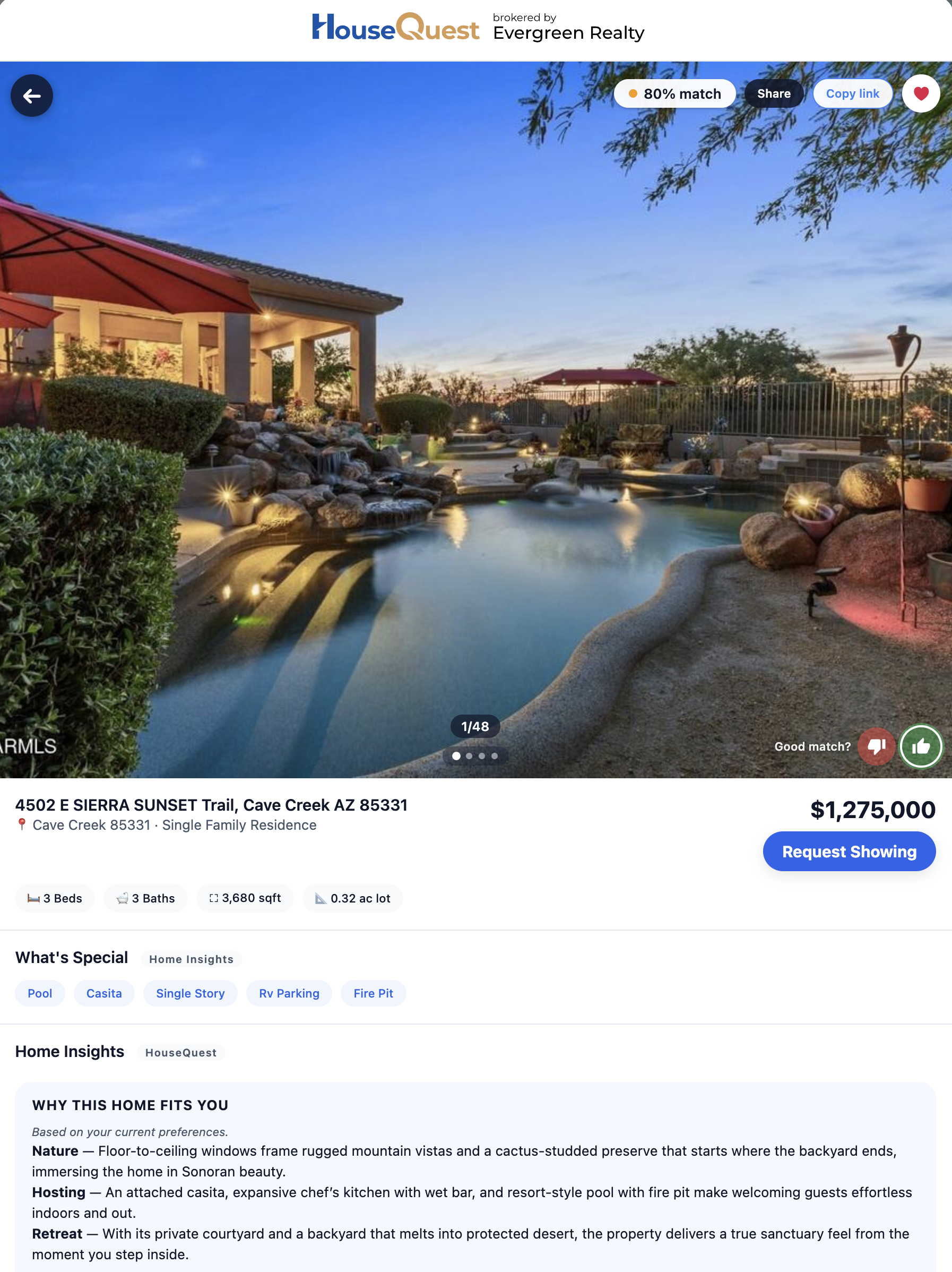
There is a house in Cave Creek, on the northern edge of Phoenix, with a walled front courtyard, a pool, and a backyard that opens straight onto protected desert.
For one buyer, it is close to perfect. For another, it would be a mistake they feel every morning on the drive for coffee.
Nothing about the house changes between those two buyers. What changes is what they need from the place around it. That is the part of the home search most tools still guess at.
Home consumers are asking AI tools where they should live, and the answers sound confident. A neighborhood gets called “charming” or “convenient,” and there is usually no way to know where that came from. Sometimes it is right. Sometimes it is a plausible sentence built from nothing in particular.
For agents, that is a real problem. Their value has always been local knowledge, and a buyer who has already read a polished, unverifiable description of a neighborhood is harder to advise, not easier. When the AI gets a place wrong, the agent is the one who has to correct it in the car.
The answer is not less AI. It is AI that reads from real data, where every claim about a place traces back to a score someone can check. Give a model that, and it can do what no listing filter ever could: match a person to a place, and explain why.
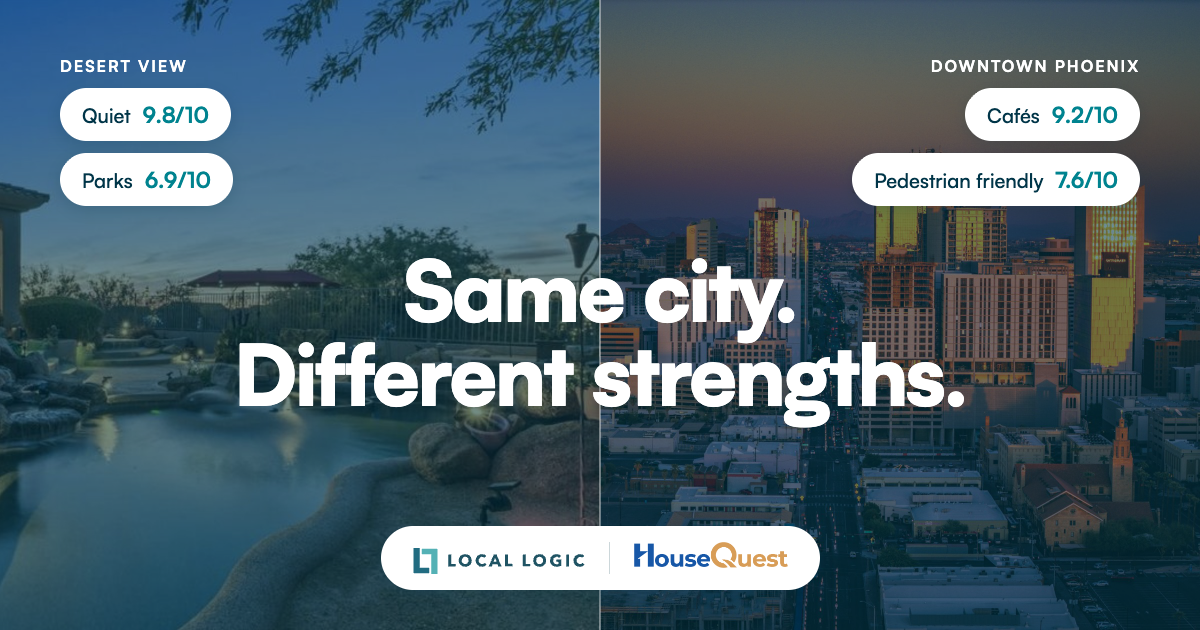
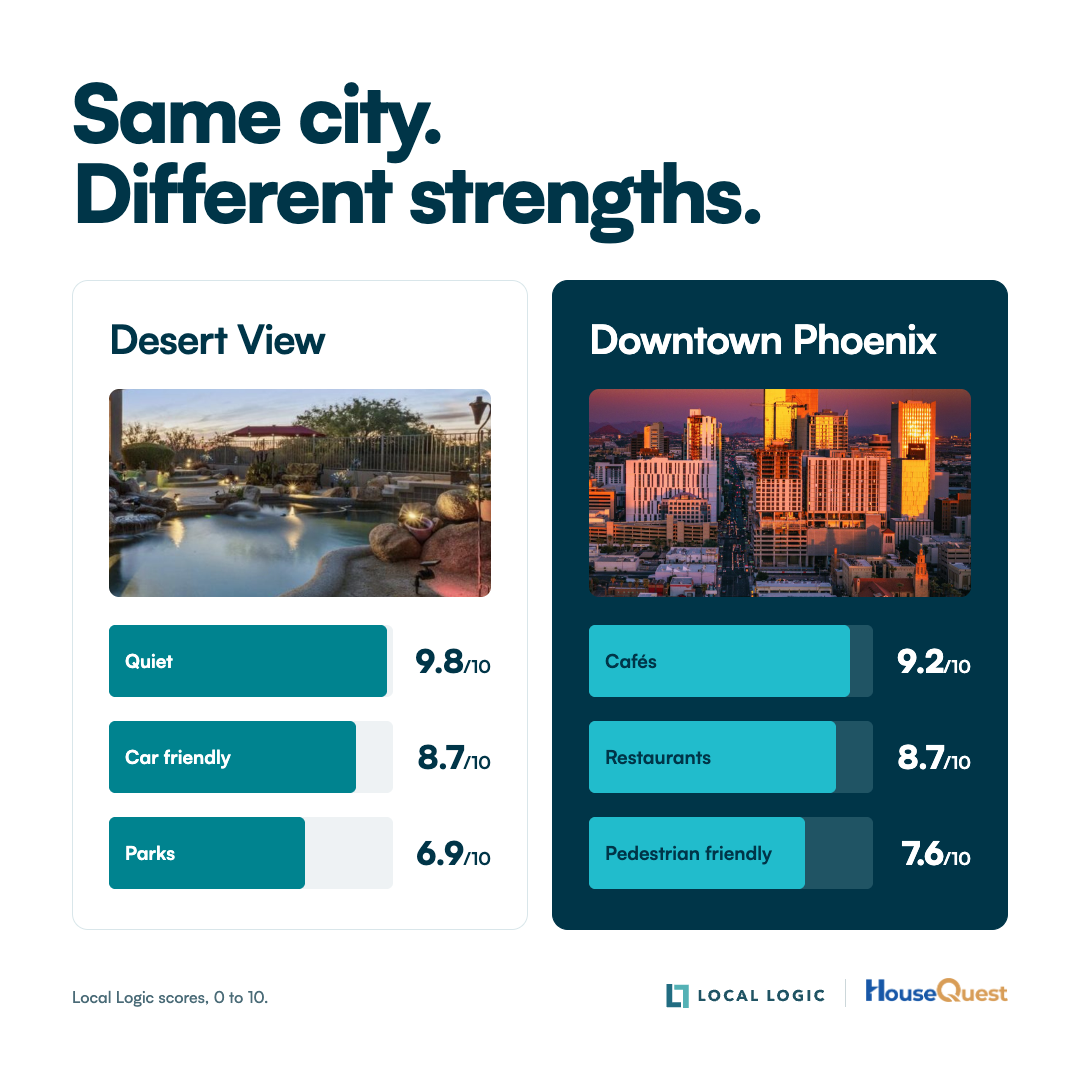
Here is what Local Logic data says about Desert View, the Phoenix neighborhood around that Cave Creek house, next to Downtown Phoenix at the other end of the city.
| Local Logic score (0 to 10) | Desert View | Downtown Phoenix |
|---|---|---|
| Quiet | 9.8 | 4.2 |
| Car friendly | 8.7 | 7.5 |
| Parks | 6.9 | 7.2 |
| Cafés | 2.5 | 9.2 |
| Restaurants | 4.1 | 8.7 |
| Pedestrian friendly | 3.1 | 7.6 |
| Transit friendly | 0.0 | 6.0 |
Desert View has virtually no noise sources and more than 50 green spaces nearby, including Apache Wash Trailhead and the Sonoran Preserve. Downtown Phoenix has an exceptional variety of cafés within a few minutes’ walk and frequent transit within walking distance.
Neither neighborhood is better. Each one scores near the top of the scale on something different. That is why Local Logic covers 18 location scores instead of handing out a single neighborhood grade. One number would flatten both places into “average” and undersell them both. With the full picture, every home has something true and specific to say about the life around it.
Breadth like that is what makes personalized home search possible. HouseQuest’s HiQ asks buyers how they want to live, builds a preference profile from their answers, and scores homes against it, using Local Logic neighborhood data for everything outside the four walls.
HiQ runs on AI. That’s how it can weigh 14 traits for every home and explain each match in plain language. HouseQuest’s matching intelligence engine does not use MLS data to train AI models; it scores each home on 14 traits and correlates those scores with each buyer’s personality profile. But for HouseQuest, AI is the engine, not the product. The product is a home search that’s easier, more fun and a lot faster. And a model reasoning about neighborhoods is only as good as the neighborhood data it reads. Local Logic’s scores are built for that: clean, consistent and comparable across the US and Canada, so an AI can reason over them and cite them.
When HiQ matched the Cave Creek house to a buyer whose profile leans toward retreat and nature, it came back as an 80% match. The explanation pointed to the neighborhood’s quiet score and the desert preserve behind the backyard, both things a buyer or an agent can verify.
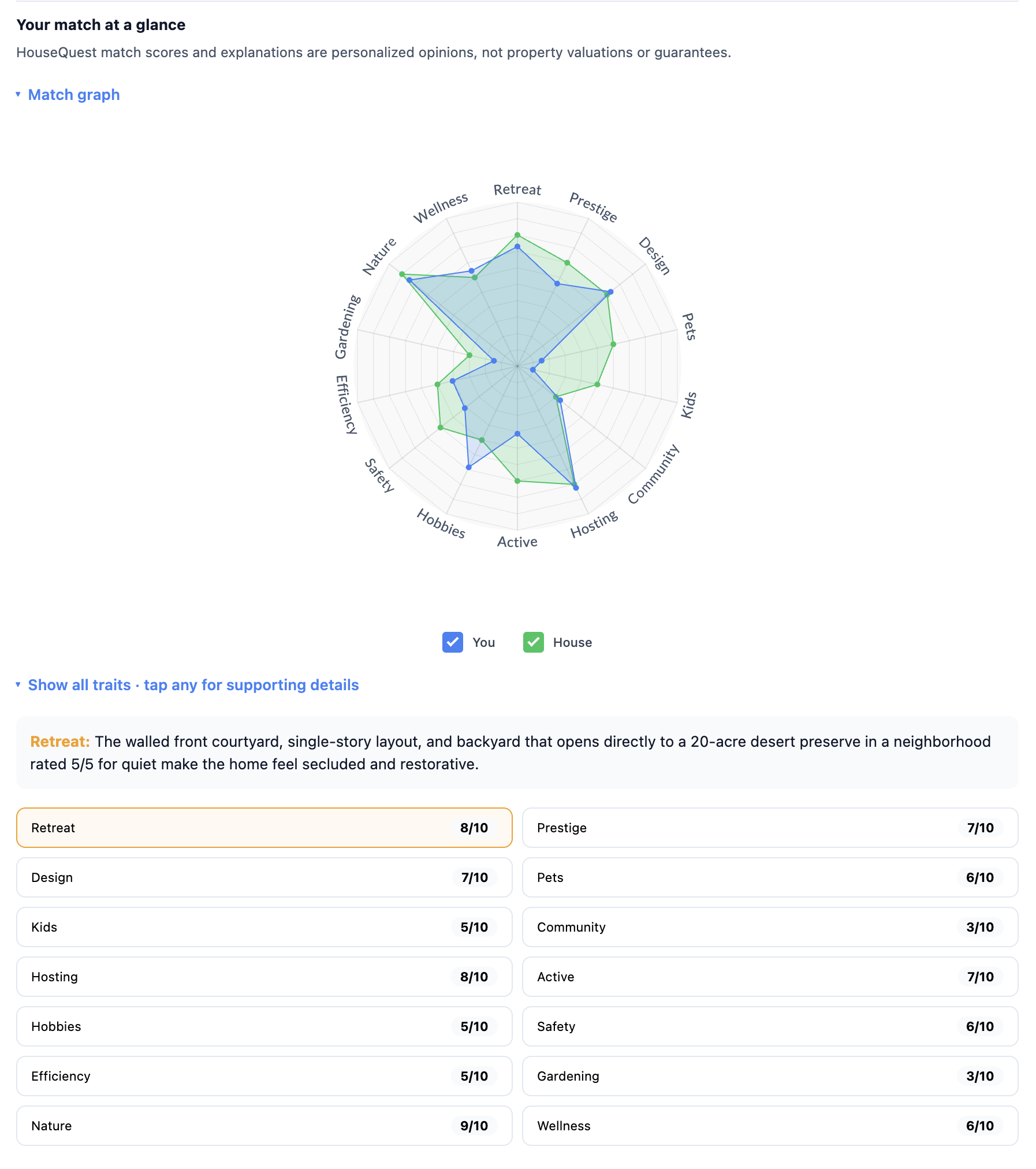
HiQ’s match graph for the Cave Creek home: the buyer’s profile (blue) against the home (green) across 14 traits, with the reason behind its Retreat score.
A buyer who wants to walk to coffee and leave the car at home would get a very different answer for that same house, and a much better one for a home downtown. The data did not change. The person did.
HouseQuest takes the same care on its side of the match. HiQ waits for 20 answers before it shows a buyer any match scores, so early results do not misrepresent them. A result you can stand behind is worth the wait.

Where you live has a profound impact on your life, and that includes both your home and the neighborhood around it. That’s why we partnered with Local Logic to help people find homes and neighborhoods where they can truly thrive. By combining psychometric science, Local Logic’s neighborhood data and advanced location intelligence, we’ve created a first-of-its-kind home-matching technology.
CEO and Founder, HouseQuest
The Cave Creek match isn’t a one-off. HouseQuest’s AI has scored 48,315 Arizona MLS homes using Local Logic’s neighborhood scores. In a separate side-by-side test in March, it scored 486 Arizona homes once without Local Logic data and once with it, which is where the 55-to-63 confidence gain comes from.
A newer test in November, on 500 homes drawn at random from active Arizona listings, pointed the same way. With Local Logic data, the AI was up to 11.7% more confident on location traits like Retreat, Nature and Community, and it changed its answers: Retreat scores rose 18%, while Community scores fell 17%. The data didn’t just make the AI more sure of itself. It changed what the AI concluded.
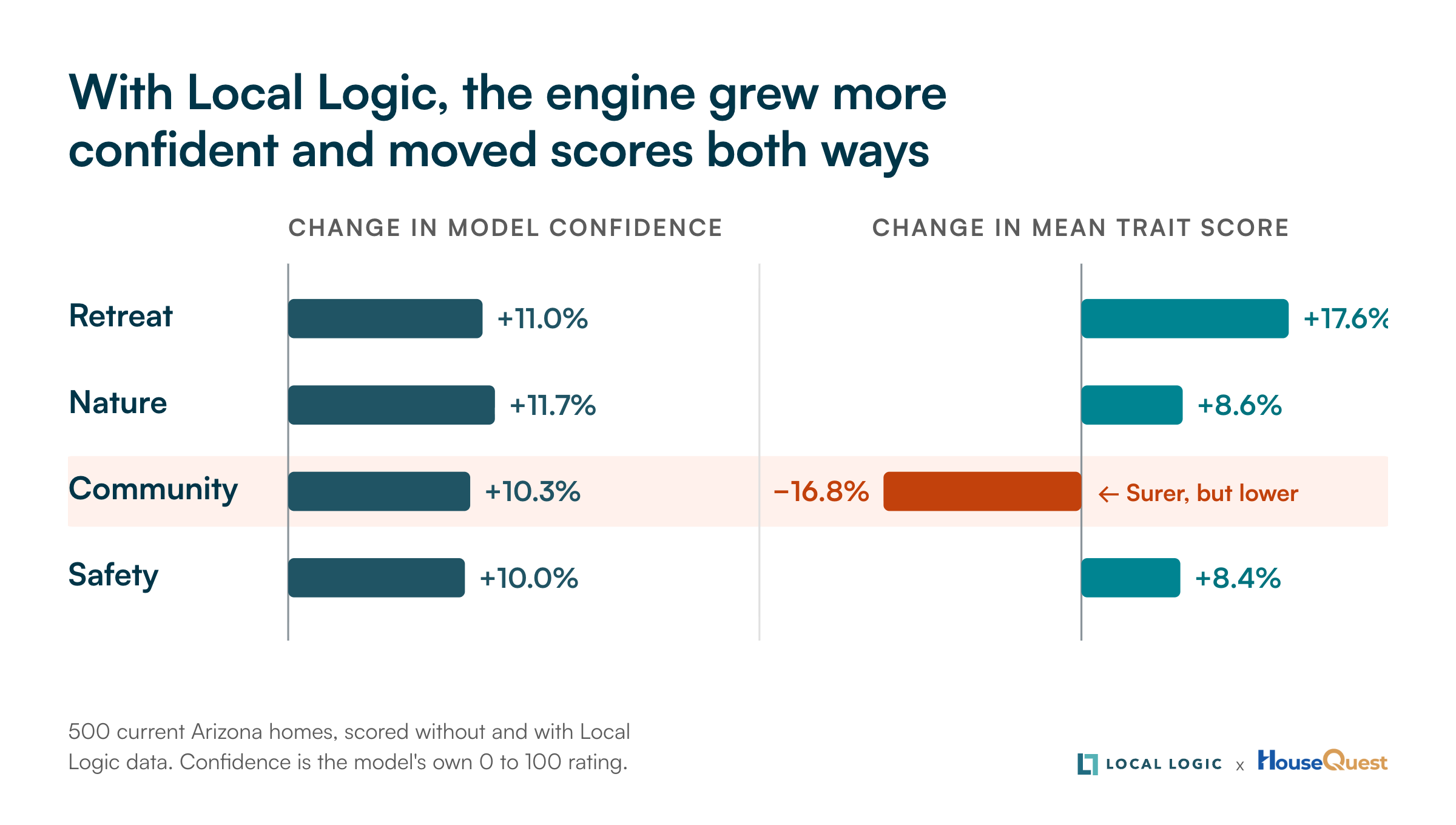
November test, 500 Arizona homes: change in the model’s own confidence rating and in mean trait scores with Local Logic data.
Across the full set, 15 of the 16 Local Logic scores in the analysis moved together with at least one of HiQ’s home scores, quiet most strongly of all.
In both tests, confidence is the AI’s own rating, and HouseQuest hasn’t yet checked results against what buyers went on to choose. But the direction is consistent: give the model real neighborhood data, and it stops guessing about the part of the home a listing can’t describe. HouseQuest’s full analysis is in our white paper, Grounded AI for Home Search.
An AI can only use data it reads the same way every time. Local Logic’s scores were built for that:
That’s why an application like HiQ can be personal without making anything up.
An 80% match is interesting. “This home fits you because the neighborhood has virtually no sources of noise and more than 50 parks and trails nearby” is useful. It is a sentence an agent can repeat in a showing without worrying it will fall apart when the buyer checks.
That is the standard AI in real estate should meet. Recommendations can be personal and fun, but the facts underneath them have to be real. When they are, the agent stays the trusted voice in the room, now with better evidence than ever.
A kitchen can be redone, and a floor plan can be opened up. The commute, the noise on the street, and the trailhead at the end of the road come with the address. Those are the things that shape daily life, and they are the things home consumers most need the truth about.
Local Logic data already runs on more than 13,000 real estate websites and reaches 50 million users a month. As home search moves into AI, it is also becoming the layer those AI products read from. HiQ shows what that makes possible: an AI that can match a buyer to a home and back up every reason it gives. If you’re building one, this is what our data is for.