
Local Logic and Elm Street Bring Neighborhood Insights to IDX Broker Agent Websites
Partnerships
| 06 Oct 2026
Someone searching for a home in San Juan has the same question as someone searching in Chicago. Not what the listing says, but what the block is like: whether the groceries are a walk or a drive, whether there’s a café nearby, how close the nearest daycare is. Puerto Rico amenity scores are now live, so that question has an answer for every address on the island.
The scores run on the same points of interest coverage, the same routing, and the same refresh cycle as the rest of our footprint. Puerto Rico is not a reduced version of the dataset. It’s the dataset.
Here’s what’s new:
Puerto Rico returns the six amenity scores for any address on the island, on the same 10-point scale used everywhere else in our data. Each score measures how much of everyday life is within reach of that specific address, calculated from nearby points of interest and real travel routes rather than straight-line distance.
Address level matters more here than the phrase suggests. A score calculated for a whole municipality would tell a home consumer almost nothing, because access changes street by street. Measuring at the address means two homes a few minutes apart can return different scores, and both can be right.
Numbers make this concrete. Below are the six amenity scores for three specific points in Puerto Rico, on the 10-point scale the SDK displays. These are scores for those exact coordinates, not averages for the municipalities around them.
| Score | Old San Juan | Bayamón | Ponce |
|---|---|---|---|
| Groceries | 8.9 | 8.6 | 8.0 |
| Cafés | 8.2 | 5.7 | 3.4 |
| Restaurants | 8.8 | 7.7 | 7.5 |
| Shopping | 8.5 | 8.8 | 8.4 |
| Daycares | 9.8 | 8.0 | 9.6 |
| Nightlife | 8.9 | 4.5 | 4.5 |
Read down the columns and you get the density story you would expect: the historic core of San Juan scores high on everything. Read across the rows and something more useful shows up.
Shopping barely moves. All three points land between 8.4 and 8.8, and the Ponce point sits within 0.1 of Old San Juan. Cafés move enormously, from 8.2 down to 3.4, a spread of 4.8 points across those same three locations. Two amenities, two completely different pictures, in the same three places.
The score text explains why. At the Old San Juan point, cafés read “wide variety of cafés within a few minutes’ walk.” At the Ponce point, they read “some cafés within a short drive.” Shopping reads “wide variety of shops within a few minutes’ walk” at both. Access is genuinely comparable for shops and genuinely different for cafés, and the scores say which is which.
Worth noticing too: Bayamón, not Old San Juan, holds the highest shopping score of the three at 8.8. Density does not win every category, and that only becomes visible when each dimension is measured on its own.
Which is the argument for six scores instead of one. Average these six into a single “amenities” number and Old San Juan reads 8.8 against Ponce’s 6.9. That one 1.9-point gap would bury both of the facts above: that shopping access is nearly identical, and that café access is not close. Someone weighing a specific house needs to know which of those applies to the way they live.
One thing these numbers are not is a verdict on any of these places. A café score of 3.4 means cafés are a drive rather than a walk. Plenty of home consumers prefer that, and the score measures access, not rank.
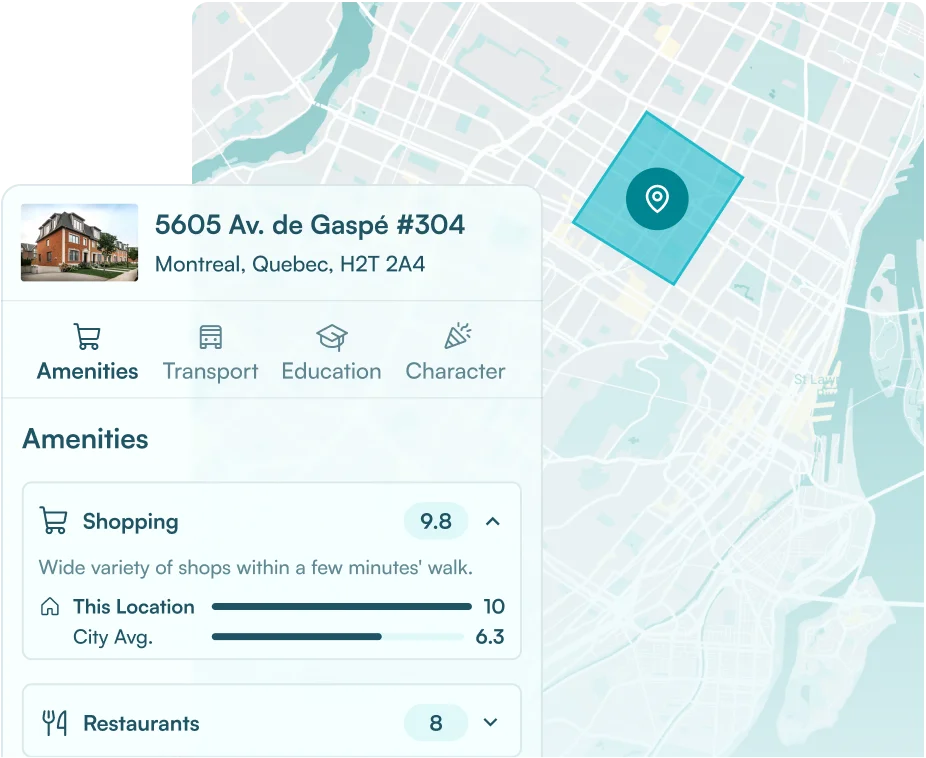
Puerto Rico addresses are served by the same endpoints as everywhere else. The Location Scores API returns them, and because the scores are live, Puerto Rico is supported in the Local Content SDK.
Any team already rendering listing and neighborhood experiences with the SDK can point it at a Puerto Rico address and get the same neighborhood insights they get for a mainland one. There’s no separate endpoint, no regional flag, and no configuration change. If your product already handles a US address, it already handles this one.
The sequence matters more than any single market. The United States, then Canada, now Puerto Rico. Each addition gets the same address-level scoring, the same routing against the real street network, and the same refresh cadence as the existing footprint.
That consistency is deliberate, and it’s the harder way to do it. Shipping a market quickly with thinner coverage or a slower update cycle would let us claim the pin on the map sooner. It would also mean a home consumer searching in Ponce got a worse read on their own neighborhood than one searching in Toronto, and that’s the opposite of the point. Our mission is to give every housing stakeholder the best available read on location, which only means something if “every” holds.
We’re going to keep going. Each market goes live when it can go live on the same terms, and we’ll announce them as they do.
The bigger picture
Location is the part of a home decision that shapes daily life the most, and it does that identically regardless of which part of the map someone is looking at. A person deciding whether a street in Ponce fits their morning deserves the same quality of answer as a person deciding about a street in Toronto.
Adding a market is not really about coverage. It’s about extending that answer to more of the people asking the question.
See what Puerto Rico amenity scores look like on your own listings and pages: book a demo.
Yes. Amenity scores are live for any address in Puerto Rico and are returned by the same endpoints as United States and Canadian scores. They cover Groceries, Cafés, Restaurants, Shopping, Daycares, and Nightlife.
Yes. Because the amenity scores are live, the Local Content SDK works for Puerto Rico addresses. Teams already using the SDK do not need to change their setup, add a flag, or call a different endpoint.
The same way as everywhere else in our footprint. Scores are calculated at the address level from nearby points of interest, routed against the real street network so the result reflects the trip someone would actually make, and they distinguish what is within a short walk from what is a short drive.
Yes. Puerto Rico is included in the monthly amenity score refresh alongside the United States and Canada, so island addresses are not on a slower update schedule than mainland ones.
No. Existing integrations work without modification. Pass a Puerto Rico address or coordinate pair to the endpoints you already call and the scores come back.
We expand market by market and announce each one as it goes live. The United States and Canada came first, Puerto Rico is live now, and more are in progress. Every new market gets the same address-level scoring and the same refresh cycle as the existing footprint.