
How to Get Your Neighborhood Pages Cited by AI: A Step-by-Step AEO Guide for Real Estate
Residential
| 02 Nov 2026
A Local Logic customer story with HouseQuest. November 2026.
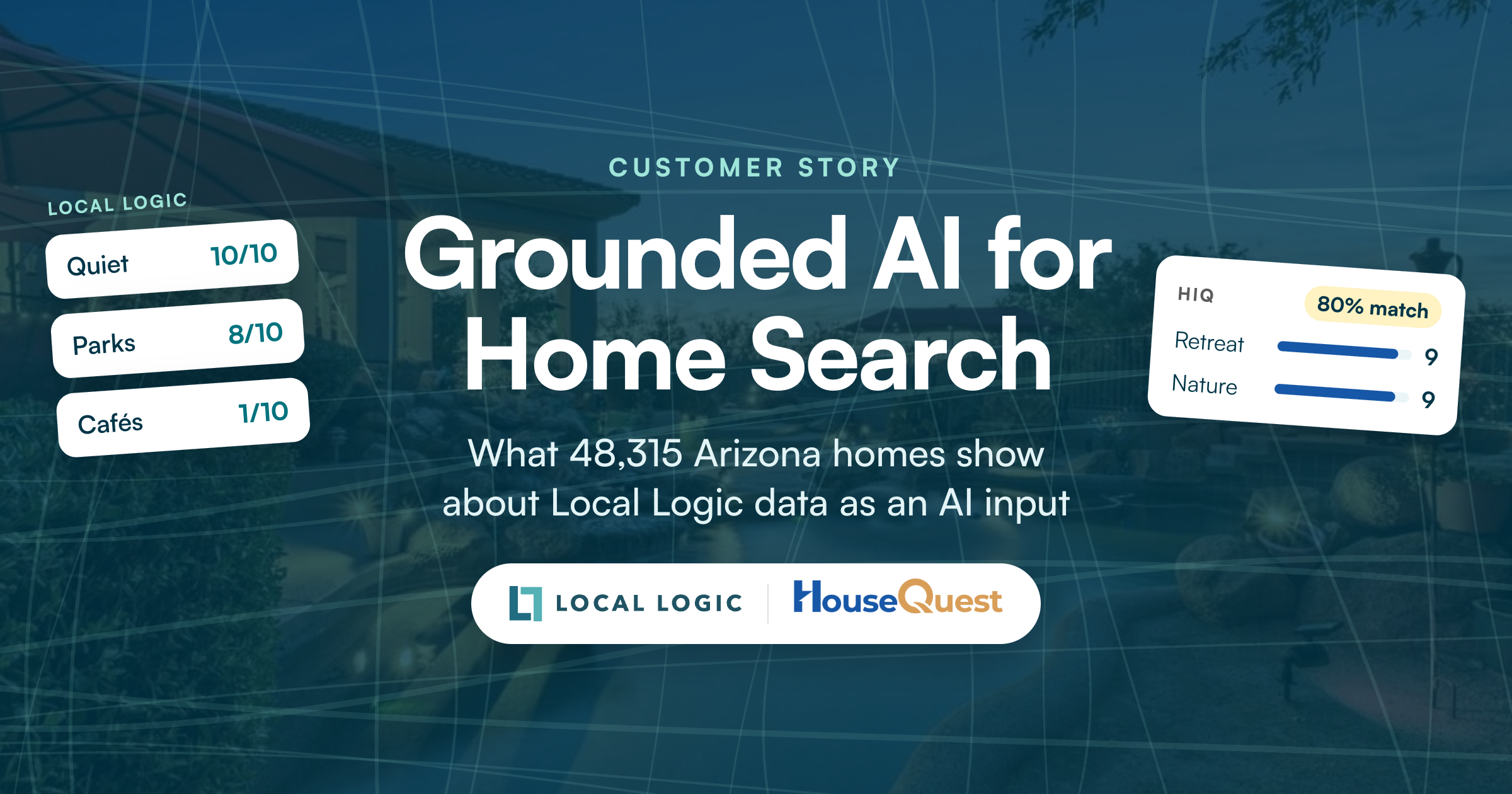
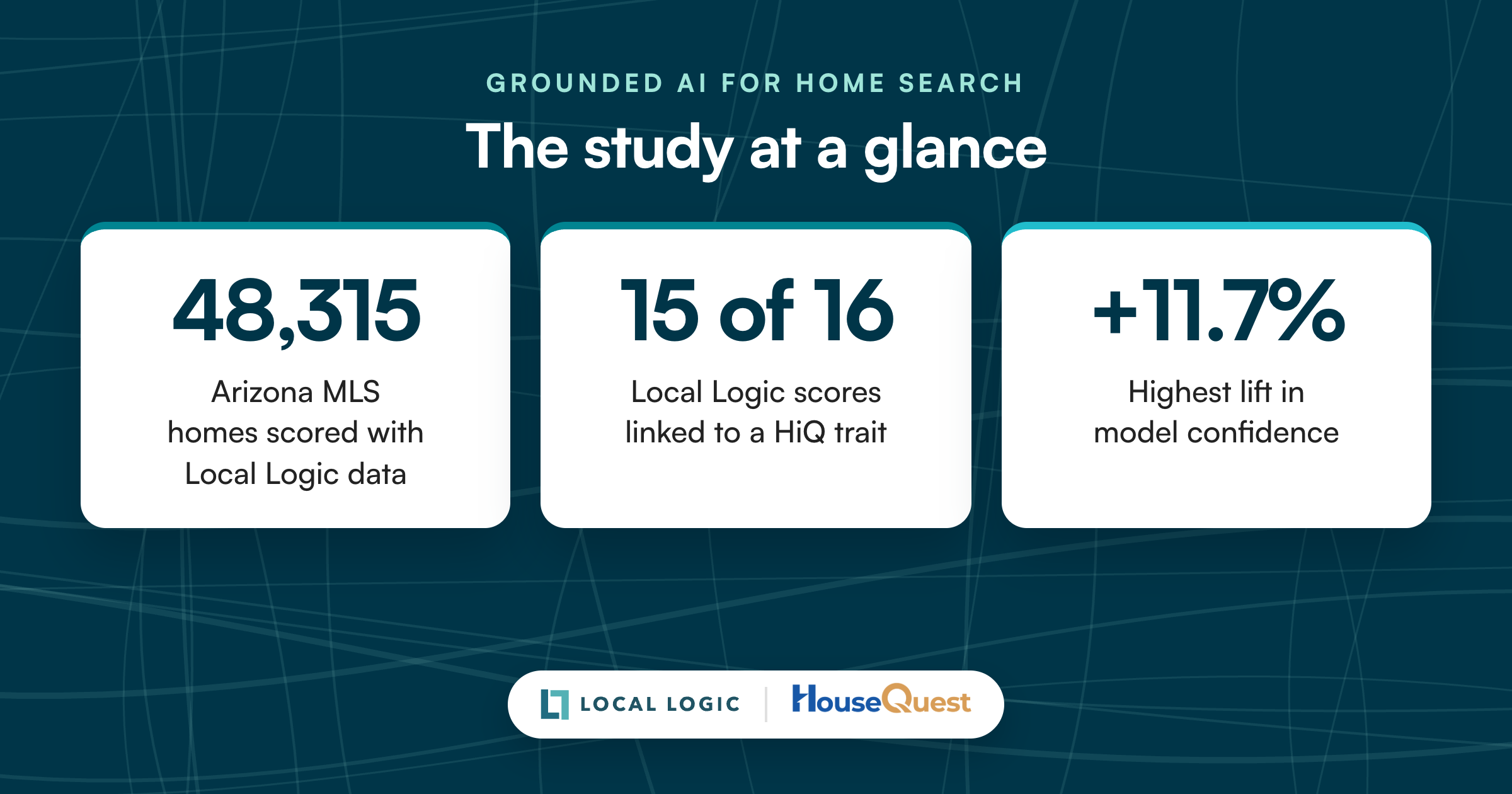
Listings describe the house, not the street. Most AI tools fill that gap with plausible but unsourced language, so the location half of a home match is guessed. HouseQuest’s HiQ grounds it in Local Logic neighborhood data. This paper reports what that looks like across 48,315 Arizona homes.
| Detail | |
|---|---|
| Customer | HouseQuest |
| Product | HiQ, matching intelligence engine |
| Market tested | Arizona Regional MLS |
| Local Logic data | 16 location scores and neighborhood profiles, via API |
| Scoring model | OpenAI o3 |
“Where you live has a profound impact on your life, and that includes both your home and the neighborhood around it. That’s why we partnered with Local Logic to help people find homes and neighborhoods where they can truly thrive. By combining psychometric science, Local Logic’s neighborhood data and advanced location intelligence, we’ve created a first-of-its-kind home-matching technology.”
Randy Marsden, CEO and Founder, HouseQuest
Any engine that matches people to homes has to reason about the part of a home a listing can’t describe: the street, the noise, the walk to coffee, the trail at the end of the road. Most AI tools fill that gap with plausible but unsourced language. HouseQuest’s HiQ fills it with Local Logic neighborhood scores.
This paper reports two analyses. The first examines how 16 Local Logic scores relate to HiQ’s 14 home traits across 48,315 Arizona listings. The second rescored 500 current listings three times to separate the effect of Local Logic data from the model’s normal run-to-run variation.
Local Logic data also changed the scores themselves. Mean trait scores for Retreat, Nature, Community and Safety moved by 8.4% to 17.6%: Retreat, Nature and Safety rose, while Community fell. The data did not simply push every score upward. It raised some traits and lowered others, depending on what each neighborhood is like.
| HiQ trait | Mean trait score shift with Local Logic data |
|---|---|
| Retreat | +17.6% |
| Nature | +8.6% |
| Community | −16.8% |
| Safety | +8.4% |
500 current Arizona listings, scored with and without Local Logic data.
The test does not establish that the resulting scores are more accurate or that buyers make better decisions. That comparison comes next.
A listing describes a house: bedrooms, square footage, a pool, a renovated kitchen. It says almost nothing about the life around it. Yet that is often what decides whether a home fits. A buyer who wants quiet mornings and trails and a buyer who wants to walk to dinner can read the same listing and need opposite answers.
Language models are good at producing confident descriptions of places. A model can infer neighborhood character from an address, school names and general patterns, but those inferences aren’t facts about the specific location. Structured neighborhood data gives the model address-level facts and explanations it can use.
For a matching engine, the gap is larger. Matching depends on comparing homes across many dimensions. If the location half of that comparison is guessed, the match is only half grounded.
| Inside the four walls | Outside the four walls |
|---|---|
| What the listing describes | What decides whether it fits |
| Beds, baths, square footage, pool, casita, single story | Street noise, walk to coffee, trails and parks, nightlife, nearby schools |
| Structured, sourced, already in the MLS record | Guessed by most AI tools. Grounded by Local Logic. |
Key takeaway: if the location half of a comparison is guessed, the match is only half grounded.
Local Logic quantifies what happens outside the four walls of a home. Four properties make the data usable by an AI model:
Local Logic data describes a place: how quiet it is, how walkable it is, and what is nearby. It does not judge whether a neighborhood is good or bad, and it does not suggest who should live there. Local Logic does not provide crime data or demographic data in its scores.
HiQ’s 14 traits, including Safety and Kids, are HouseQuest’s own. When Local Logic data informs them, it does so through those same descriptions, such as street noise or how close the nearest schools are. Local Logic’s school scores describe proximity only. They don’t rate schools.
| Category | Scores |
|---|---|
| Transportation | Pedestrian friendly, cycling friendly, transit friendly, car friendly |
| Amenities | Groceries, shopping, cafés, restaurants, nightlife |
| Education | High schools, primary schools, daycares |
| Character | Quiet, vibrant |
| Nature and wellness | Parks, wellness |
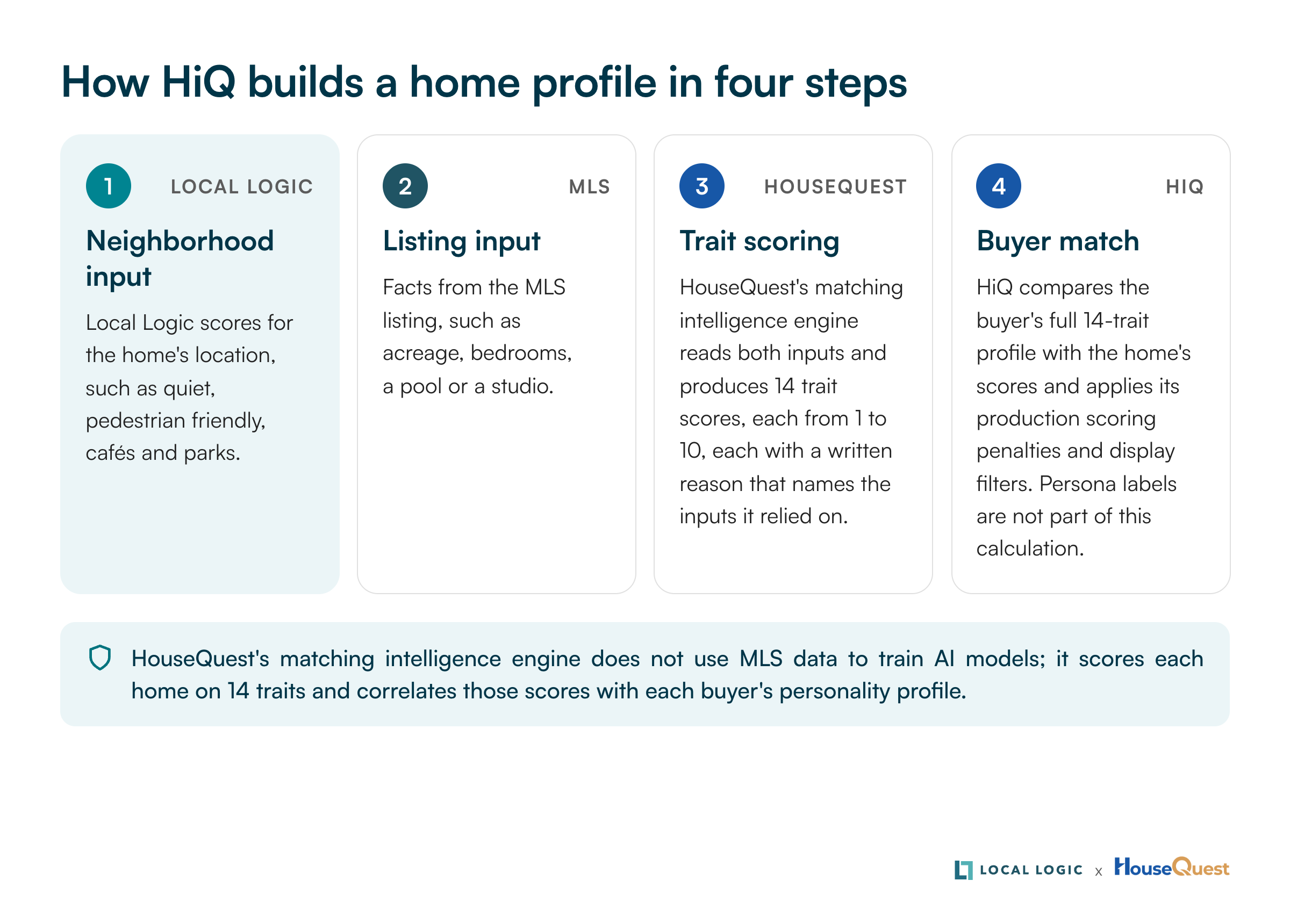
HiQ is HouseQuest’s home-matching product. A buyer’s questionnaire produces a 14-trait preference profile. HiQ compares that full profile with each home’s 14 trait scores, then applies the buyer’s stated property and location requirements. Persona names summarize a profile for display; they do not calculate the match score.
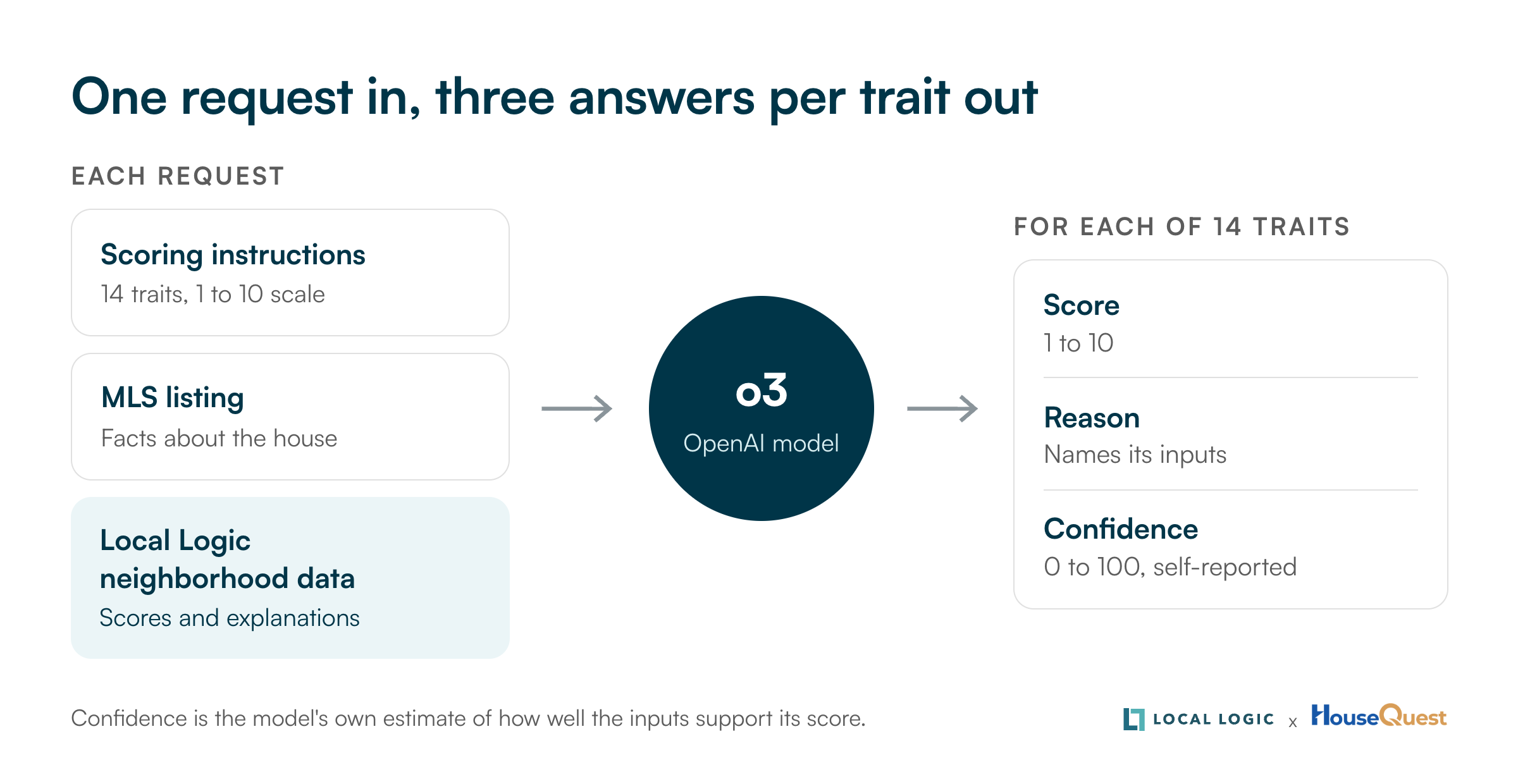
The current scorer uses OpenAI’s o3 model. Each request contains the scoring instructions, the MLS listing and the Local Logic neighborhood data. For each trait, the model returns a score, a reason and a confidence rating from 0 to 100. The confidence rating is the model’s own estimate of how well the supplied information supports its score. HouseQuest records that rating without calibration.
The Local Logic input, as a HiQ buyer sees it (Desert View, Phoenix). The neighborhood panel shows Local Logic’s 0 to 5 values with their explanations and attribution. This paper doubles them to a 0 to 10 scale.
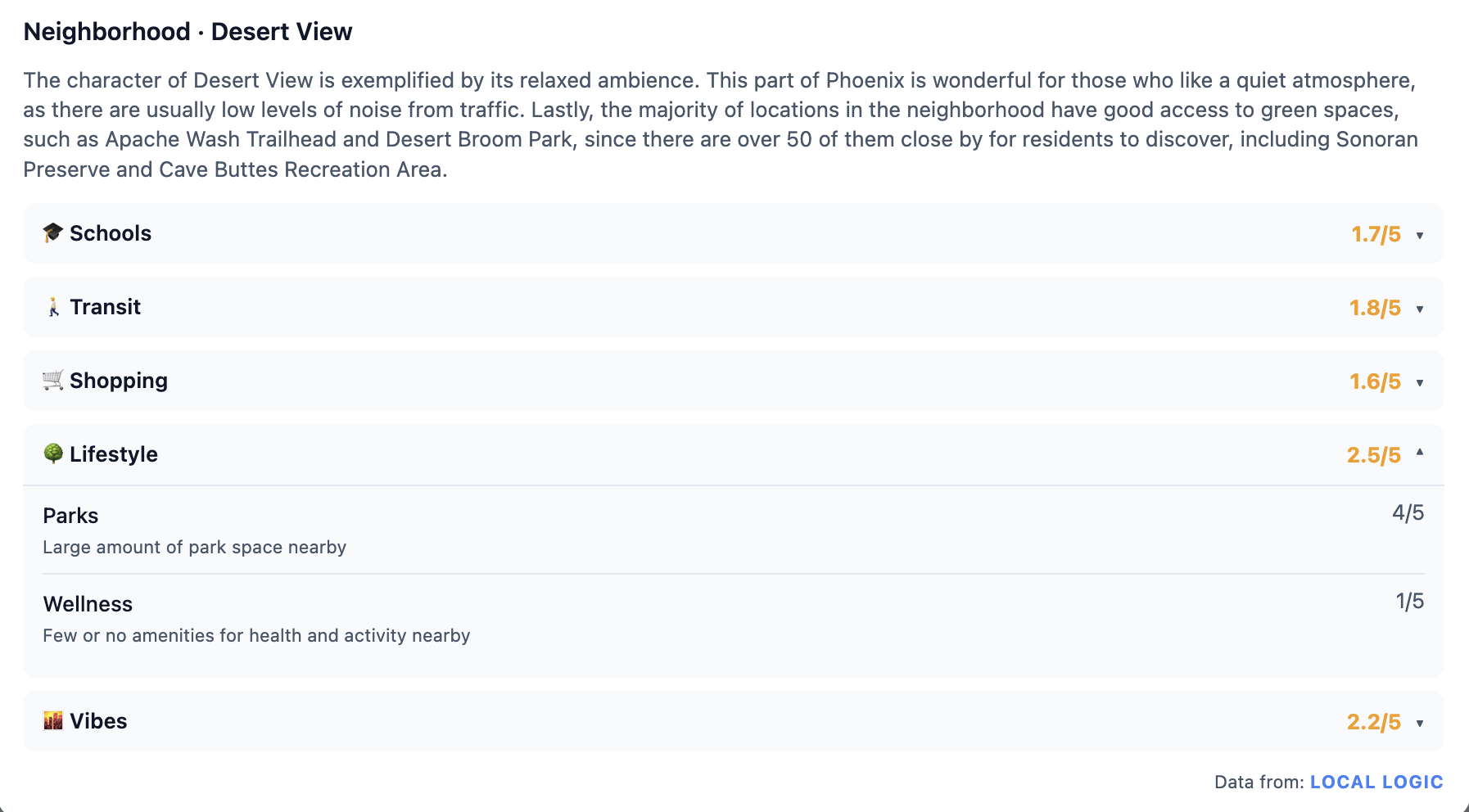
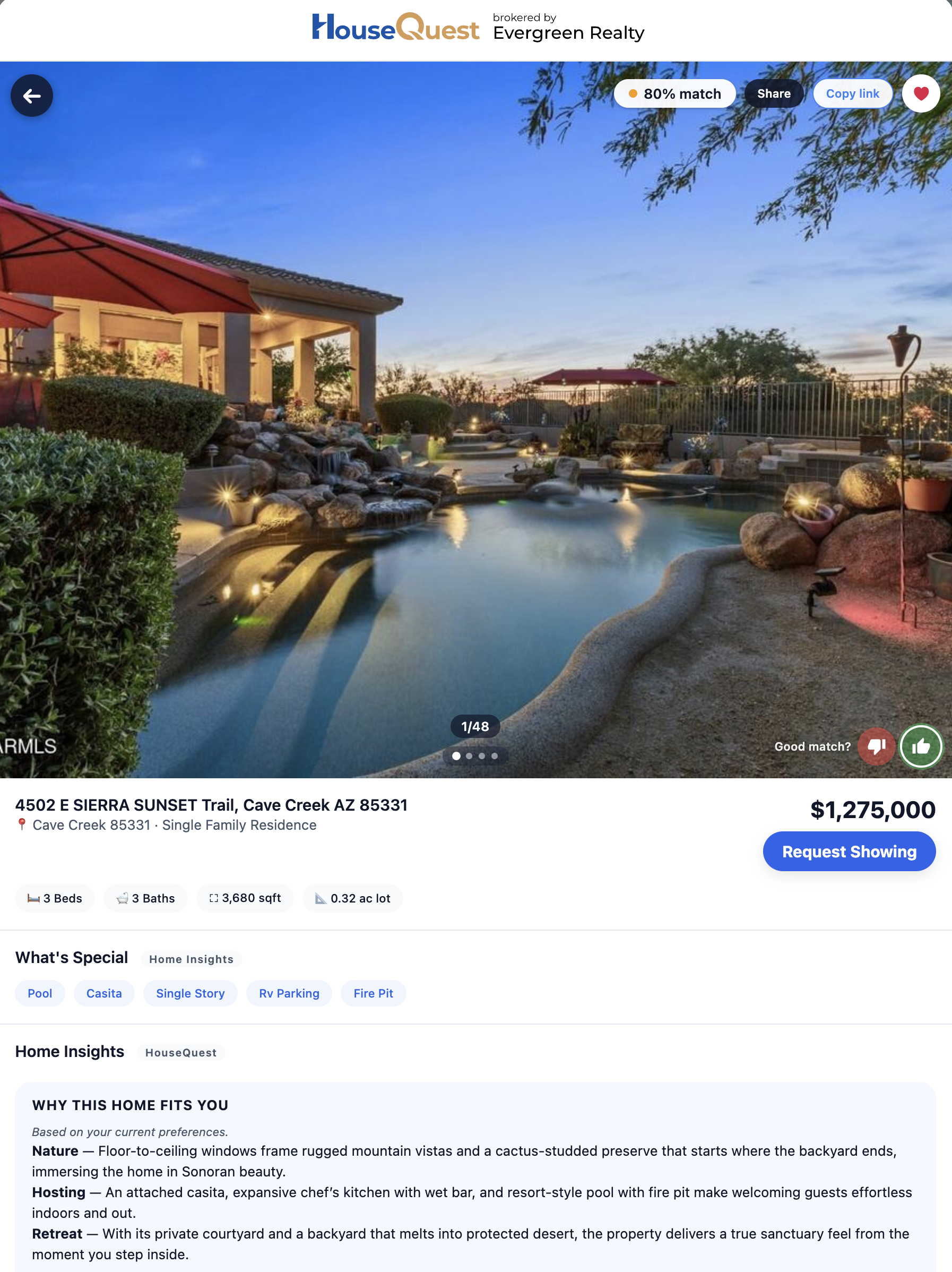
A buyer opens a listing, sees the neighborhood through Local Logic data, then sees how the home’s 14 traits line up with their own profile, with a written reason behind each score.
A. The listing. MLS facts and an overall match score for this buyer.
B. The match. The buyer’s profile (blue) against the home (green) across all 14 traits.
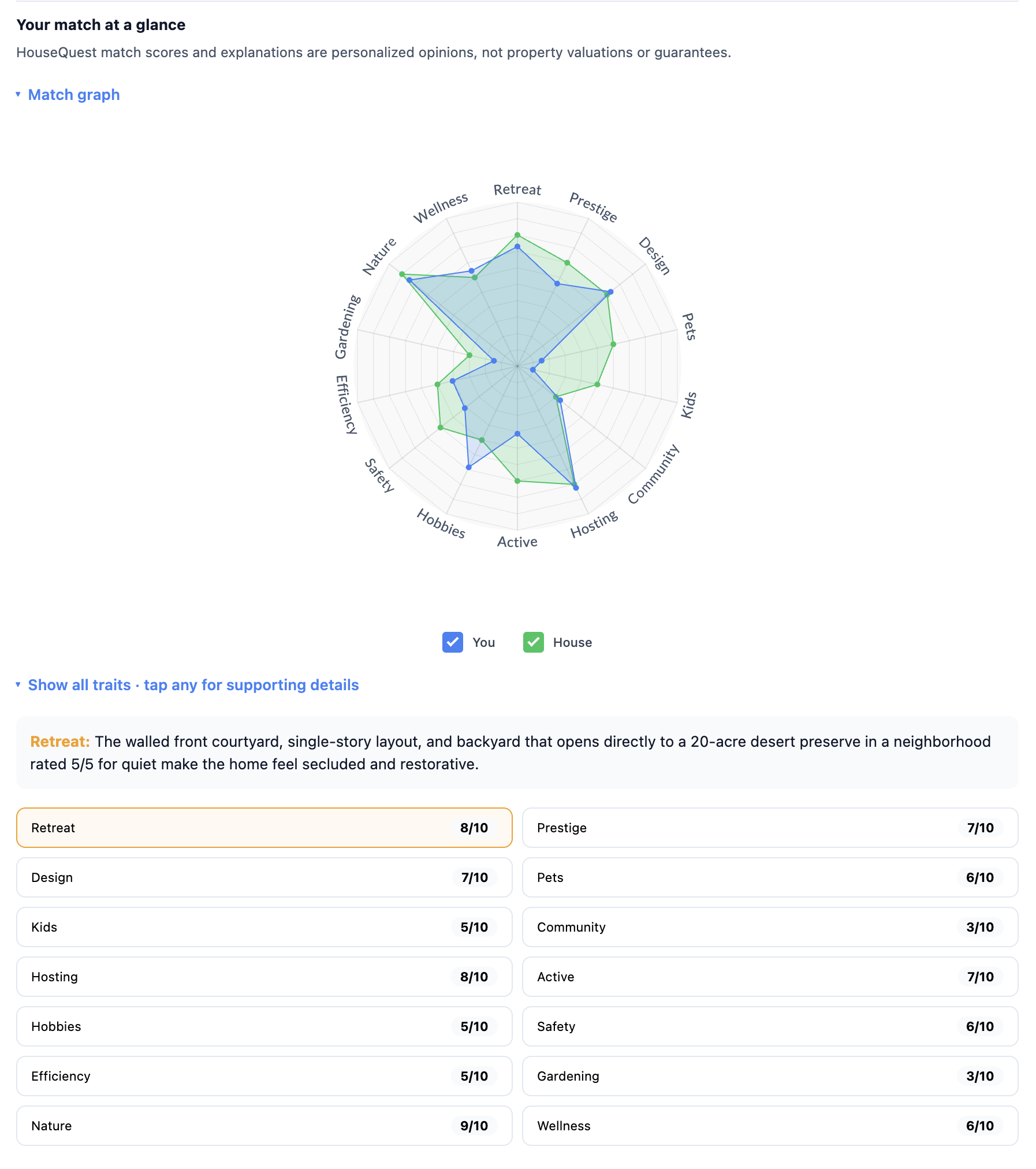
The reason behind Retreat 8/10: “The walled front courtyard, single-story layout, and backyard that opens directly to a 20-acre desert preserve in a neighborhood rated 5/5 for quiet make the home feel secluded and restorative.” The reason cites the Local Logic quiet score (5/5 on the API scale, 10/10 on this paper’s scale).
HouseQuest’s matching intelligence engine does not use MLS data to train AI models; it scores each home on 14 traits and correlates those scores with each buyer’s personality profile.
| Analysis | Listings |
|---|---|
| Arizona MLS listings scored with Local Logic data (July 14 to November 6, 2026) | 48,315 |
| With all 16 scores: correlation analysis | 25,191 |
| With a price and a quiet score: quiet and price analysis | 48,313 |
The analysis includes 48,315 Arizona Regional MLS listings scored with the 14-trait version of HiQ between July 14 and November 6, 2026. Listings without stored Local Logic data were excluded. Some included listings have since gone under contract or sold.
HouseQuest calculated the correlation between each Local Logic score and each HiQ trait, using the 25,191 listings with a complete set of the 16 scores. The results table reports the strongest absolute correlation for each score. An absolute correlation of 0.20 or more is described as a link. This is an association, not proof that one score caused the other.
HouseQuest divided listings into four price groups and compared average Retreat scores at the lowest Local Logic quiet value, 0, with scores at the highest values, 9 or 10. The low-quiet groups contain 119 to 176 listings per price group. The high-quiet groups contain 8,727 to 9,550, so the comparison is descriptive rather than a balanced experiment.
HouseQuest drew 500 homes at random from 26,371 active Arizona listings, spanning 77 cities and 11 counties. The production scorer evaluated each home without Local Logic data and twice with it. Every call used the same o3 model, 14 traits, 1 to 10 scale and MLS record; only the Local Logic neighborhood section changed.
| Run | Setup |
|---|---|
| Run 1: Baseline | o3 model, 14 traits on a 1 to 10 scale, same MLS record, no Local Logic section |
| Run 2: With Local Logic | o3 model, 14 traits on a 1 to 10 scale, same MLS record, Local Logic neighborhood section |
| Run 3: With Local Logic, repeated | o3 model, 14 traits on a 1 to 10 scale, same MLS record, Local Logic neighborhood section |
An earlier test, in March 2026, scored 486 Arizona homes once without Local Logic data and once with it. The model’s average confidence across all its traits rose from 55 to 63 out of 100, about 14% higher. The November comparison is the one reported in detail in this paper.
Local Logic’s API returns scores from 0 to 5. This paper doubles them for display on a 0 to 10 scale. The conversion changes only how the number is shown.
Among the 25,191 complete records, 15 of the 16 Local Logic scores had an absolute correlation of at least 0.20 with one or more HiQ traits. Quiet had the strongest relationship, with Retreat at 0.60. Vibrant, nightlife, pedestrian access and cafés had their strongest relationships with Community. Car friendly was below the threshold at 0.17. These are correlations, not estimates of how much Local Logic caused a trait to change.
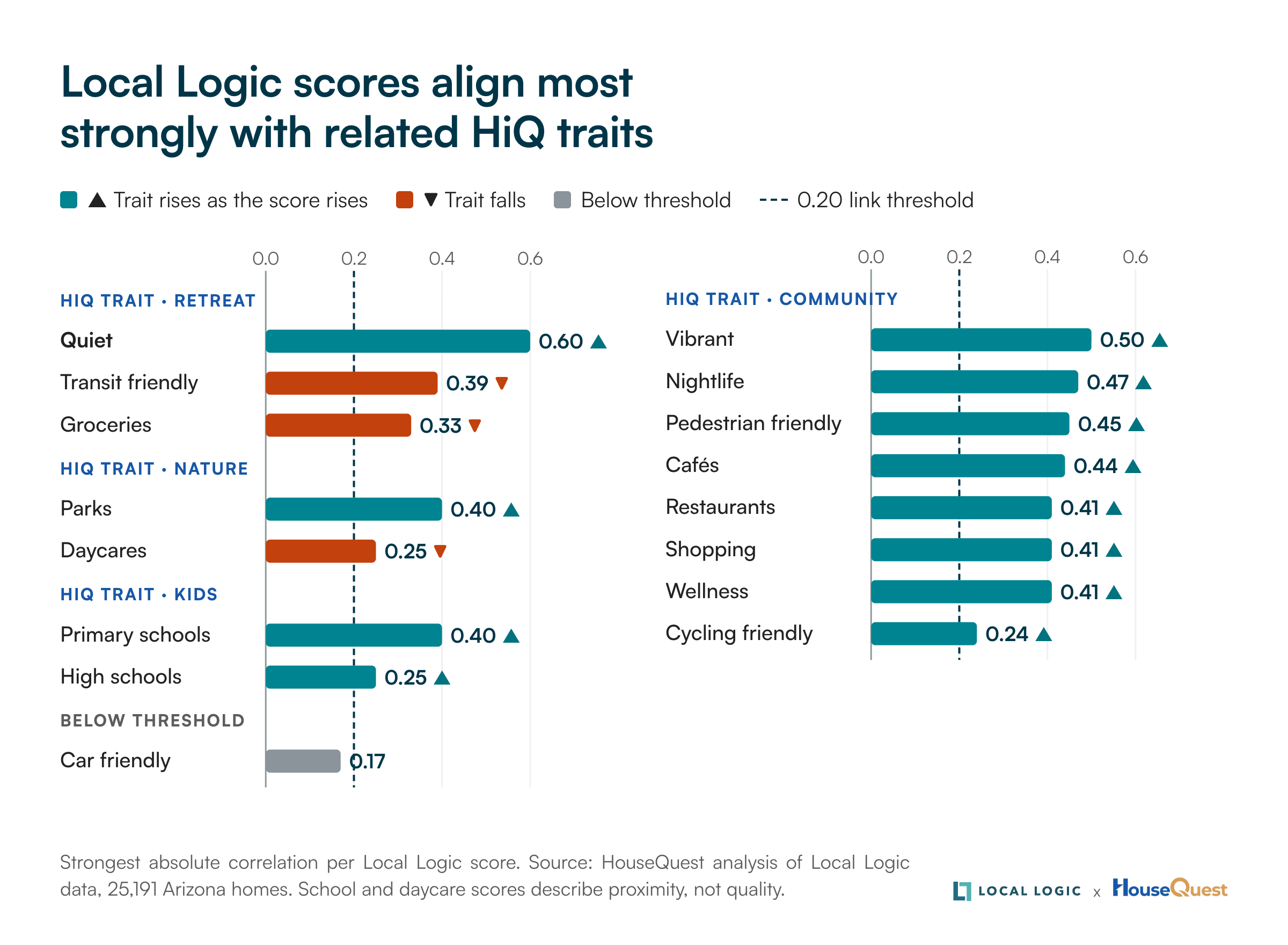
What it means: quiet goes with Retreat, walkable amenities with Community, parks with Nature and nearby schools with Kids.
In each price group, listings with a Local Logic quiet score of 9 or 10 had a higher average Retreat score than listings with a quiet score of 0. Quiet is one of the inputs used to score Retreat, so this pattern is expected. The analysis shows that the relationship appears in every price group; it does not prove that quiet alone caused the difference.
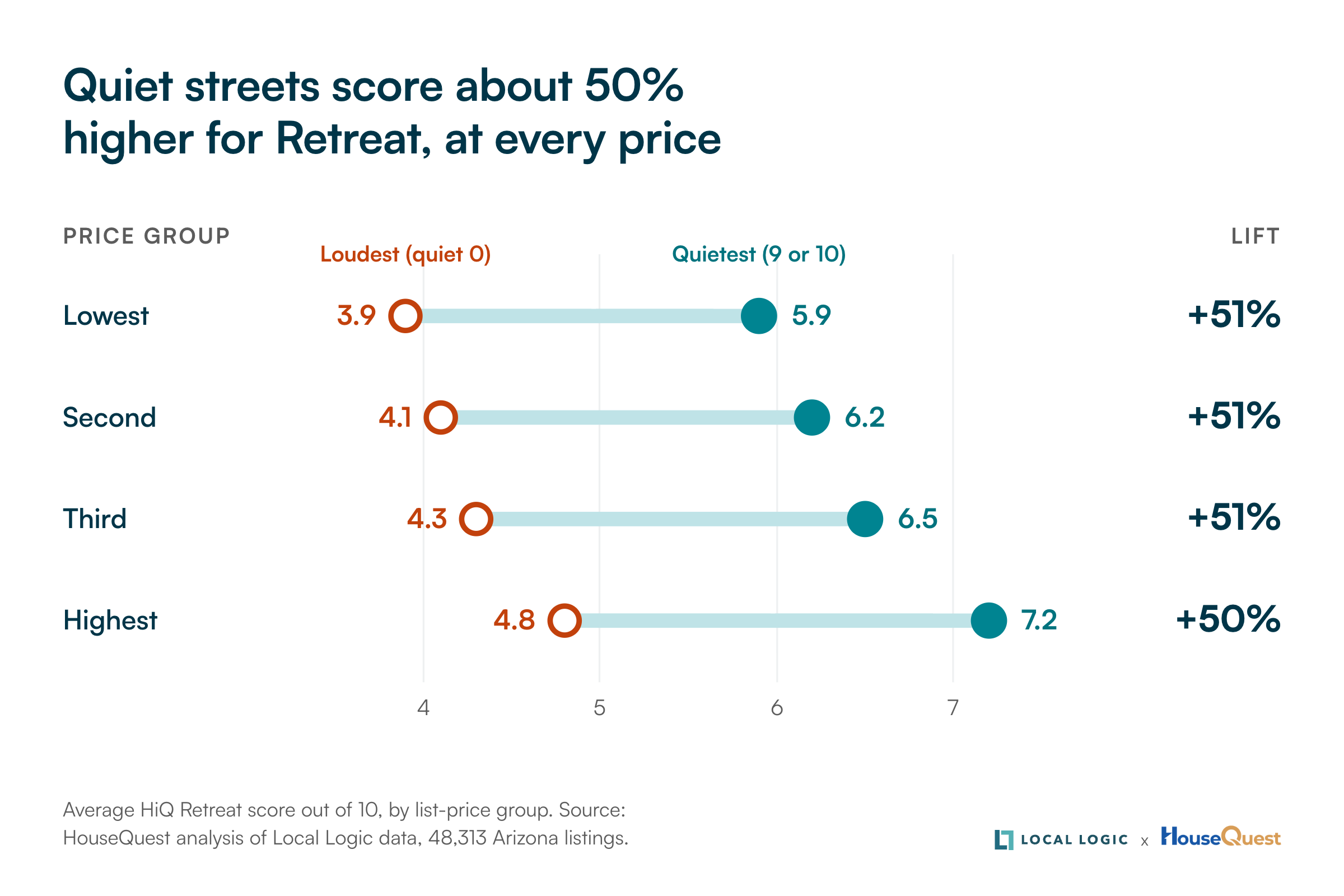
What it means: Retreat follows the street, not just the price tag. The gap between the loudest and quietest streets holds at about 50% from the lowest price group to the highest.
The largest confidence shifts were Retreat at 11.0%, Nature at 11.7%, Community at 10.3% and Safety at 10.0%. Their corresponding mean trait-score shifts were Retreat +17.6%, Nature +8.6%, Community −16.8% and Safety +8.4%. These percentages divide each mean shift by that trait’s mean without Local Logic, so traits with different starting values can be compared.
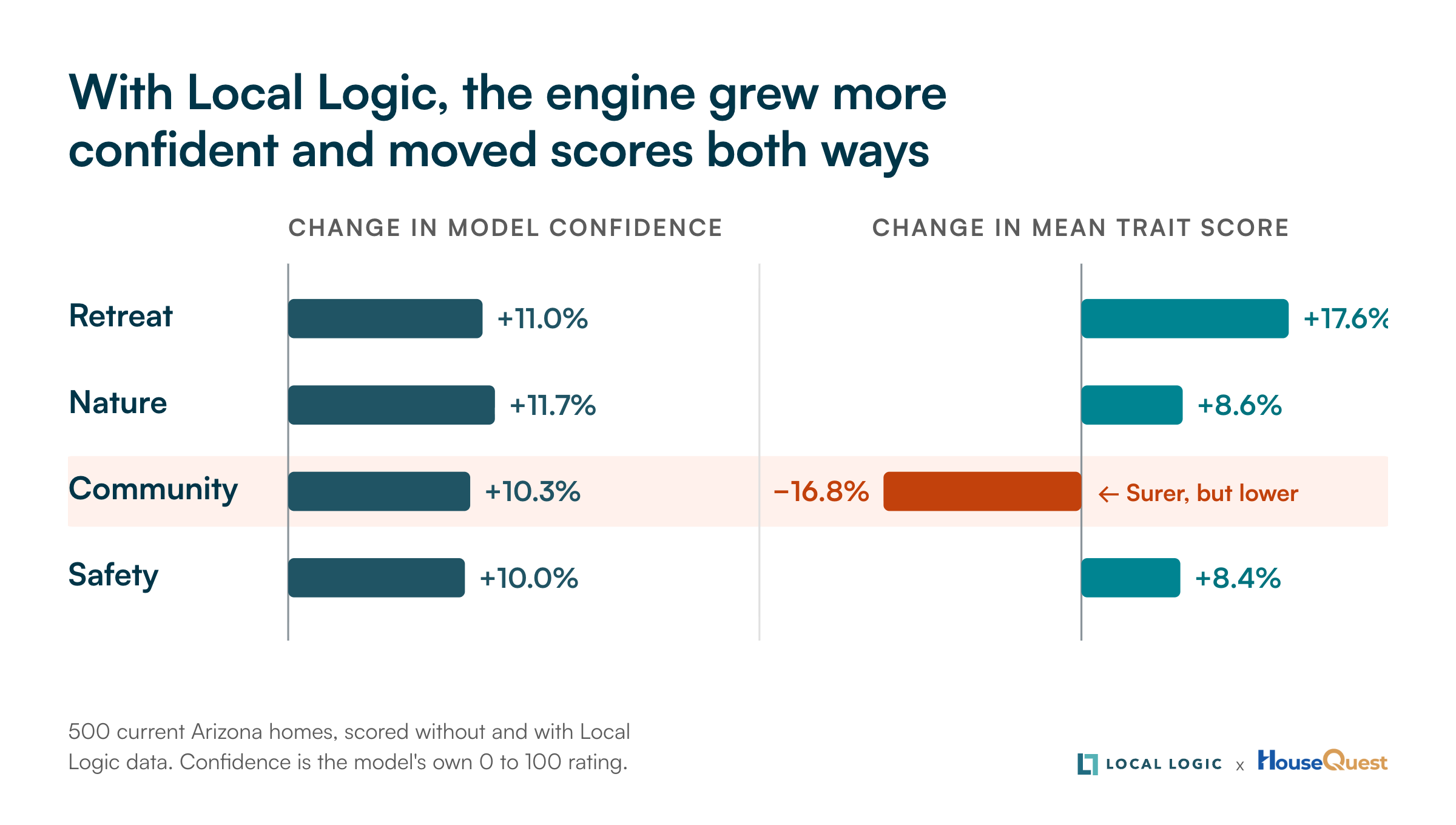
What it means: the direction matters. Local Logic did not simply raise every score; it made the model more certain while moving each trait toward what the neighborhood data describes.
Safety is a HiQ trait, not a Local Logic score. Local Logic doesn’t provide crime data. In this test, the model had more descriptive information about the neighborhood, such as noise levels and what is nearby, and it reported more confidence in its Safety score as a result.
Kids shows why score and confidence differ. Overall Kids confidence barely changed, but a high primary school score, meaning schools close by, raised the Kids trait score, while a low one lowered it.
Both examples come from the 48,315-listing analysis. The excerpts are taken from the stored engine reasons. An ellipsis marks omitted words. Numbers in square brackets convert Local Logic’s API values to the 0 to 10 scale used in this paper.
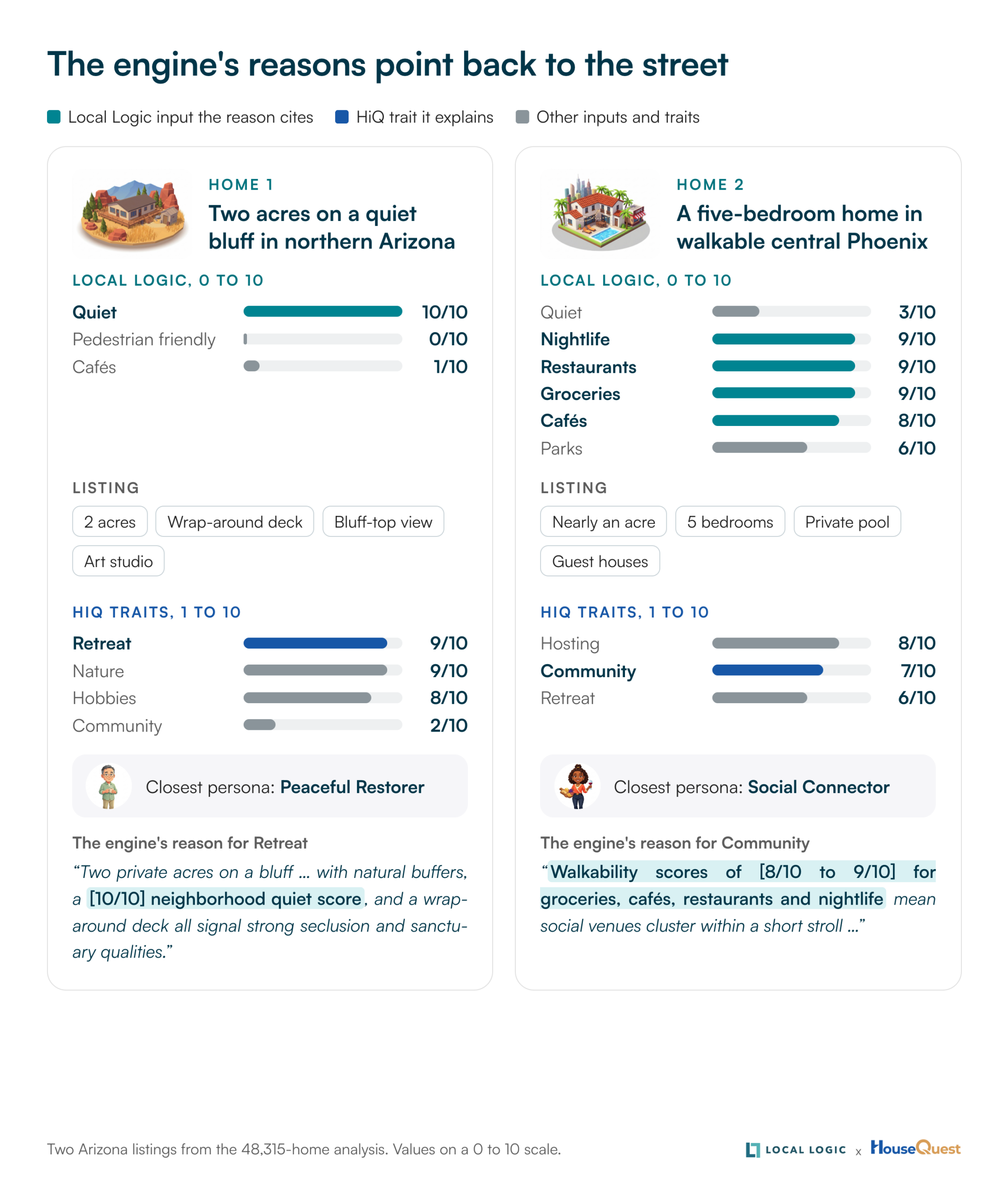
The engine’s reason for Retreat (Home 1): “Two private acres on a bluff … with natural buffers, a [10/10] neighborhood quiet score, and a wrap-around deck all signal strong seclusion and sanctuary qualities.”
The engine’s reason for Community (Home 2): “Walkability scores of [8/10 to 9/10] for groceries, cafés, restaurants and nightlife mean social venues cluster within a short stroll …”
In both examples, the engine’s explanation names the Local Logic inputs that support its neighborhood description. These examples show traceability. They do not test whether the description is accurate across all homes.
| What this test shows | What it does not yet show |
|---|---|
| Local Logic scores move with related HiQ traits | That the trait scores are more accurate |
| The model reports more confidence with Local Logic data | That buyers make better decisions |
| Trait scores move in both directions, not only up | That one score caused another |
| The engine’s reasons cite the Local Logic inputs they used | That results hold beyond Arizona and one model |
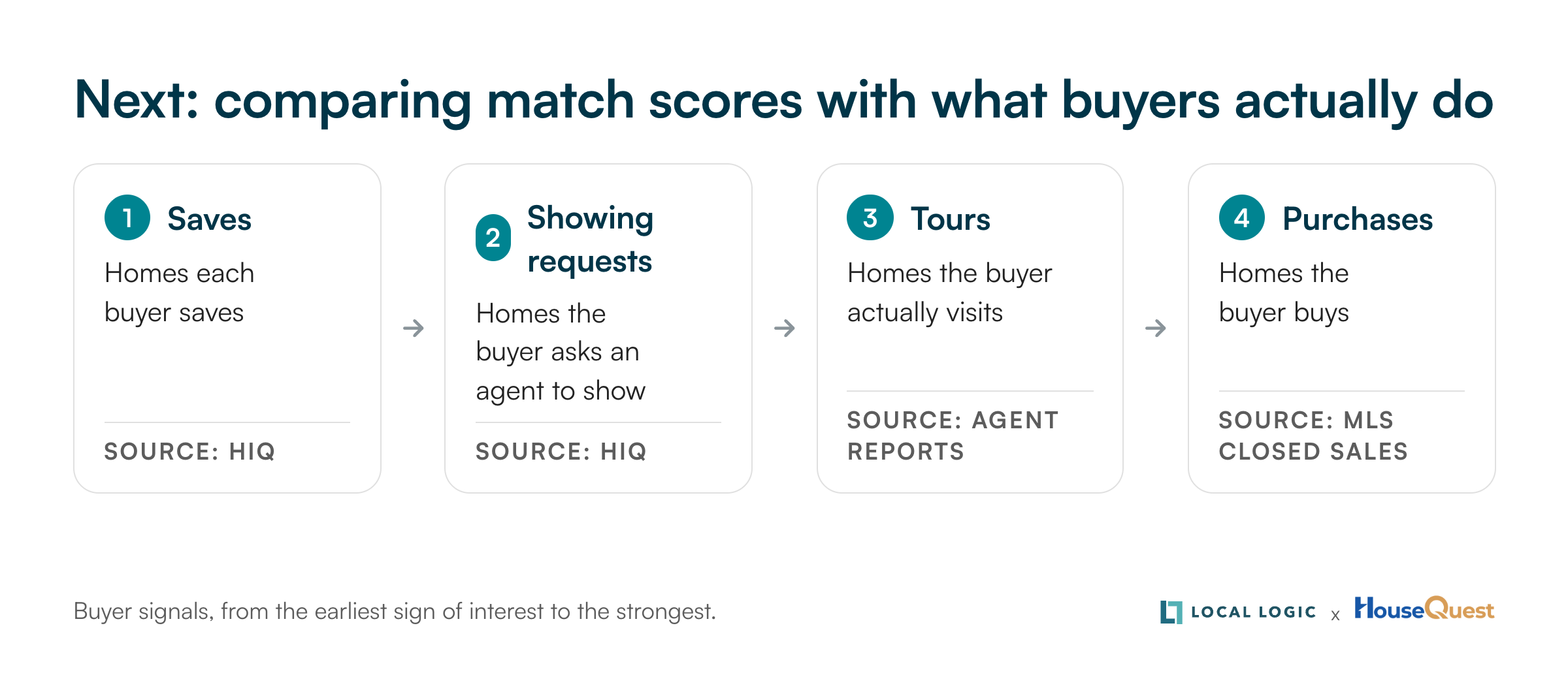
HouseQuest plans to compare each buyer’s match scores with the homes that buyer saves and asks an agent to show. Tour data will depend on agent reports, and purchase data will come from closed sales in the MLS.
HiQ is HouseQuest’s home-matching product. A buyer’s questionnaire produces a 14-trait preference profile, and HiQ compares it with each home’s 14 trait scores, built from the MLS listing and Local Logic neighborhood data.
HouseQuest requests 16 Local Logic location scores and neighborhood profiles through Local Logic’s APIs each time it scores a listing. Its engine, built on OpenAI’s o3 model, reads those scores and their plain-language explanations alongside the MLS listing to score each home on 14 traits.
Across 500 current Arizona homes, model confidence rose 10.0% to 11.7% on four location-sensitive traits, and trait scores moved in both directions: Retreat rose 17.6% while Community fell 16.8%.
No. Confidence is the model’s own rating of how well its inputs support a score. HouseQuest plans to validate matches against buyer behavior, such as saves, showing requests, tours and purchases.
No. Local Logic data describes a place, such as how quiet it is, how walkable it is and what is nearby. It does not include crime or demographic data in its scores, and its school scores describe proximity only.
HouseQuest analyzed 48,315 Arizona MLS listings scored between July 14 and November 6, 2026, and rescored 500 randomly selected active listings once without Local Logic data and twice with it, changing only the Local Logic section.
Product teams access Local Logic’s location scores through its APIs, and AI agents can query them through the Local Logic MCP server.
Ground your AI in Local Logic data | Try HiQ
Local Logic is a location intelligence company that quantifies everything outside the four walls of a home. Its data runs on more than 13,000 real estate websites, reaches 50 million users a month, and covers 18 location scores across more than 250 million addresses in the US and Canada.
Where you live shapes your happiness. It matters. HouseQuest is reimagining home discovery by combining AI and neuroscience to match buyers with homes that resonate with their personalities and lifestyles. HouseQuest also provides a spatial computing app that turns a look around the neighborhood into an interactive discovery experience, revealing property insights through the phone’s camera. Together, these innovative tools make finding a home personal, engaging, and fun. HouseQuest was founded by serial entrepreneur and Swype co-founder Randy Marsden. Learn more at housequest.com.