How Grounding Reduces Hallucinations at a Lower Cost
Commercial, Other, Residential
| 15 Sep 2026
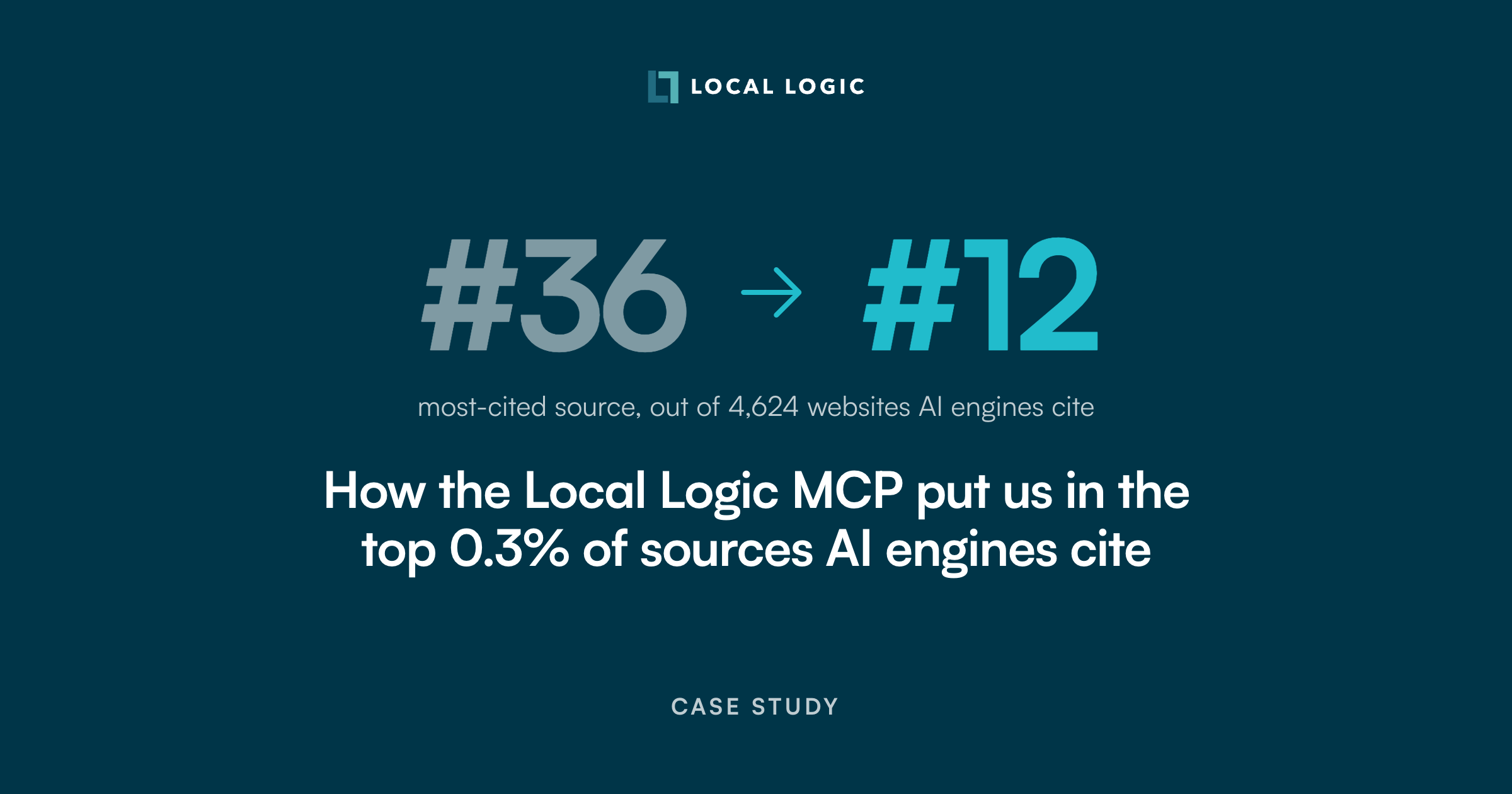
On the neighborhood questions we monitor, we went from the 36th to the 12th most-cited source in two months, out of 4,624 domains. Here’s how we did it, and how you can too.
Challenge: Google now answers many neighborhood questions before it shows a single result, and ChatGPT, Gemini and Perplexity answer them with no results page at all. AI engines also decide whom to trust before they search. In research reported by Lily Ray, Suganthan Mohanadasan found that in 21 of 27 cases, ChatGPT’s first search already included brand names the user never mentioned. Ranking well is no longer enough. A real estate site has to be a source AI engines already consider reliable.
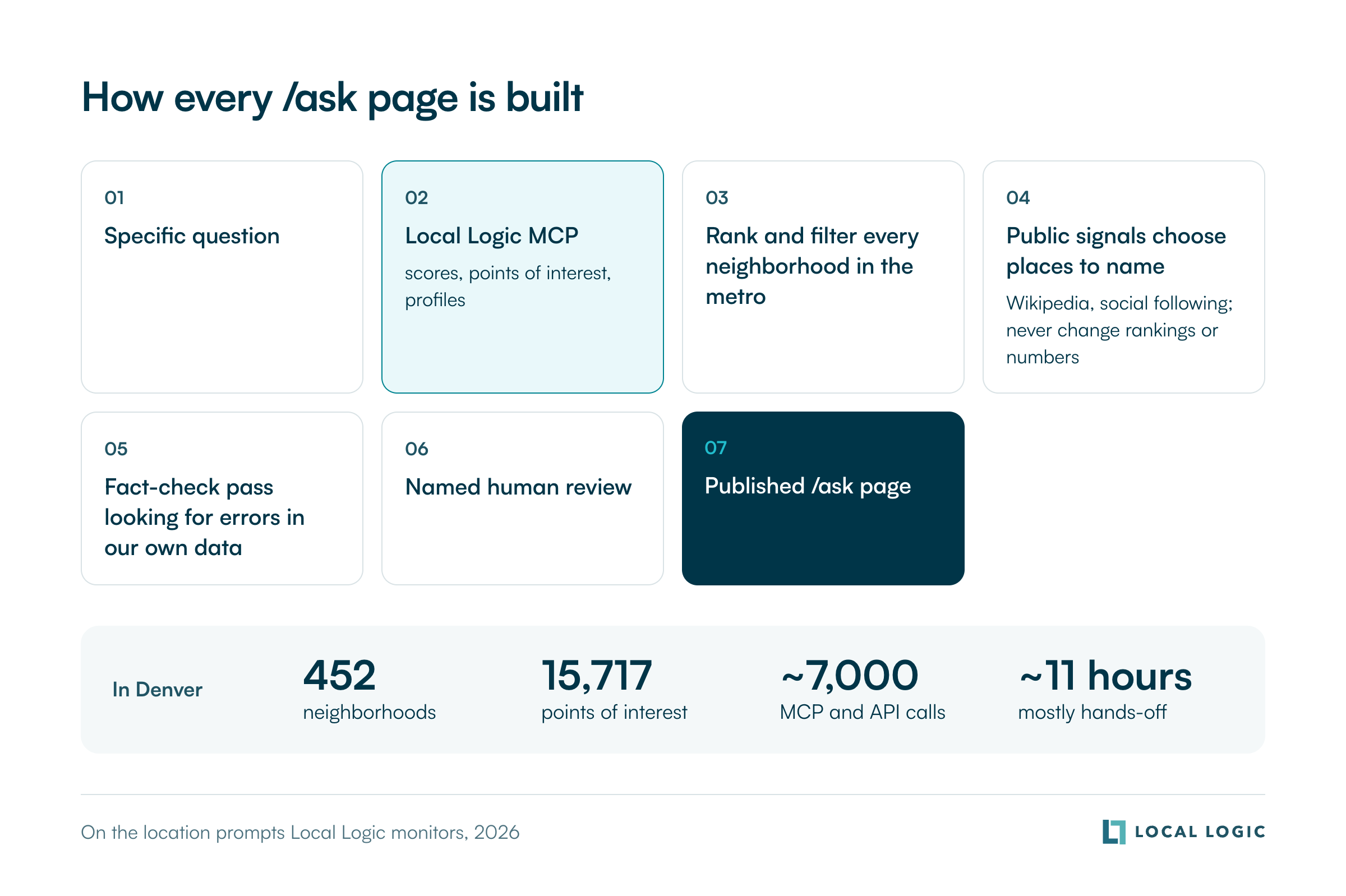
Solution: We published one page per specific neighborhood question under locallogic.co/ask. Every score, ranking and metric on those pages comes from Local Logic data through the Local Logic MCP. The build then uses public signals, like Wikipedia coverage and social following, to choose which parks, landmarks, restaurants and cafes to name in the text. Every page is fact-checked against our data and reviewed by a named person.
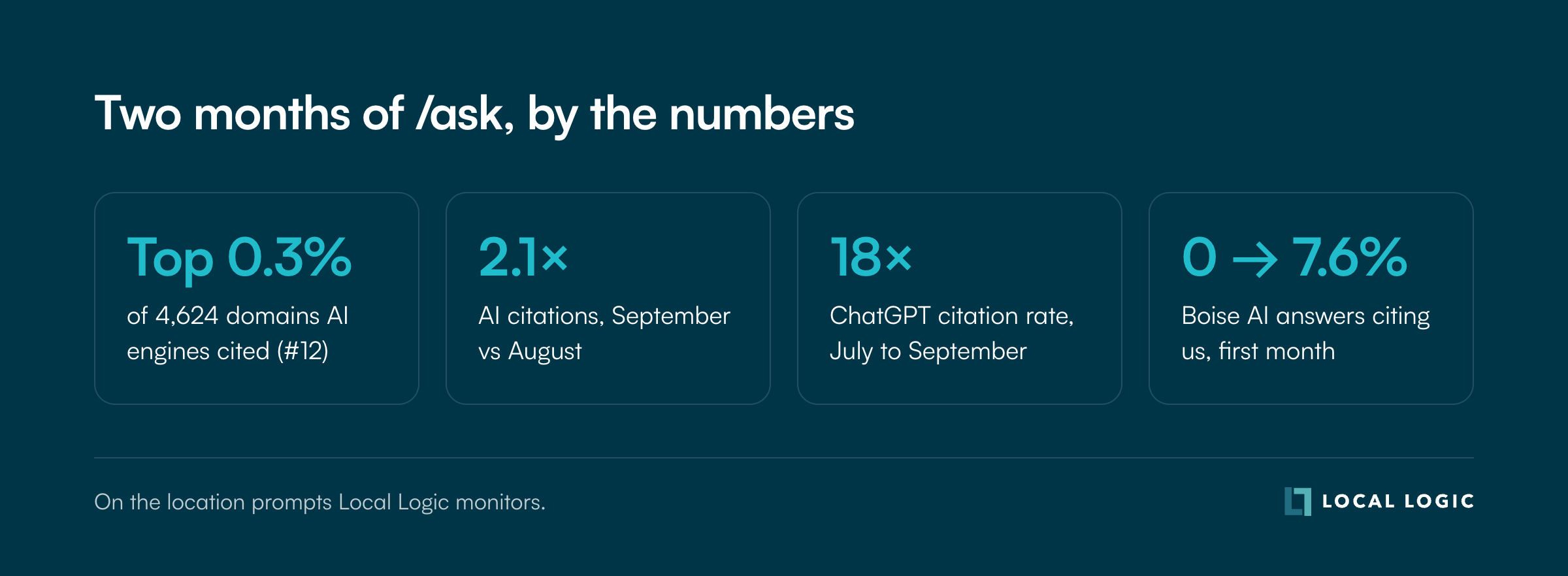
Results, on the location prompts we monitor:
Search Google for the best Atlanta neighborhoods for a short commute and a walkable weekend, and often the first thing you see is an answer, not a list of links. Gemini writes an AI Overview above the results and cites a few sources inside it. Ask ChatGPT or Perplexity the same question, and there’s no results page at all.
That changes what winning means. In a Pew Research Center study of real browsing behavior, Google users clicked a result in 8% of searches that showed an AI summary, compared with 15% of searches that didn’t. SparkToro found that 68% of US Google searches ended without a click in early 2026, and Google says AI Mode now has more than 1 billion monthly users.
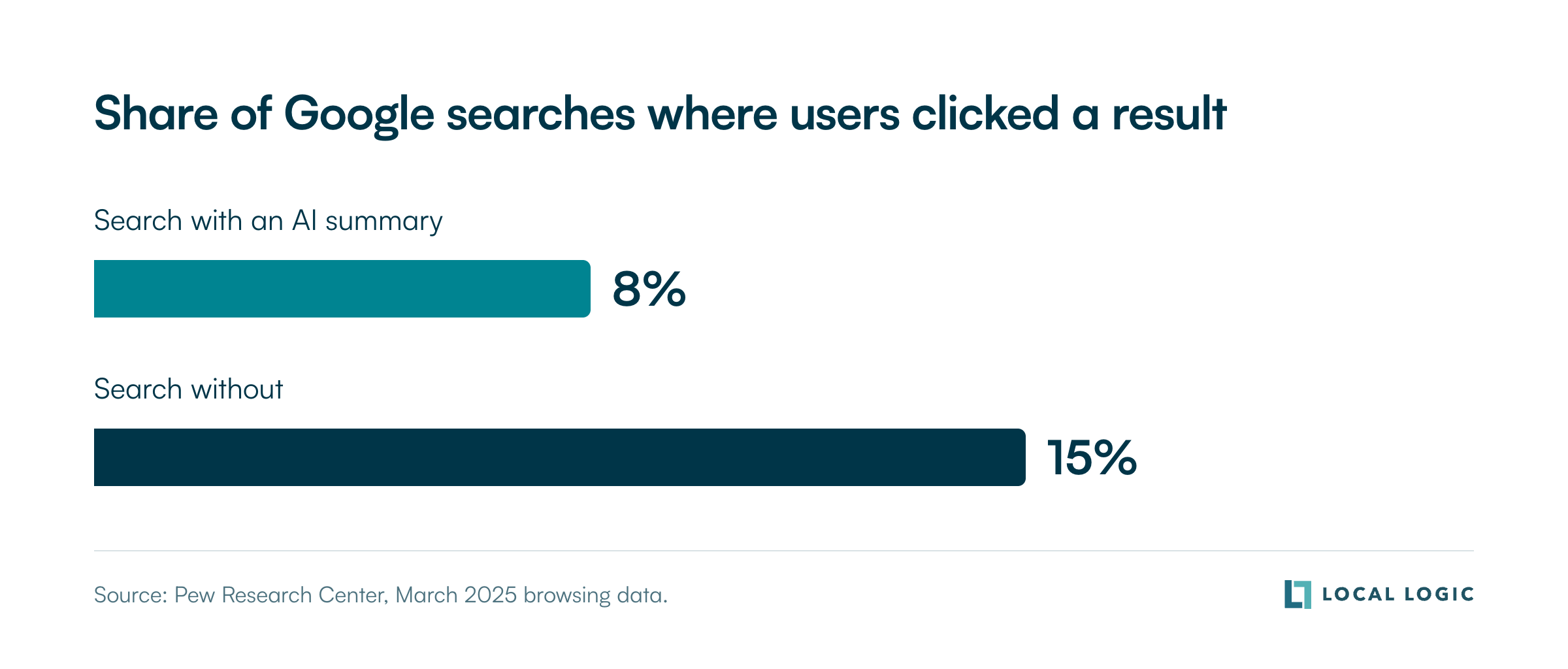
A page can rank on page one and still be invisible if the AI answer above it cites someone else. In a growing share of searches, the sites a home consumer sees are the ones cited in the answer.
The good news for brokerages is that the trusted source usually isn’t a portal. On the location questions we monitor, brokerage and agent sites earn 38% of all AI citations, spread across more than 2,500 sites. Zillow, Redfin and Realtor.com each earn less than 2%.
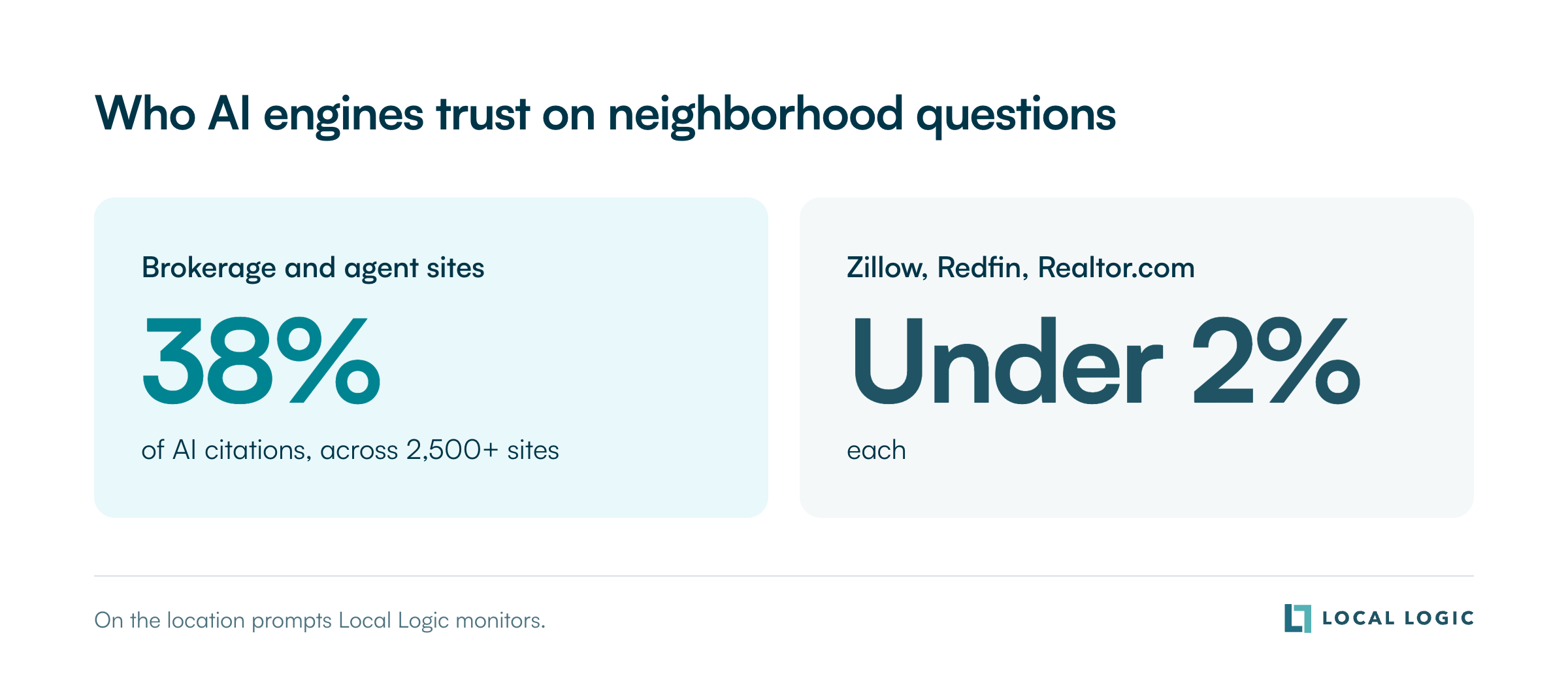
Answer engines are built to avoid being wrong in public. When they pick sources, they favor the same signals Google’s own guidance on helpful, reliable content calls E-E-A-T: experience, expertise, authoritativeness and trust.
Most neighborhood pages on real estate sites score poorly on all four. They’re written for a city rather than a question. They describe places as “vibrant”, “charming” or “convenient”, which can’t be verified. They rarely say where their facts come from or who checked them. An engine has no reason to trust that page over another, so it cites a source it can trust.
So our thesis for /ask was simple. To get cited, you need authority. To have authority, you need to be a reliable source. And the fastest way to become a reliable source is to publish facts that come from good data and say so plainly.
We launched /ask on July 30, 2026 in Miami, Atlanta and Chicago, with one guide per specific question in each metro. We have since expanded to eight metros: Atlanta, Boise, Boston, Chicago, Denver, Miami, Philadelphia and Washington, DC. Here is how each part of E-E-A-T shows up on the page.
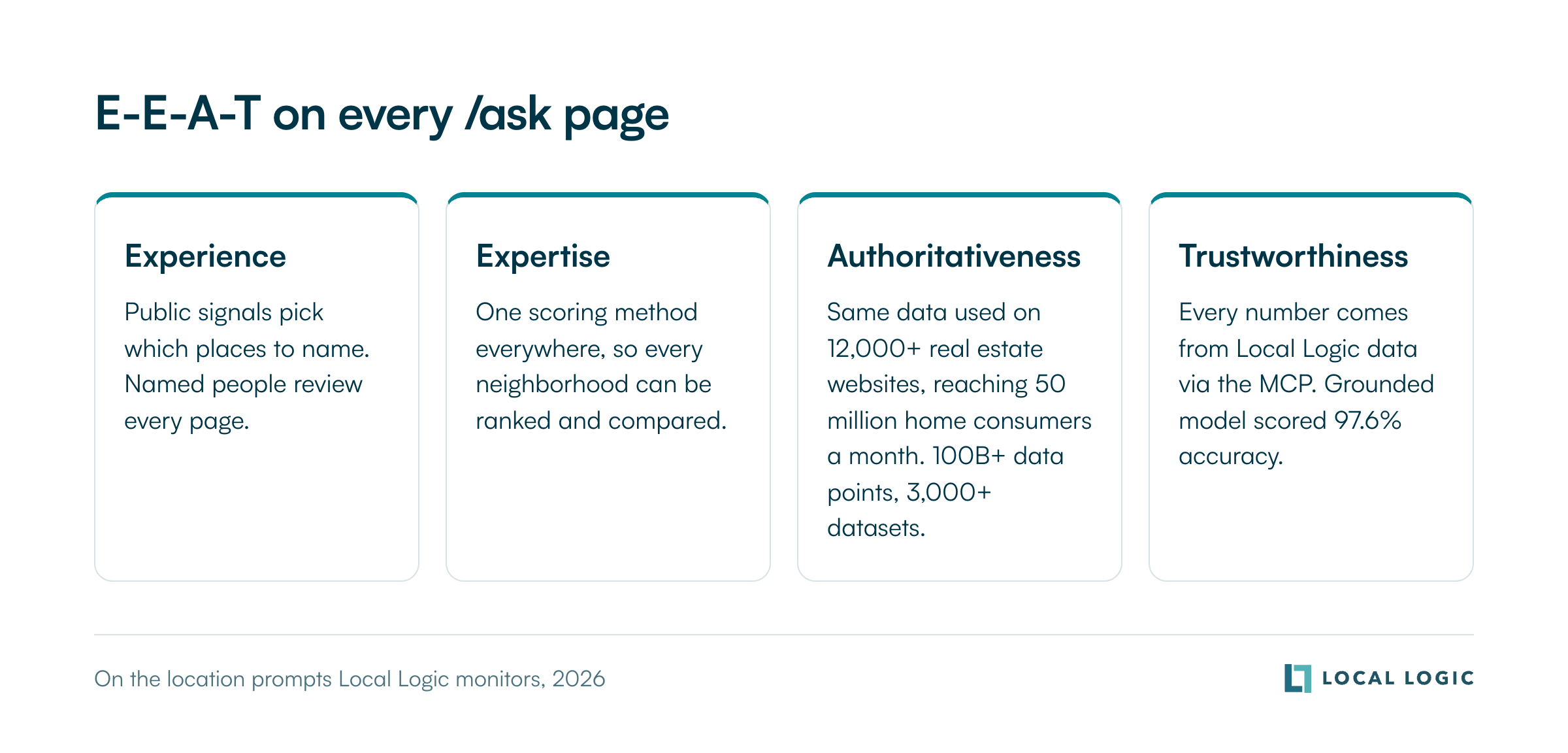
Data tells you a neighborhood has around 150 restaurants. Locals tell you which ones people actually go to. To bridge that gap, the build checks public signals: Wikipedia coverage for parks and landmarks, and social following for restaurants, bars and cafes. Those signals decide which places a page names and where it adds context. They never change a ranking or a number.
Every page is reviewed by a named person before it goes live. We use neighborhood names people actually say, like LoHi and Uptown, in the visible text and in structured data. Local testers in Atlanta said the descriptions were more accurate than they expected.
Local Logic calculates its scores the same way in every neighborhood, whether that’s Midtown Atlanta or a quiet street in Boise. That consistency lets you compare any neighborhood with any other, and it’s what makes the strongest claims on a neighborhood page possible.
Through the MCP, the build can rank all of a city’s neighborhoods on any score in a single call. In a few seconds, it can tell you that Midtown ranks third out of Atlanta’s 423 neighborhoods for nightlife. It can also show which neighborhoods clear the bar on both walkability and transit, and which ones fall short. Each /ask guide starts from that kind of cut: it takes every neighborhood in the metro, keeps the ones that meet the audience’s must-haves, and ranks what’s left.
That matters because people ask AI engines comparison questions. “Best”, “quietest” and “most walkable” can’t be answered from memory or from one neighborhood’s profile. The engine needs a source that has measured every option the same way. Every prompt in “Winning specific questions” below is a comparison question, and we think that’s no coincidence.
Every /ask page also has its own “About the data” section and links to how Local Logic data is built and how location scores are calculated. Each pick goes through a research pass whose only job is to find where our own data is wrong. Picks are compared against established lists, and any outlier has to be defensible.
Producing all this took far less effort than you’d expect. In Denver alone, the pipeline evaluated 452 neighborhoods and checked 15,717 points of interest across about 7,000 MCP and API calls, in roughly 11 hours of mostly hands-off run time.
The facts on /ask come from the same data that powers neighborhood insights on more than 12,000 real estate websites and reaches 50 million home consumers every month. That data includes more than 100 billion data points from over 3,000 datasets, covering 250 million addresses across the US and Canada. It combines open data, proprietary models and partners such as ATTOM, HomeJunction and Transit App.
A page grounded in that data carries the data’s authority. A page written from an agent’s impressions can’t.
Each page is built end to end on the Local Logic MCP, which connects an AI model directly to Local Logic’s data. The model doesn’t describe a neighborhood from memory. It pulls scores, points of interest and profiles and writes from those.
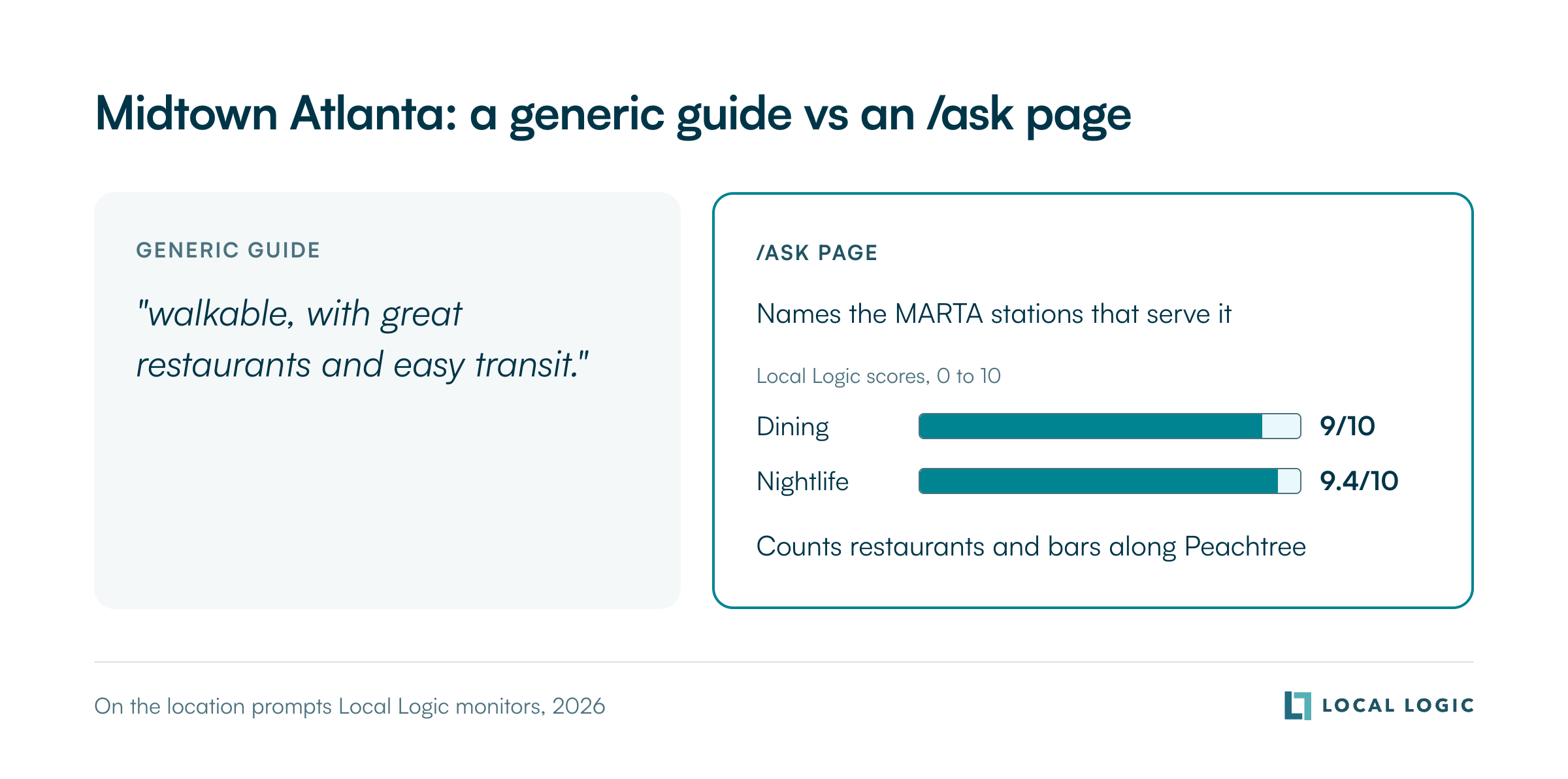
The difference shows up on the page. A generic guide calls Midtown Atlanta “walkable, with great restaurants and easy transit.” The /ask page names the MARTA stations that serve it, scores its dining at 9 out of 10 and its nightlife at 9.4, and counts the restaurants and bars along the same stretch of Peachtree. An engine can check every one of those details.
We also measured accuracy directly. In our AI hallucination benchmark, a low-cost model grounded on the MCP scored 97.6% accuracy on neighborhood questions. A frontier model answering from memory scored 96.9%, at about seven times the cost per answer.
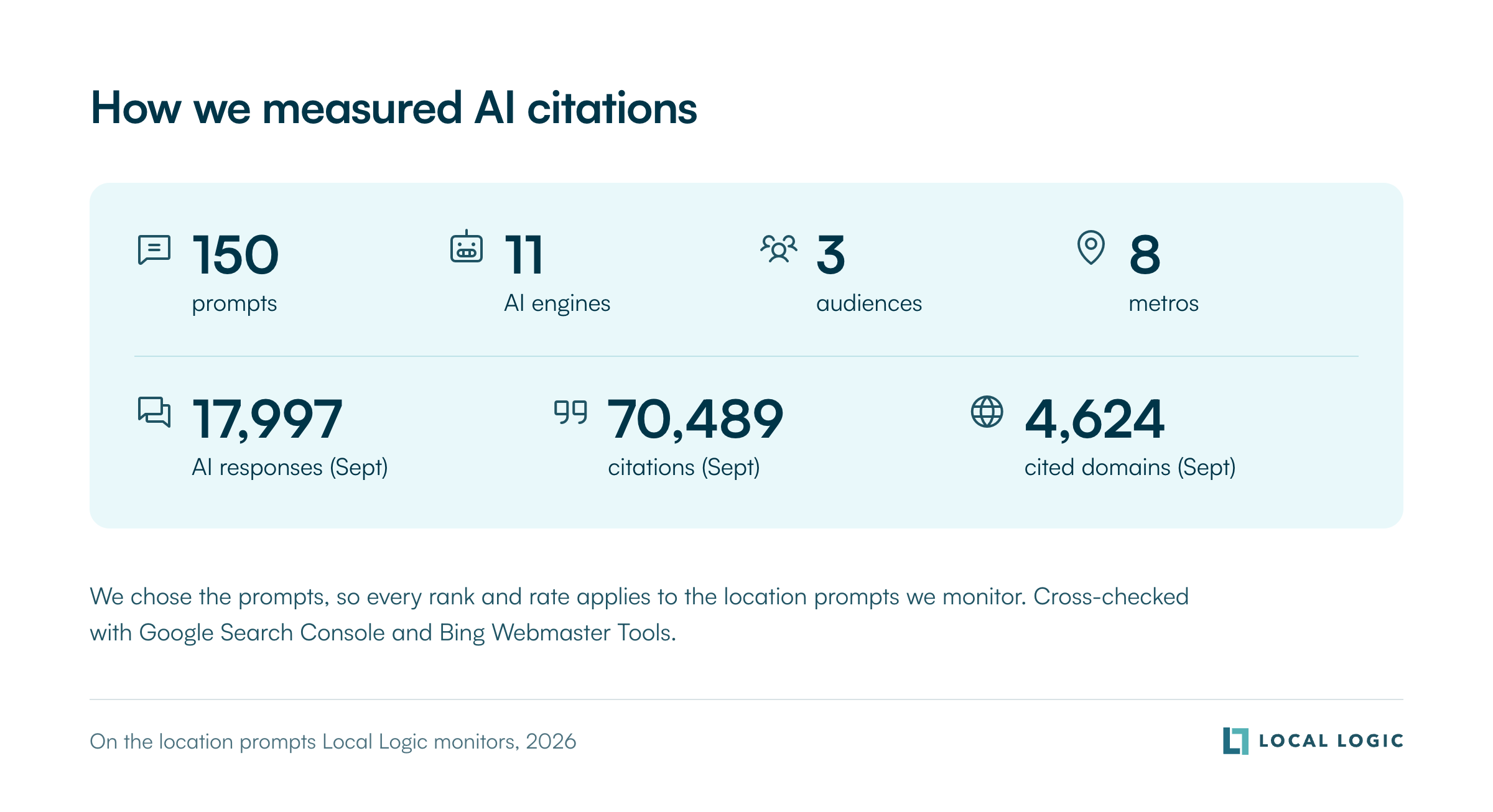
We track 150 home-search prompts across 11 AI engines, including ChatGPT, Perplexity and Microsoft Copilot. The prompts cover 3 audiences across 8 metros. In September alone, that produced 17,997 AI responses and 70,489 citations across 4,624 cited domains. We cross-check against Google Search Console (AI Overviews and AI Mode impressions) and Bing Webmaster Tools’ AI performance report.
We chose the prompts ourselves, so every rank and rate below applies to the location prompts we monitor. Any brokerage can do the same. Start with the markets you want to win in, list the questions your buyers and sellers actually ask about those markets, and track who gets cited for them every month.
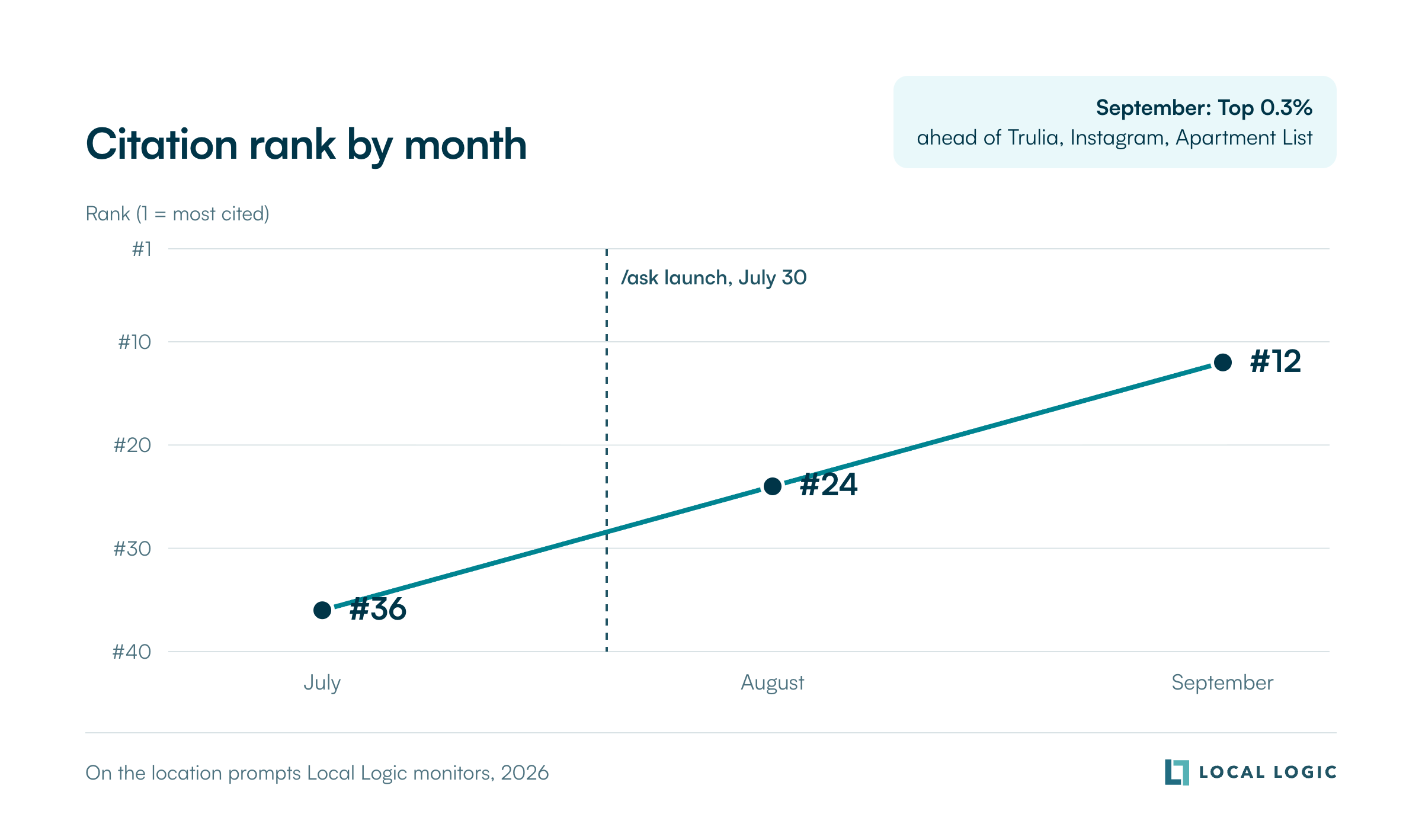
Before /ask launched, Local Logic was the 36th most-cited source on our monitored prompts. After one month, we were 24th. After two months, we were 12th out of 4,624 cited domains, ahead of Trulia, Instagram and Apartment List.
Boise: from zero to cited in one month. In August, Local Logic had no pages about Boise at all, neither /ask guides nor blog posts, and no AI answers about Boise neighborhoods cited us. In September, its first month with /ask pages, 7.6% did.
Denver: /ask pages beat blog posts. Denver started from a different place. A few of our blog posts about Denver neighborhoods were already earning citations in 7.2% of AI answers in August. After we published the Denver /ask guides, that rose to 10.7% in September, a 49% increase. The biggest gains came on the questions the guides were written to answer. Citations on young-professional prompts nearly doubled, from 11% to 21%. On family prompts, they more than doubled, from 6% to 14%.
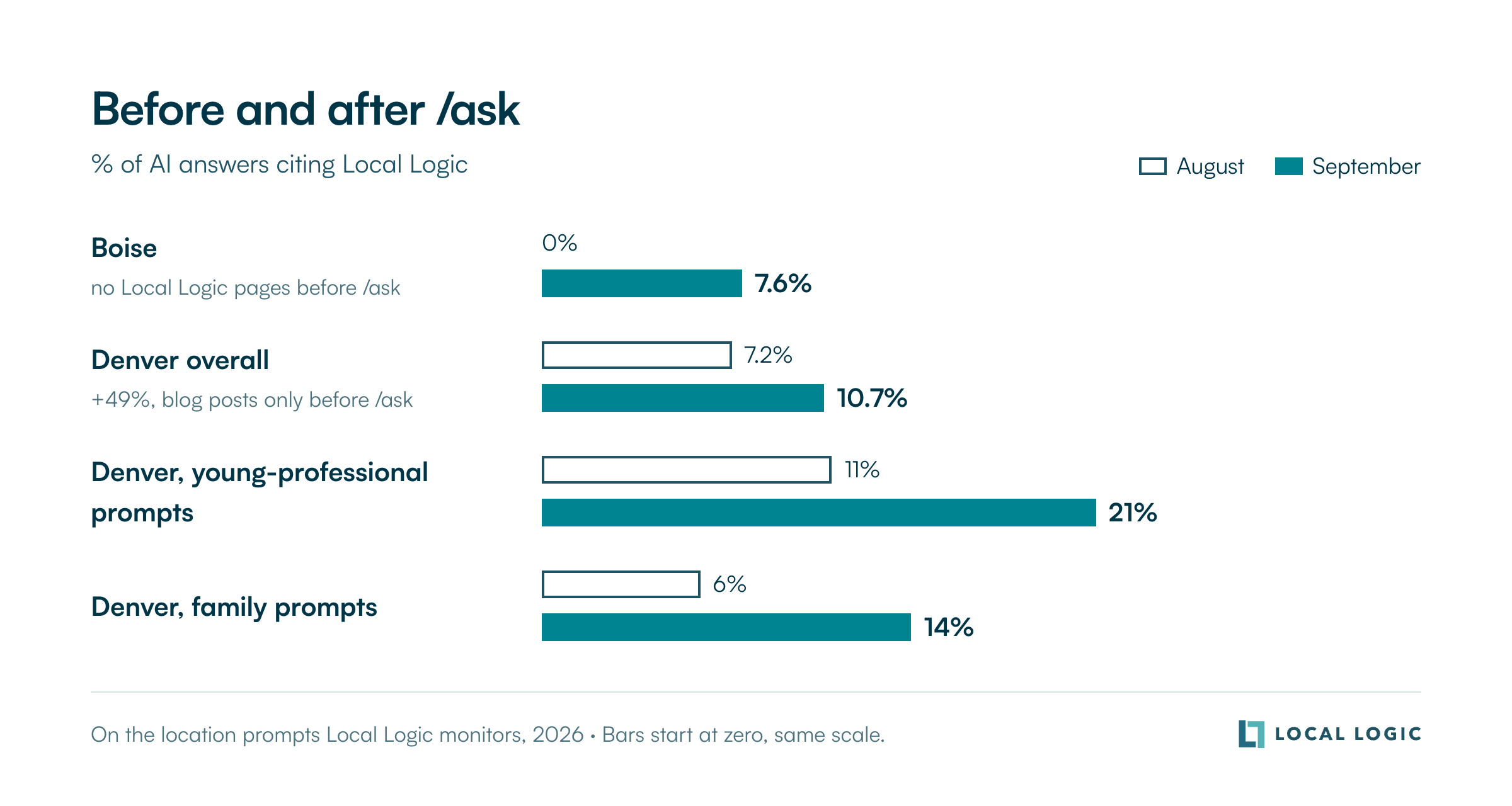
Together, the two metros show that publishing grounded, question-specific pages gets a site cited from scratch, and gets it cited more often than general blog content does.
| Engine | Result |
|---|---|
| ChatGPT | Citation rate grew 18-fold from July to September. Cites Local Logic in 17.2% of its answers and accounts for 44% of all answers that cite us. |
| Perplexity | Cites Local Logic in 10.4% of its answers and accounts for 27% of answers that cite us. |
| Microsoft Copilot and Bing | First citations of /ask pages in August. Bing’s AI cited us 2.1 times as often in September. |
| /ask impressions in AI Overviews and AI Mode more than tripled, August to September. | |
| All engines | Cited for 31% of our 150 monitored prompts in September, up from 21% in August. |
A change to ChatGPT’s search behavior in August also contributed to its growth. Microsoft Copilot and Bing were already citing Local Logic for business questions about location data, and August was the first month they cited our /ask pages on home-search questions. In September, Bing’s AI citations included our data pages and the hallucination benchmark. When Philadelphia and Washington, DC launched, Google impressions on the existing /ask pages went up too.
We are now the #1 cited source on 6 of our top 10 prompts, up from 1.
| Prompt | Answers citing Local Logic | Result |
|---|---|---|
| “quiet Miami neighborhoods with good healthcare access for retirees?” | 45% | #1 source, ahead of Niche. No answers cited us before /ask launched. |
| “good Boise neighborhoods for retirees?” | 44% | #1 source in the first month Boise had /ask pages |
| “best Denver neighborhoods for young professionals?” | 36% | Four times the rate in July |
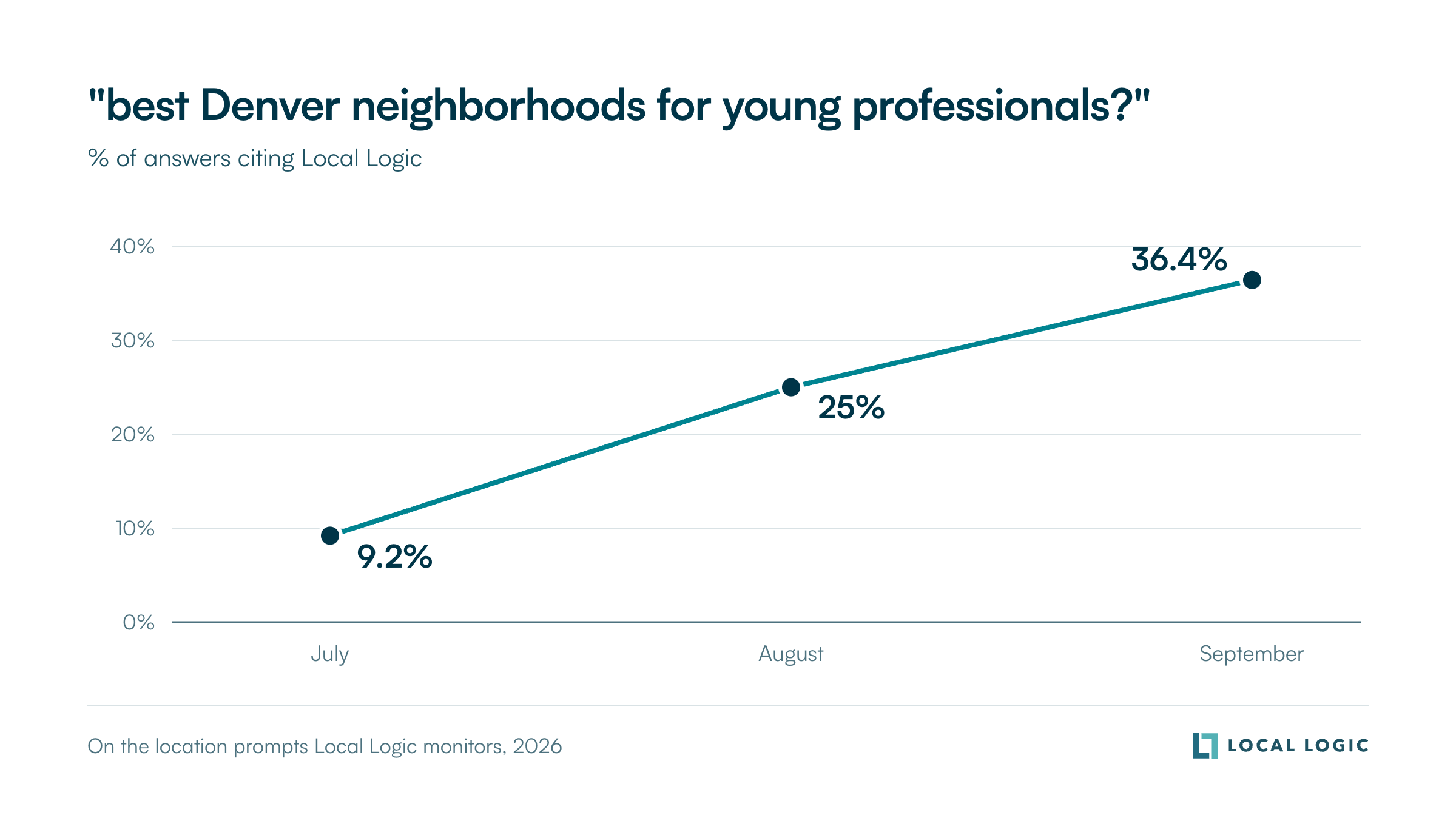
Across all our monitored prompts, pages built on grounded data for one specific question were cited about 90 times as often as our other pages.
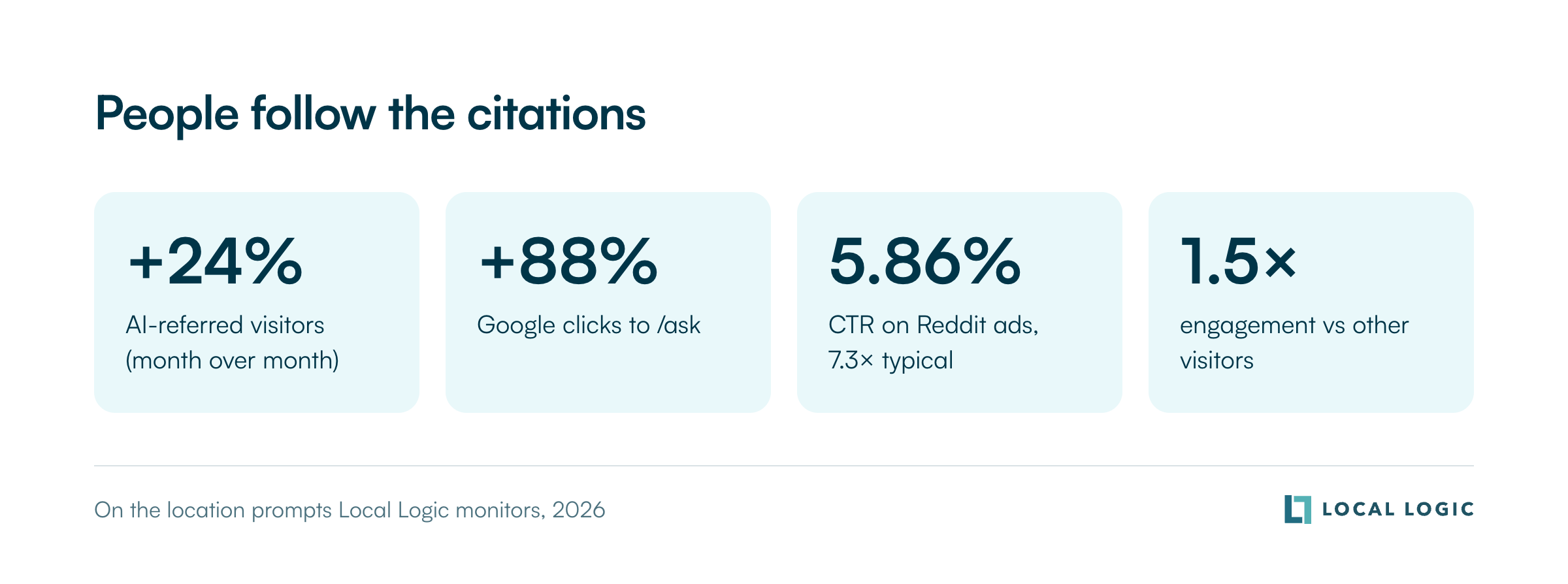
Citations are the main result, and people are starting to click through. Visitors referred by AI engines grew 24% month over month. Google clicks to /ask pages grew 88%, on about four times as many total Google search impressions. Reddit ads pointing to /ask earned a 5.86% click-through rate, at least 7.3 times a typical Reddit ad, and those visitors engaged with the page 1.5 times as often as other visitors.
Two months in, a few lessons shape how we’d build the next metro. They’re also the details that separate a page an engine cites from one it skips.
/ask runs on the same MCP our customers use to build their own AI-ready neighborhood content, assistants and search experiences. With it, your team gets:
Every brokerage, franchise and portal already has neighborhood pages. The question is whether an AI engine trusts them enough to cite them. Book a demo, and we’ll show you how the MCP grounds neighborhood content, how we measure citation rate, and what a proof of concept on your markets would look like.
No. Google often answers a question with a Gemini-powered AI Overview before showing any links, and Pew Research found that users clicked a result in 8% of searches with an AI summary compared with 15% without one. Being the source cited inside the answer now matters as much as ranking below it.
By becoming a source AI engines consider reliable. That means one page per specific neighborhood question, facts drawn from credible data and stated so they can be checked, a visible methodology, and named reviewers. Local Logic followed this approach and went from the #36 to the #12 most-cited source on the location prompts we monitor in two months.
E-E-A-T stands for experience, expertise, authoritativeness and trust, the qualities Google uses to describe reliable content. AI engines favor sources that show them. For neighborhood content, that means grounding facts in authoritative data, explaining the method, and having knowledgeable people review the page.
Run a fixed set of prompts on a regular schedule across several AI engines and record which domains each answer cites. We track 150 prompts across 11 engines, about 18,000 responses a month, and cross-check against Google Search Console and Bing Webmaster Tools.
No. On the location prompts we monitor, brokerage and agent sites earn 38% of all citations, while Zillow, Redfin and Realtor.com each earn less than 2%.
A Model Context Protocol server that connects AI applications to Local Logic’s verified location data, including 18 location scores, points of interest, neighborhood profiles and market statistics for the US and Canada. In our benchmark, a low-cost model grounded on it scored 97.6% accuracy on neighborhood questions.
Further reading: AI is confidently wrong about neighborhoods. We measured it, then fixed it. · How grounding reduces hallucinations at a lower cost · RISMedia: Local Logic launches MCP server