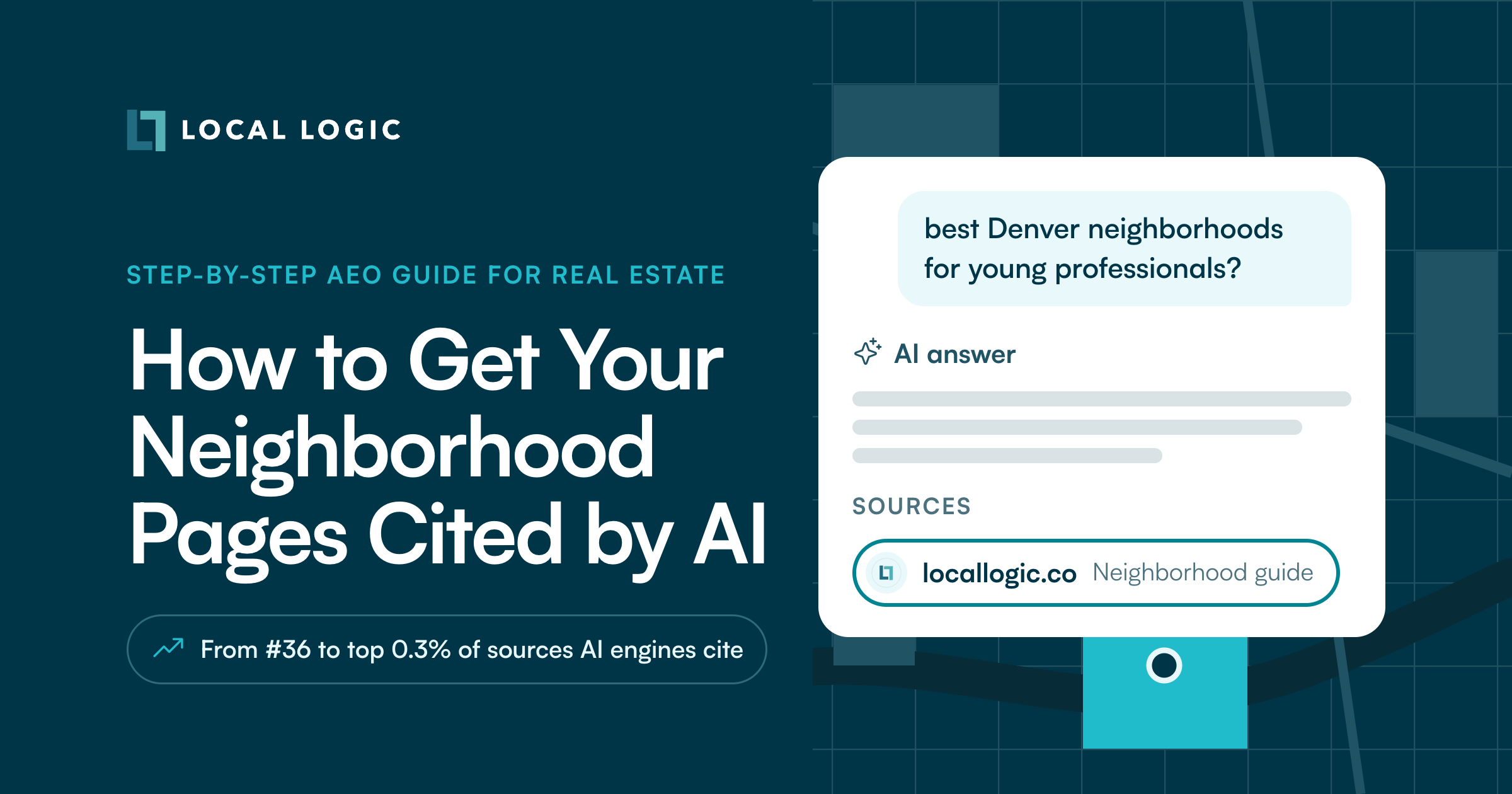
How the Local Logic MCP Put Us in the Top 0.3% of Sources AI Engines Cite
Residential
| 15 Oct 2026
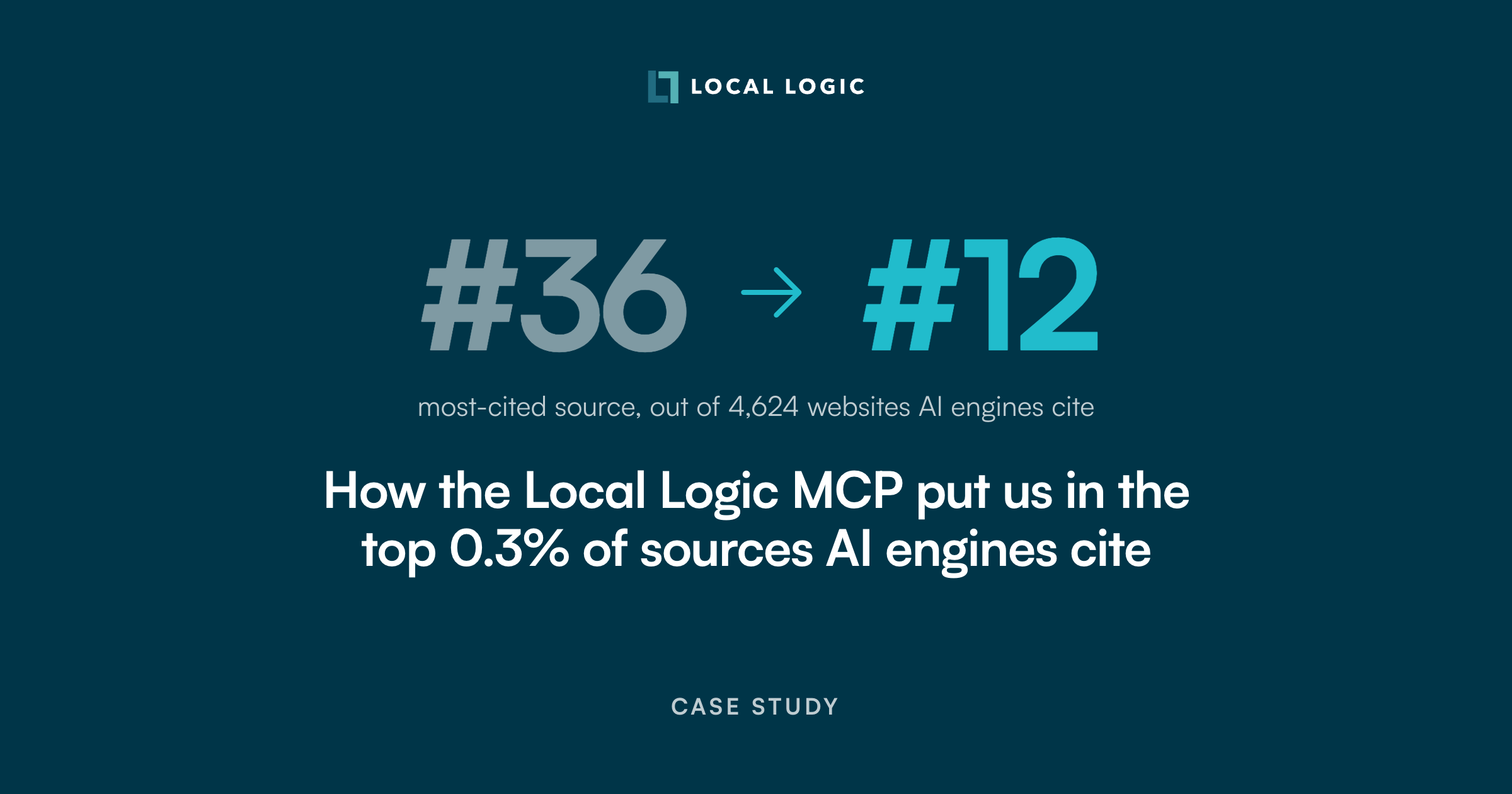
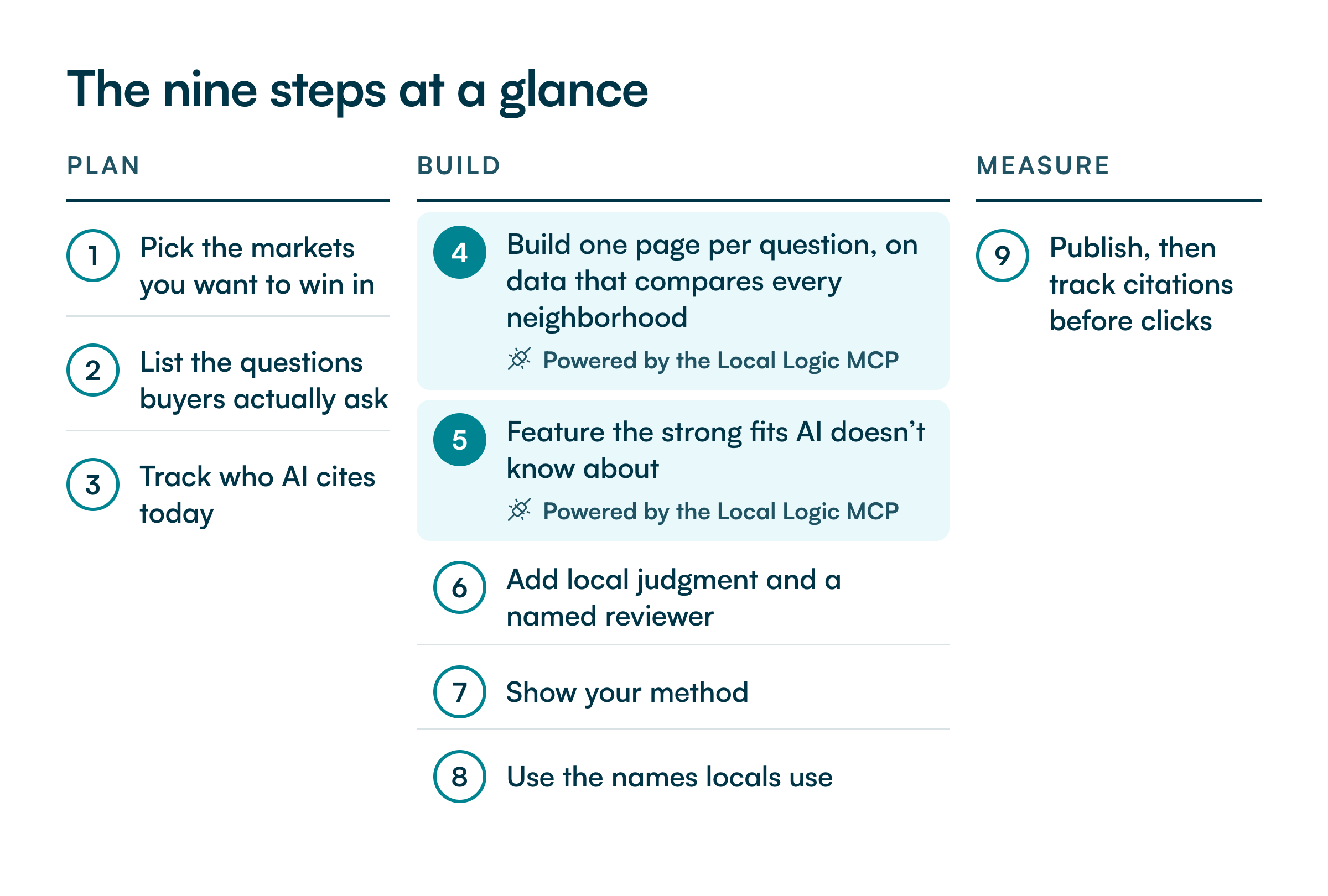
We used our own data to build neighborhood guides, and in two months we went from the 36th to the 12th most-cited source on the neighborhood questions we monitor. This guide breaks that work into nine steps any brokerage can follow.
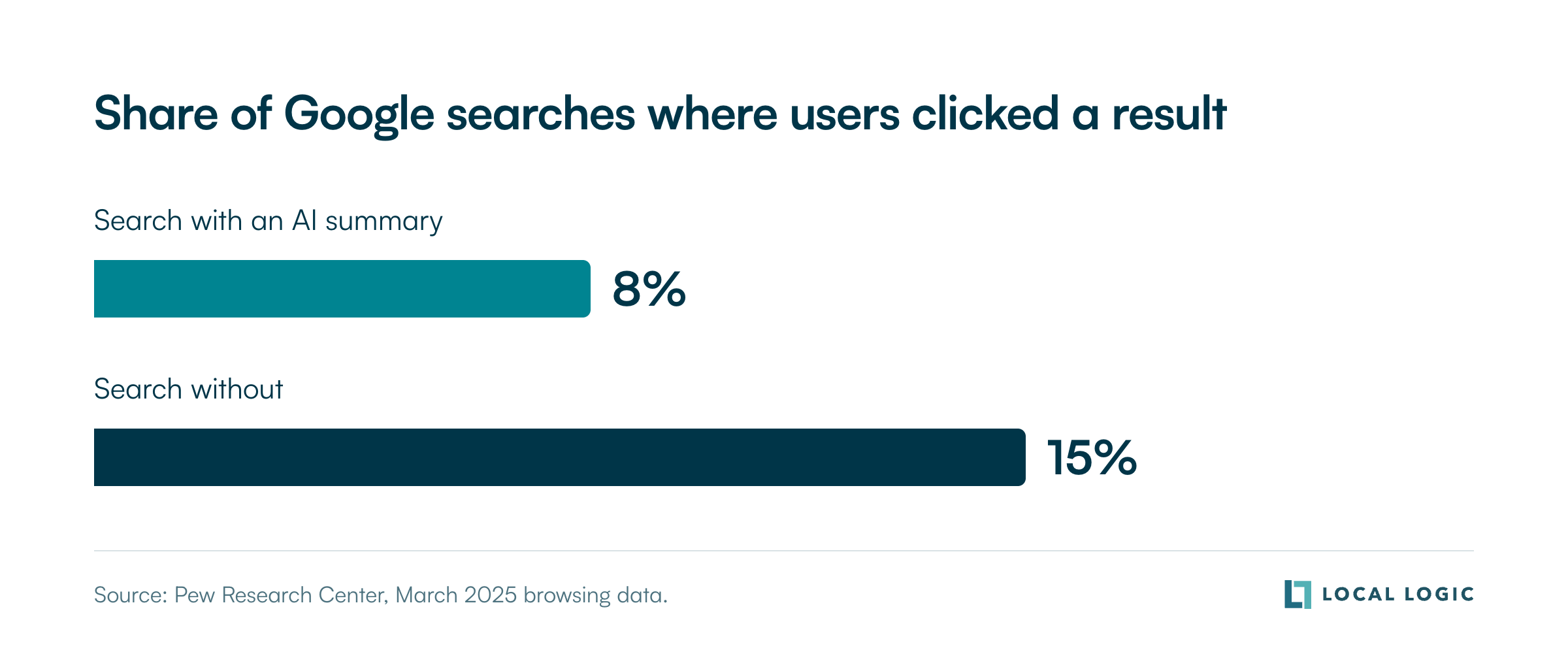
When a buyer asks Google for the best neighborhoods in a city, the first thing they often see is an AI answer, not a list of links. ChatGPT and Gemini skip the results page entirely. In a Pew Research Center study, people clicked a result in 8% of Google searches that showed an AI summary, compared with 15% of searches that didn’t.
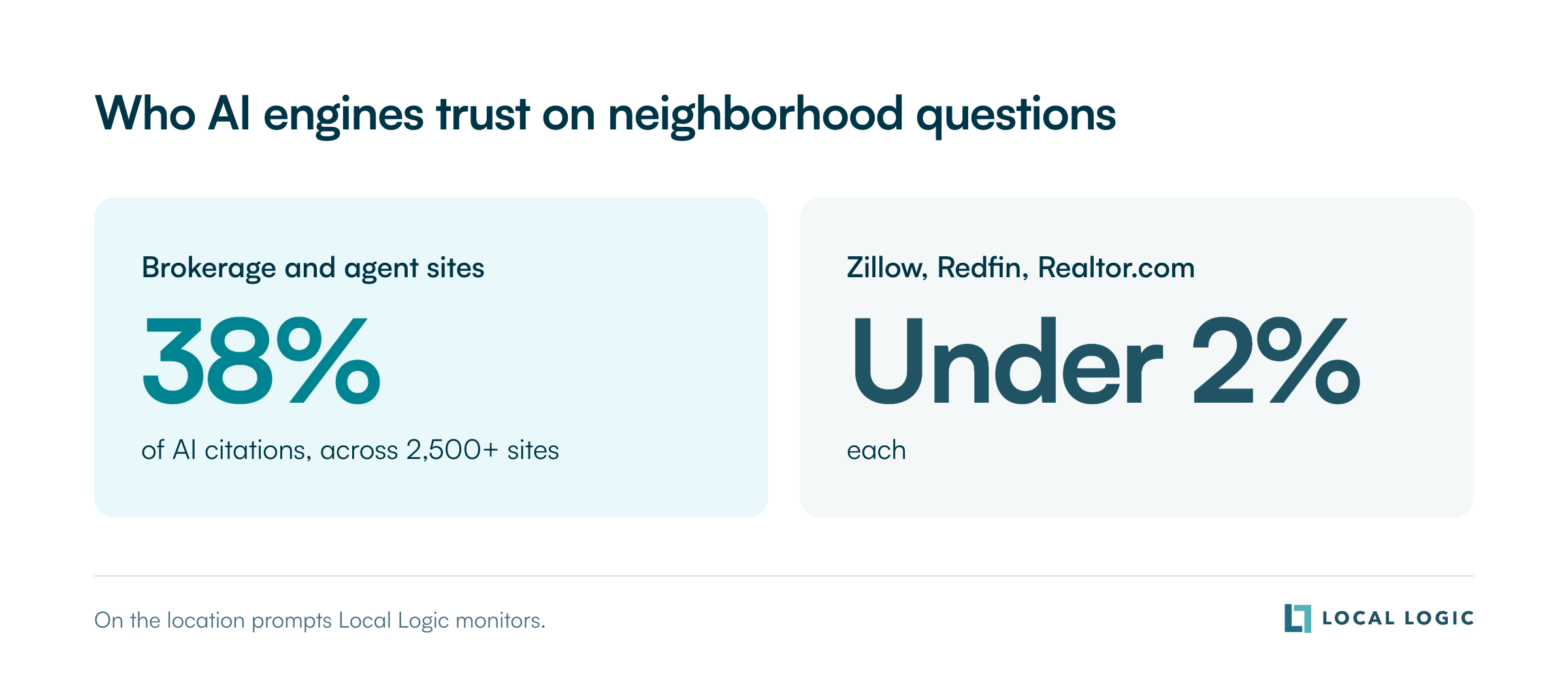
Answer engine optimization (AEO) is the work of becoming a source those answers cite. For real estate, the opportunity is bigger than most teams realize. On the neighborhood questions we monitor, brokerage and agent sites earn 38% of AI citations. Zillow, Redfin and Realtor.com each earn less than 2%. AI engines aren’t looking for the biggest site. They’re looking for the most reliable answer.
Here is how to become that answer.
Don’t start with every city you serve. Start with the few markets where more visibility would matter most to your business, whether that’s where you have the most listings, the most agents or the most room to grow.
Focus makes everything that follows easier to build, track and improve. We launched in three metros, learned from them, and then expanded one metro at a time to the 10 we cover today.
People don’t ask AI engines for “Denver real estate.” They ask specific, comparison questions:
Write down 10 to 20 questions per market. Use your agents’ experience, your site search data and the questions people ask in your inquiries. Phrase them the way a buyer would type them into ChatGPT, not the way a marketer would write a keyword.
Why it matters: pages built to answer one specific question were cited about 90 times as often as our other pages in September. Specificity is the single biggest lever in this guide.
Before you publish anything, find out who AI engines cite for your questions right now. Run each question through the major engines (ChatGPT, Claude, Google AI Overviews and AI Mode, Gemini, Perplexity and Microsoft Copilot) on a regular schedule and record which websites each answer cites.
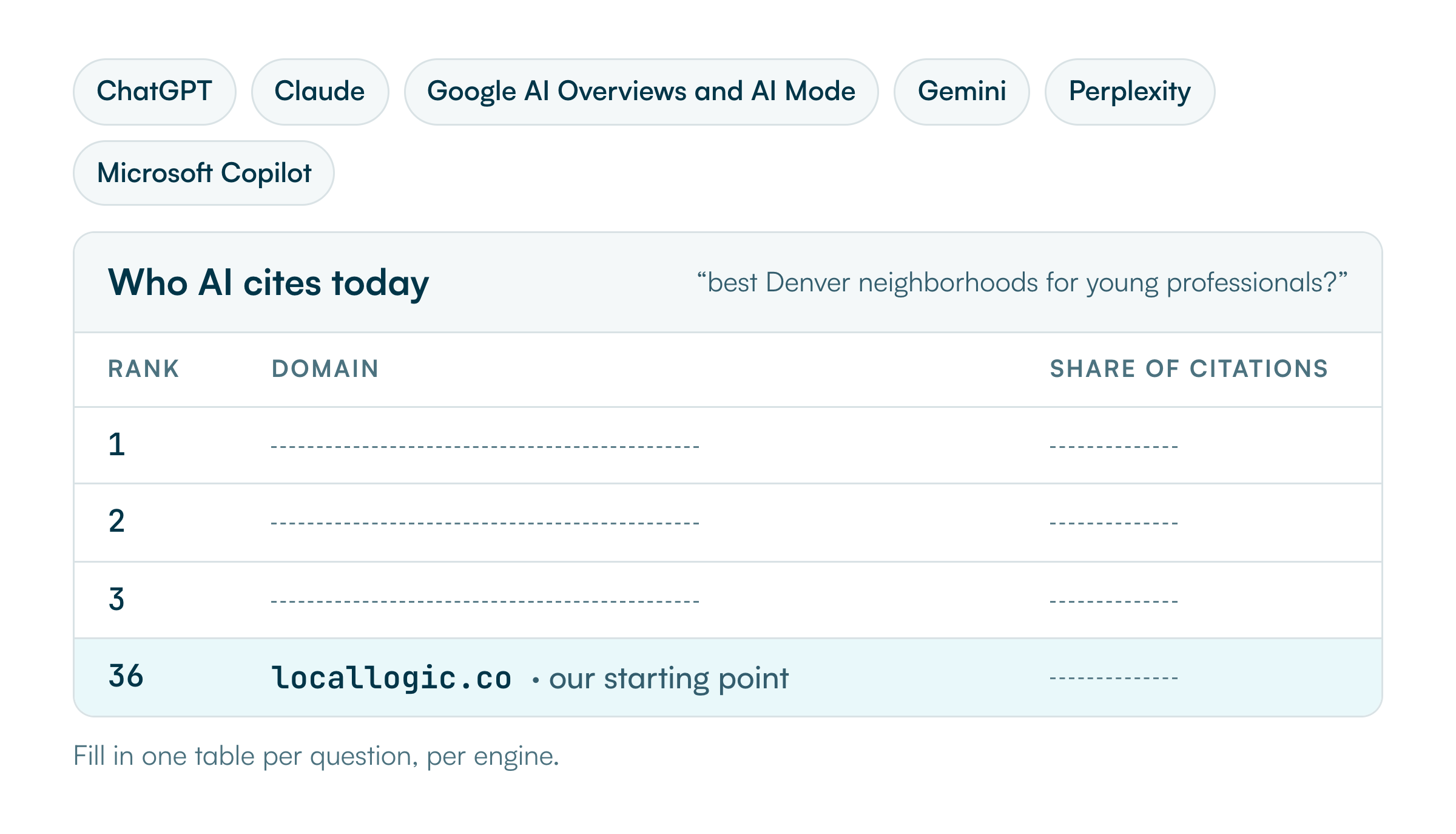
You can do this by hand for a handful of prompts, or use an AI visibility tool to run hundreds. Pair it with the free reports you already have: Google Search Console shows AI Overviews and AI Mode impressions, and Bing Webmaster Tools has an AI performance report.
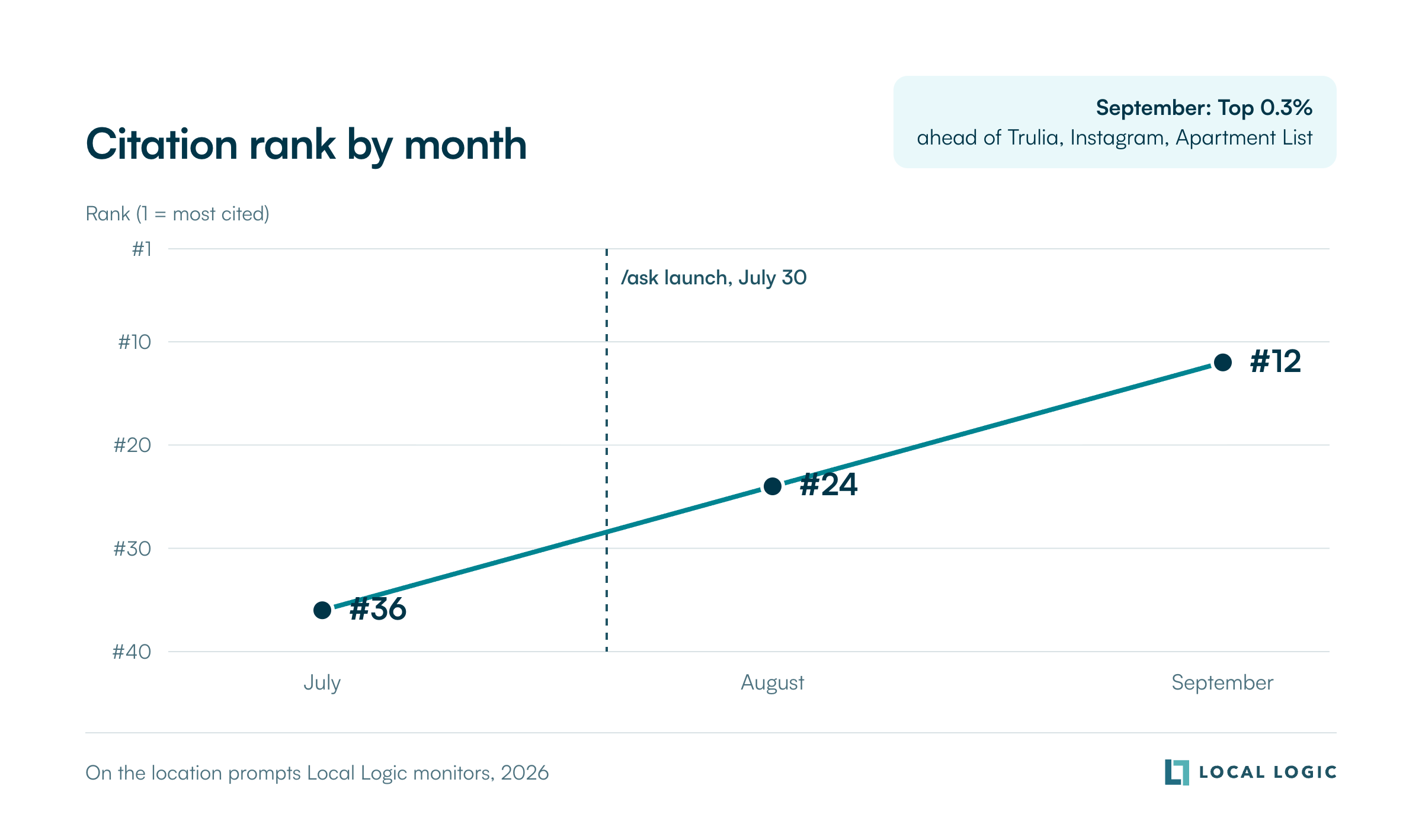
This baseline tells you who you’re up against and gives you a starting point to beat. When we started, Local Logic was the 36th most-cited source on our prompts.
This is where most neighborhood content falls short. A typical page describes one area as “vibrant” or “convenient.” An AI engine can’t check that, so it has no reason to trust it.
A question like “best neighborhoods for young professionals” is a comparison. To answer it credibly, you need data that scores every neighborhood in the market the same way, so you can rank them and show your work. With consistent scores, you can say that Midtown ranks third out of Atlanta’s 423 neighborhoods for nightlife, scoring 9.4 out of 10. An engine can check a claim like that.
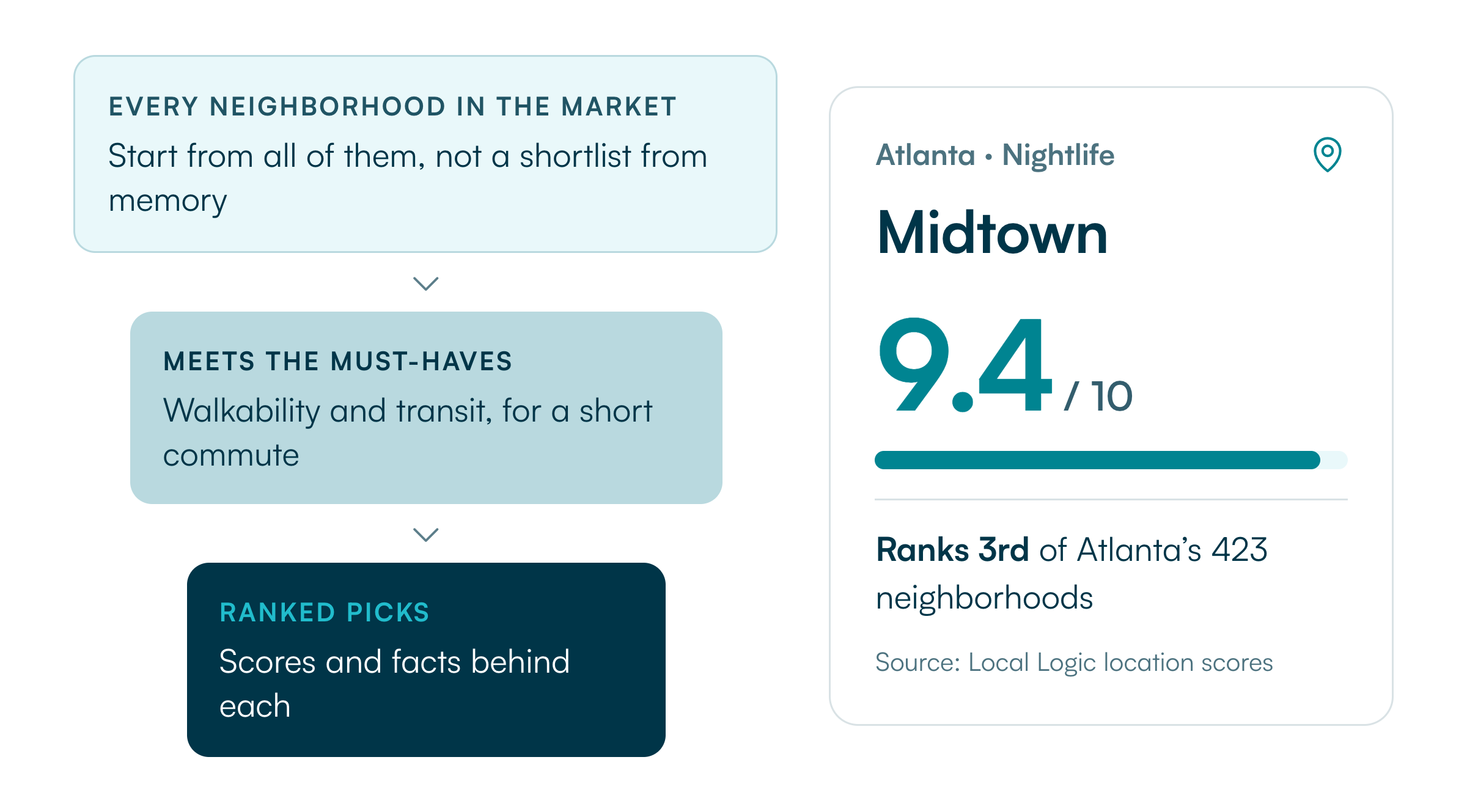
For each page:
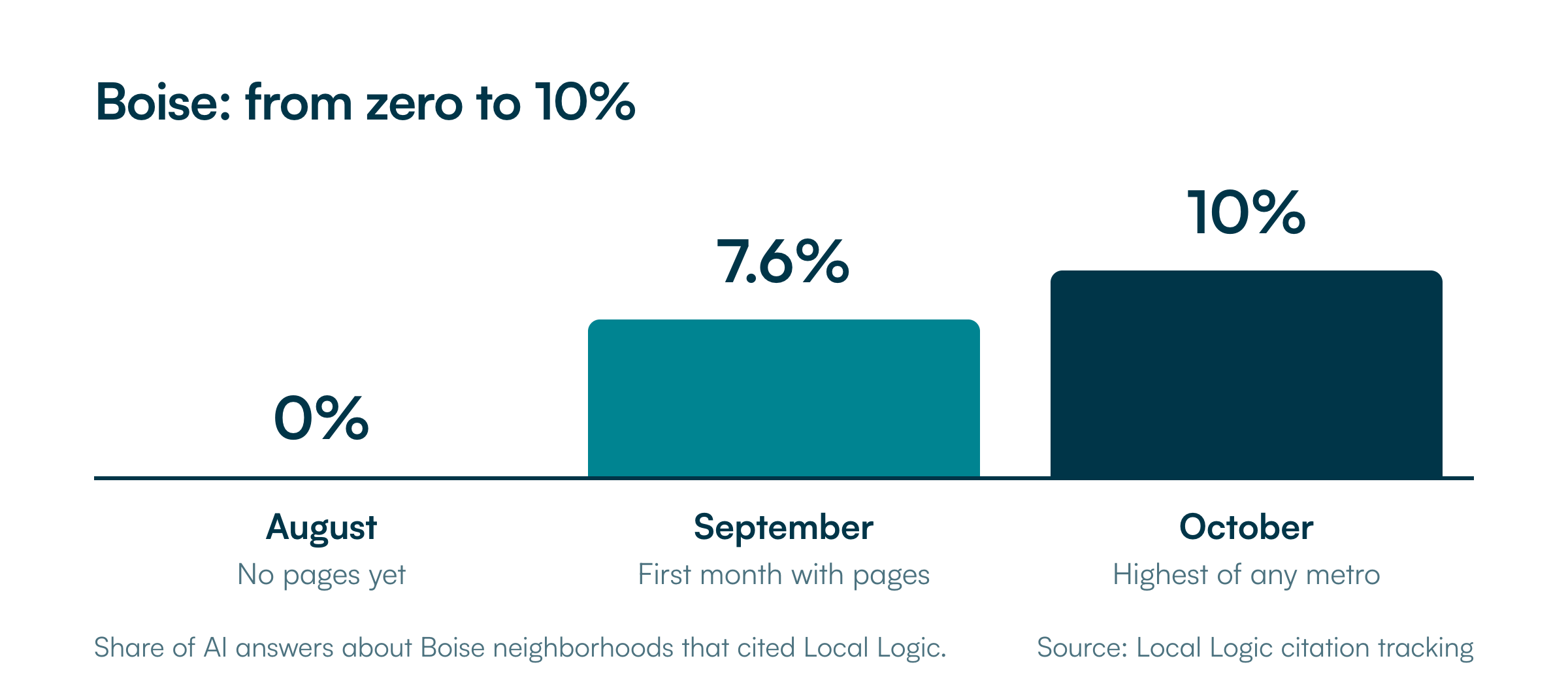
Proof: Boise had no Local Logic pages and zero AI citations in August. In September, its first month with question-specific pages, 7.6% of AI answers about Boise neighborhoods cited us. By October, it was 10%, the highest of any metro we monitor.
Ask ChatGPT for good neighborhoods without letting it search, and it tends to list the same well-known names. Your page adds the most value when it makes a data-backed case for neighborhoods that fit the question but rarely appear in generic lists.
This is where AEO goes beyond getting cited. It changes the answer itself. When ChatGPT cited our guides, it recommended the lesser-known neighborhoods they feature 3.6 times as often as when it didn’t. Take South Park Hill in Denver. Without search, ChatGPT recommended it in 0 of 25 answers. When it cited our guide, it recommended South Park Hill in 22 of 22.
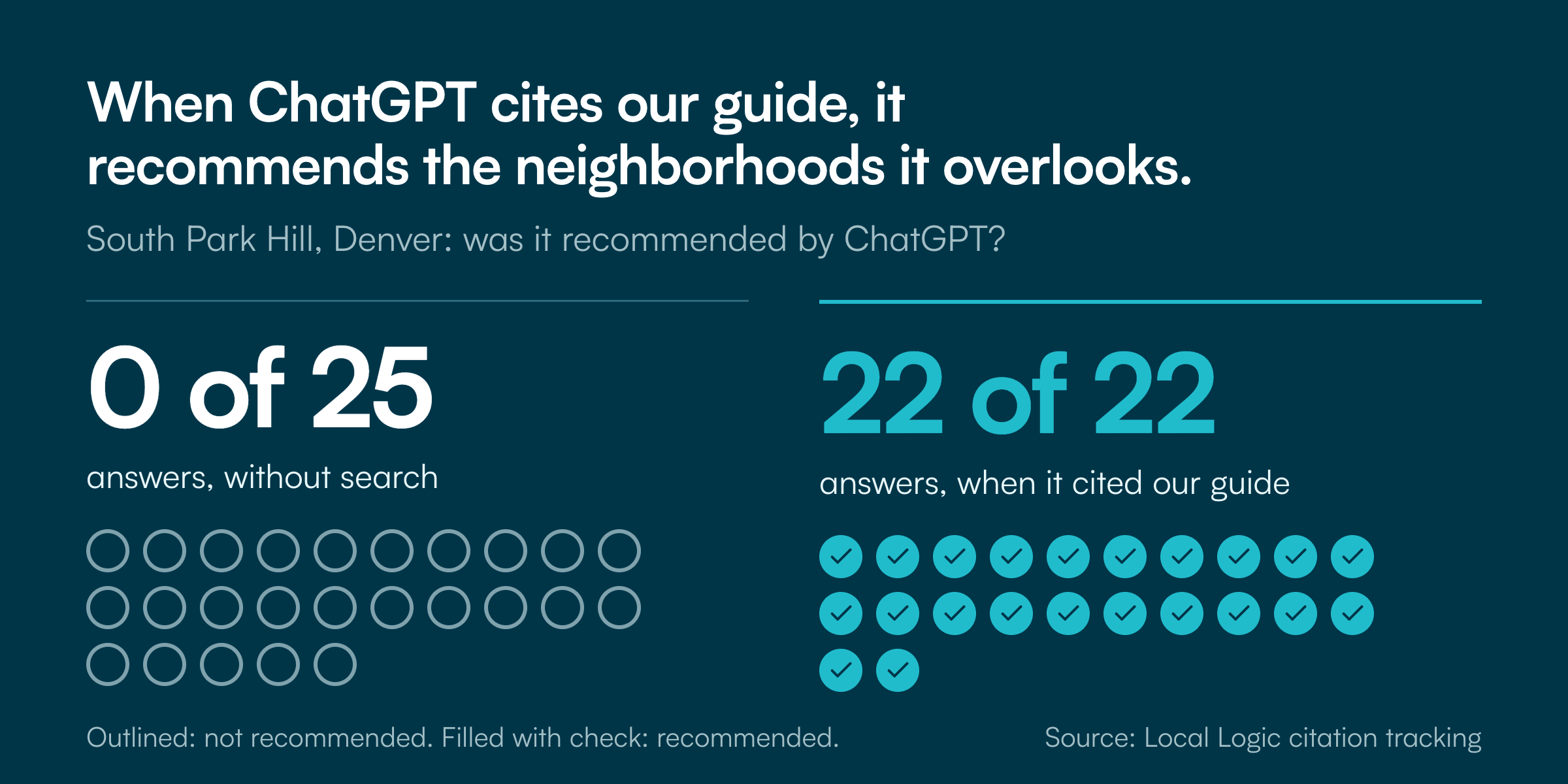
For a brokerage, that’s the difference between AI sending buyers to the same five famous neighborhoods and AI sending them to the areas where your listings are.
Data tells you a neighborhood has around 150 restaurants. Locals tell you which ones people actually go to. Combine both.
Experience is the first “E” in E-E-A-T, the qualities Google’s own guidance on helpful, reliable content describes, and the signals AI engines lean on when they choose sources.
Trust is the last letter in E-E-A-T, and it’s the easiest to earn. Tell readers and AI engines where your facts come from.
Grounding also makes the content more accurate. In our AI hallucination benchmark, a low-cost model grounded on Local Logic data scored 97.6% accuracy on neighborhood questions. A frontier model answering from memory scored 96.9%, at about seven times the cost per answer.
Official neighborhood boundaries don’t always match what people call places. Buyers ask about LoHi and Uptown, not their official names. If your page doesn’t use the local name, an engine may not connect it to the question.
Put the names locals use in your visible text, your headings, and your structured data. We learned this in our first metros and now do it from day one.
Citations come first, and clicks follow. In an answer-first world, the sources an AI answer cites are the sites a home buyer sees. Track your citation rate on your question list every month, by engine and by market.
Expect the curve to build. Here’s what happened on our monitored prompts:
Then use what you learn. When testers told us affordability should count for more in the picks, we built typical home prices into the next round. When a new market goes live, add its questions to your tracking list.
Answer engine optimization is the work of becoming a source that AI engines like ChatGPT, Gemini and Google AI Overviews cite when buyers ask questions. For real estate, that usually means neighborhood questions, and the winning pages answer one specific question with facts drawn from reliable data.
They overlap, but they aren’t the same. SEO earns a ranking in a list of links. AEO earns a citation inside the answer that appears above those links, or in place of them. Pages that do well at AEO are specific, factual, clearly sourced and reviewed by people who know the market.
On the prompts we monitor, it took one month to go from zero citations to 7.6% of AI answers in Boise, and two months to reach the top 0.3% of cited sources overall. Results depend on your markets, your questions and the competition.
No. On the neighborhood questions we monitor, brokerage and agent sites earn 38% of AI citations, while Zillow, Redfin and Realtor.com each earn less than 2%. AI engines favor the most specific, reliable answer, not the biggest site.
Run a fixed list of buyer questions through several AI engines on a regular schedule and record which websites each answer cites. Cross-check with Google Search Console and Bing Webmaster Tools, which both report on AI search.
Every step in this guide comes from our own work. Read the full case study to see the results metro by metro, or book a demo to see how the Local Logic MCP can power neighborhood content for your markets.