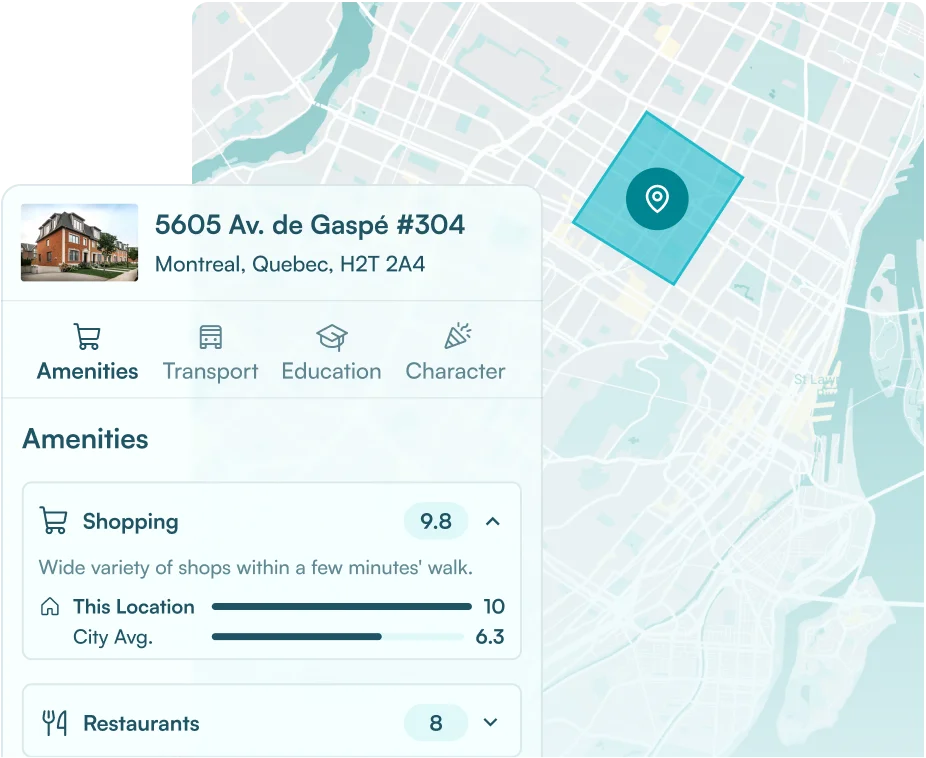



What Geographic Areas Does Local Logic Cover?
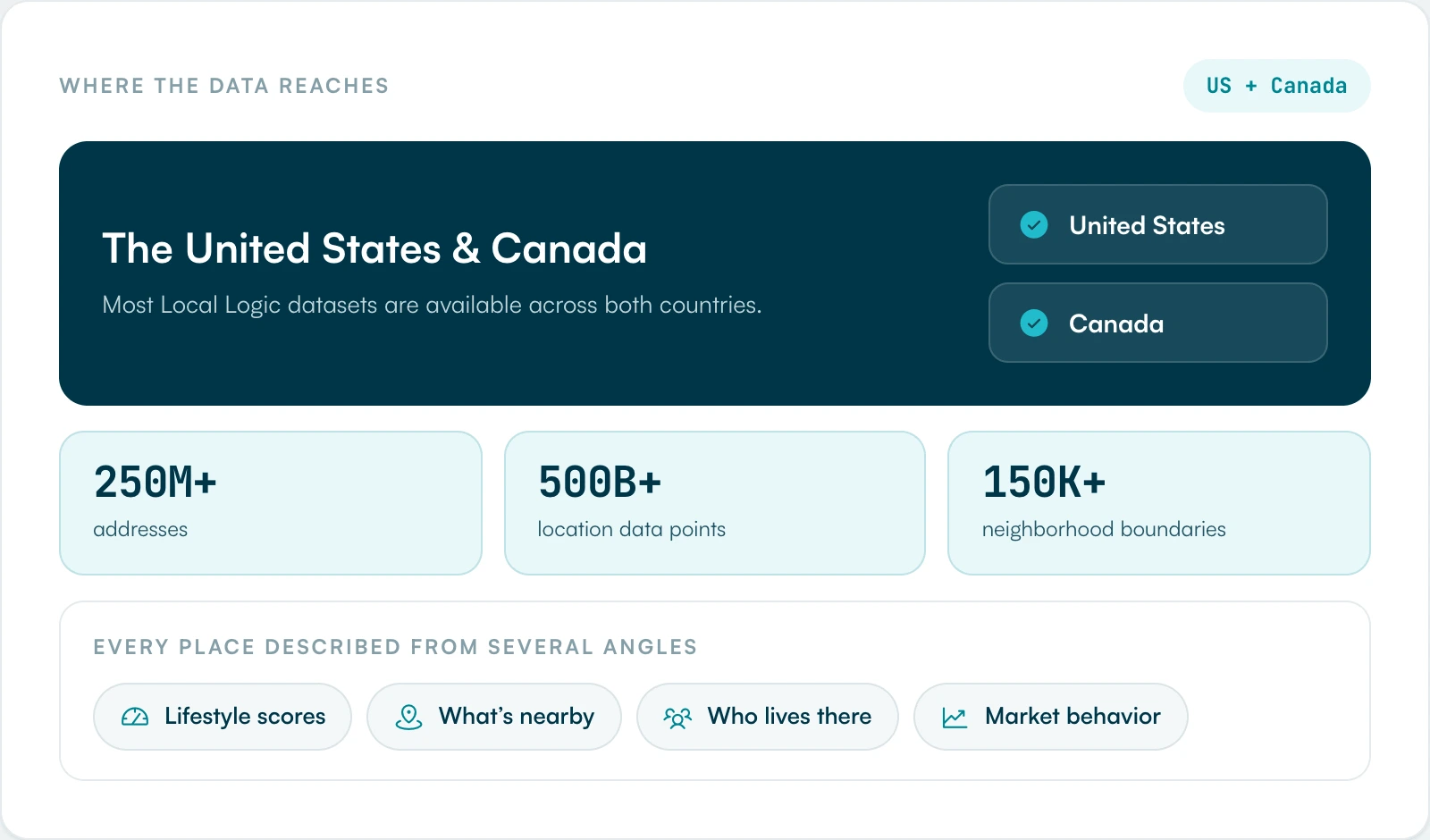
Local Logic covers the United States and Canada, spanning more than 250 million addresses. Most products, including Location Scores, points of interest, demographics, neighborhood profiles, and similar neighborhoods, are available in both countries. A few have specific notes: Market Statistics is United States only, demographic attributes vary by country, and schools are maintained as separate US and Canada datasets. Data can be requested at the address, neighborhood, city, metro, or custom-geography level.
Two questions hide inside coverage
When someone asks what a data provider covers, they are really asking two things. Where does the data reach, and how fine-grained is it? A dataset that spans a whole country but only resolves to the city level answers a very different set of questions than one that resolves to a single address. Local Logic is broad on both counts, so it is worth taking them one at a time.
Where the data reaches
Local Logic covers the United States and Canada. The foundation is more than 250 million addresses, built on over 100 billion location data points drawn from public, proprietary, and partner sources. Across those two countries, the platform describes a place from several angles: how it scores on lifestyle dimensions, what is nearby, who lives there, and how its neighborhood and market behave.
Most products are available across both countries. A few have coverage notes worth knowing up front, summarized below.
Coverage by product
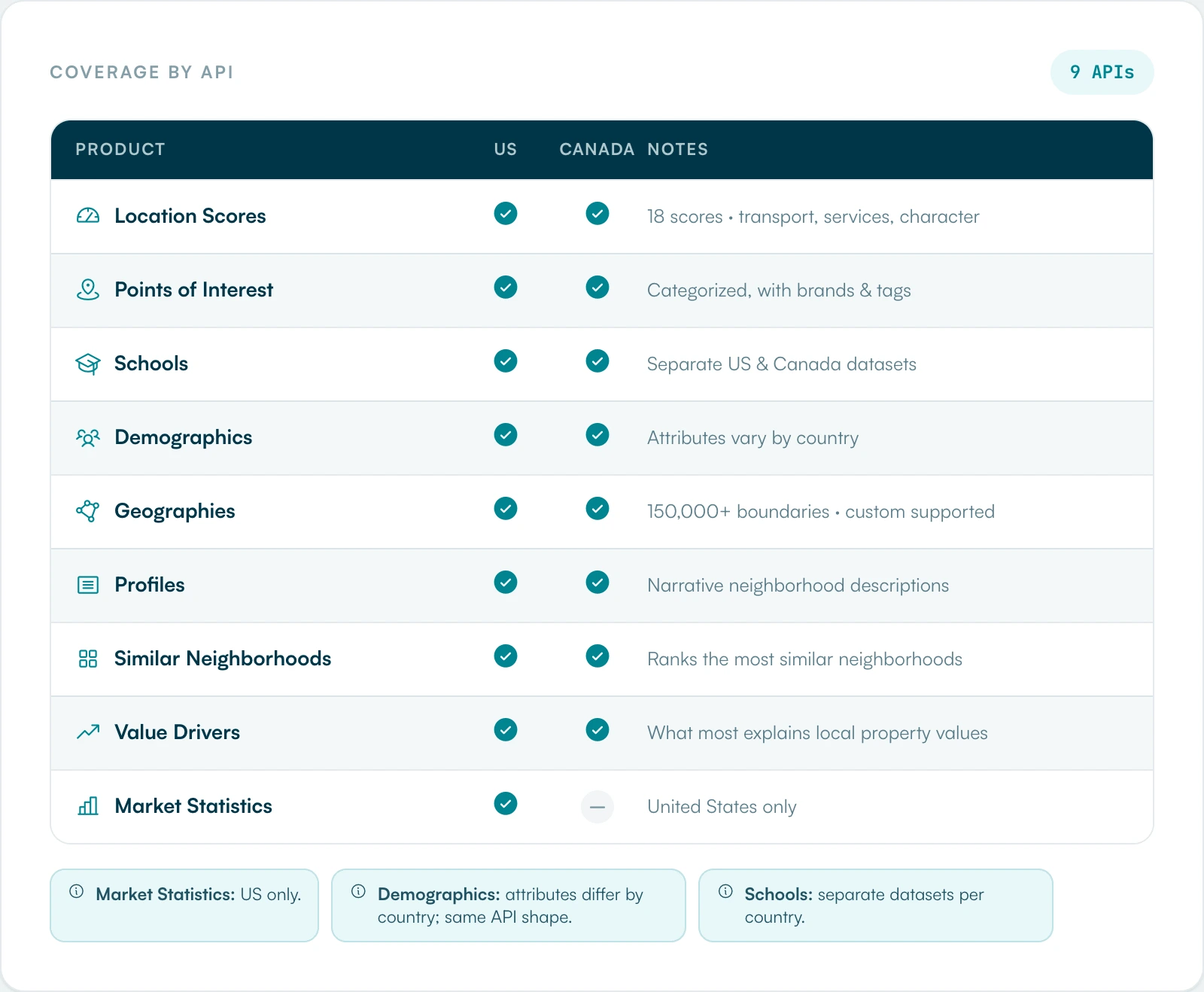
| Product | US | Canada | Notes |
|---|---|---|---|
| Location Scores | Yes | Yes | 18 scores across transportation, amenities, education, character, nature, and wellness |
| Points of Interest | Yes | Yes | Categorized, with brands and tags |
| Schools | Yes | Yes | Separate US and Canada datasets |
| Demographics | Yes | Yes | Available attributes vary by country |
| Geographies | Yes | Yes | 480,000+ neighborhood boundaries; custom supported |
| Profiles | Yes | Yes | Narrative neighborhood descriptions |
| Similar Neighborhoods | Yes | Yes | Ranks the most similar neighborhoods |
| Value Drivers | Yes | Yes | What most explains local property values |
| Market Statistics | Yes | No | United States only |
| Climate Risk | Yes | Yes | Heat, storm (precipitation), fire, drought, and flood in both countries; wind in the United States only |
Three caveats to keep in mind. Market Statistics covers the United States only. Demographic attributes differ by country because each national statistics agency publishes different things, though the API returns the same response shape, so the two can be compared without building two integrations. And schools are maintained as separate datasets per country, reflecting how differently school information is published in each.
How fine-grained the data is
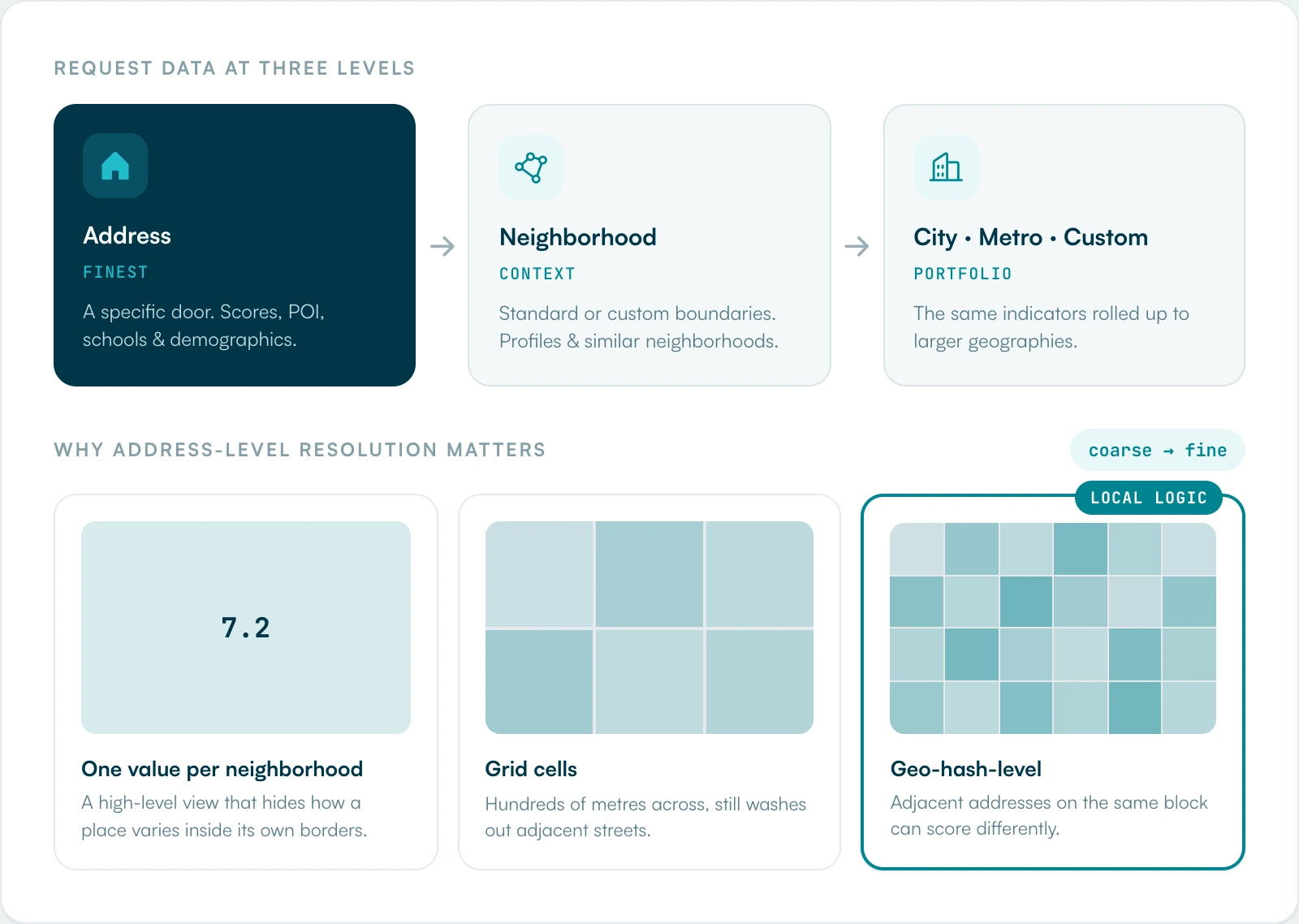
Coverage is not only about borders on a map. It is also about resolution, and this is where the data is built to do real work. You can request data at three levels:
- Address. The finest level. Location Scores, points of interest, schools, and demographics can all be retrieved around a specific address across the 250 million in the US and Canada.
- Neighborhood. For context-level questions, profiles, similar neighborhoods, value drivers, and aggregated scores or demographics are computed against standard neighborhood boundaries or custom ones you define.
- City, metro, and custom geography. For portfolio and market-level work, the same indicators roll up to larger geographies, including ones you define.
Why address-level granularity matters
The base unit at which data is computed decides how useful it is. Too coarse, and you erase the variation that makes one address worth more than the one across the street, and that variation is often the whole reason for looking at the data.
Most providers compute at one of two scales. Some assign a single value to an entire neighborhood, which works as a high-level view but says nothing about how a place varies inside its own borders. Others, like WalkScore, lay a grid over a city and compute one value per cell, where cells are often hundreds of metres across and still wash out the difference between adjacent streets. Local Logic computes Location Scores at a resolution roughly equivalent to a single mid-to-large building in a dense urban setting. At that level, scores differ not just between neighborhoods, but between addresses on the same block, which is how people actually make decisions: pricing one specific listing, evaluating one specific site, or showing a buyer what life looks like at one specific door.
A note on neighborhood coverage
One nuance that follows from how boundaries work: because neighborhoods have no official definitions, neighborhood coverage is concentrated in major cities, while municipalities and counties are covered everywhere. In practice that means Local Logic can always tell you the municipality or county for any coordinate, and can name the neighborhood across more than 480,000 of them, but not for every point in either country. Being upfront about that is part of using the data responsibly.
Why it matters
Coverage is usually the first question a serious evaluator asks, and a clear answer builds trust faster than a vague one. The short version: broad reach across the US and Canada, a handful of named exceptions rather than hidden gaps, and resolution down to the individual address. That combination is what lets a national portal, a regional brokerage, or a proptech platform build on the data with confidence about exactly where it will and will not have an answer.
Frequently asked questions
What countries does Local Logic cover?
The United States and Canada, across more than 250 million addresses. Most products are available in both countries, with a few noted exceptions like Market Statistics, which is US only.
Is Local Logic data available at the address level?
Yes. Location Scores, points of interest, schools, and demographics can be retrieved for a specific address. Scores are computed at a resolution roughly equivalent to a single mid-to-large building, so adjacent addresses can differ.
Which products are not available in both countries?
Market Statistics is United States only. Demographics is available in both countries but with different attributes, and schools are maintained as separate US and Canada datasets. Everything else is available across both.
Can Local Logic identify a neighborhood for any address?
Not everywhere. Municipalities and counties are covered everywhere, so those can always be identified. Neighborhood coverage spans more than 480,000 boundaries concentrated in major cities, so some addresses fall outside a defined neighborhood.