


Observed, Modeled, and Inferred Data: What’s the Difference?
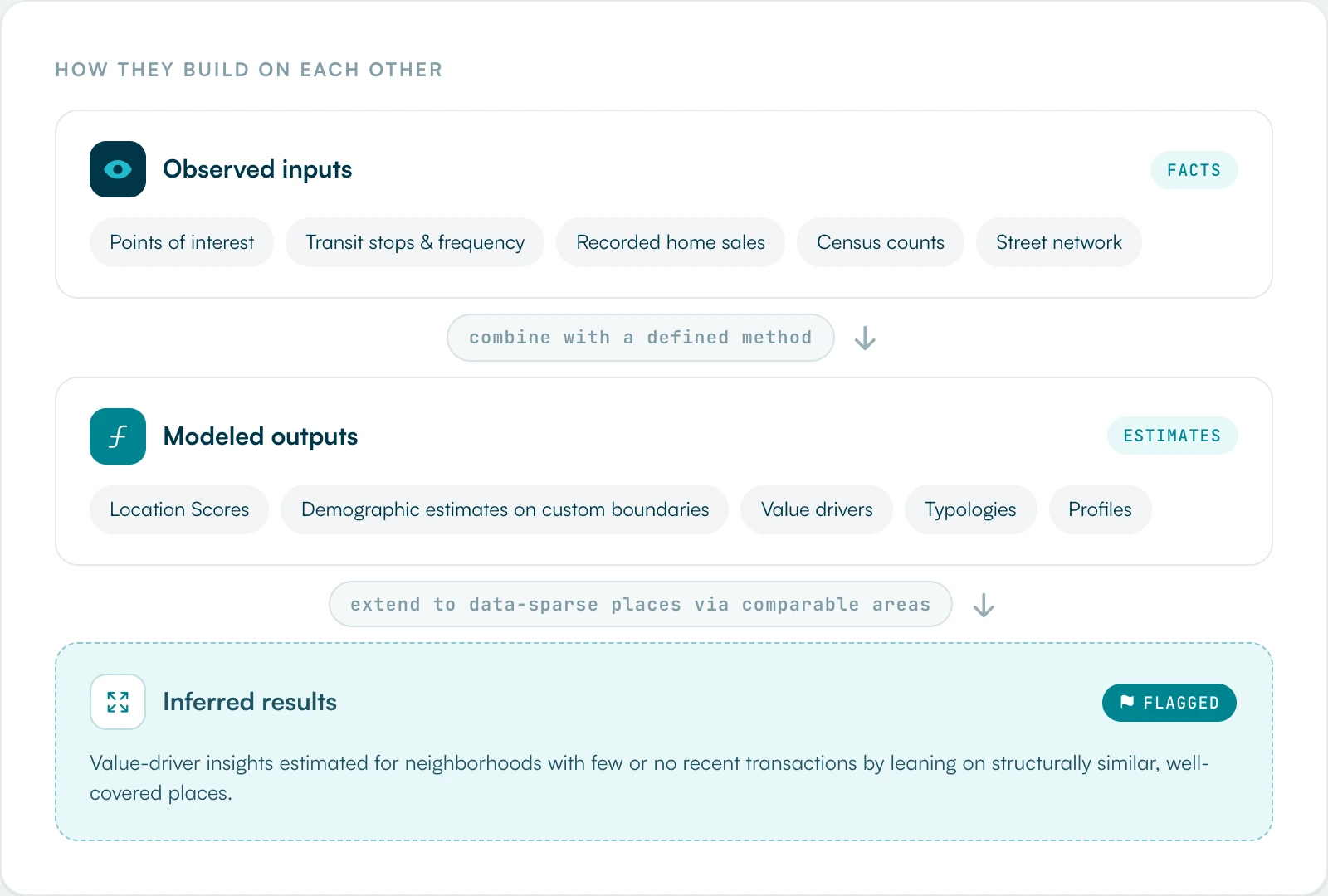
Observed data is directly recorded fact: what exists or what actually happened, like a grocery store at an address or a recorded home sale. Modeled data is computed from observed inputs using a defined method, like a walkability score built from nearby places and the street network. Inferred data is extended to places where direct data is thin or missing, by drawing on comparable areas. The difference matters because each carries a different level of certainty, and good data products are clear about which is which.
Why the distinction matters
People tend to treat all data as equally solid, but a recorded sale price and a predicted lifestyle score are not the same kind of thing. One is a fact. The other is a careful estimate. Both are useful, but you reason about them differently, and you should trust them differently. A data product that blurs the line invites overconfidence. One that is clear about it earns trust. Local Logic draws this line on purpose, across three types: observed, modeled, and inferred.

Observed data
Observed data is directly recorded: a fact about what exists or what happened. It is the closest thing to ground truth, because it is collected rather than computed. In Local Logic’s data, observed inputs include:
- Points of interest that exist at a location, such as a grocery store, cafe, or park.
- Transit stops and stations, and how often service runs.
- School locations and catchment boundaries.
- Recorded real estate transactions, the actual sale prices behind market statistics.
- Population counts published by national statistics agencies.
- The street network itself.
Observed data still has to be collected, cleaned, and kept current, but once it is, it describes what is actually there. You read it as fact.
Modeled data
Modeled data is computed from observed inputs using a defined method. It does not exist in the world to be picked up; it is produced by combining facts in a deliberate way. This is where most of the interpretation happens, and where a lot of the value is created. Local Logic’s modeled outputs include:
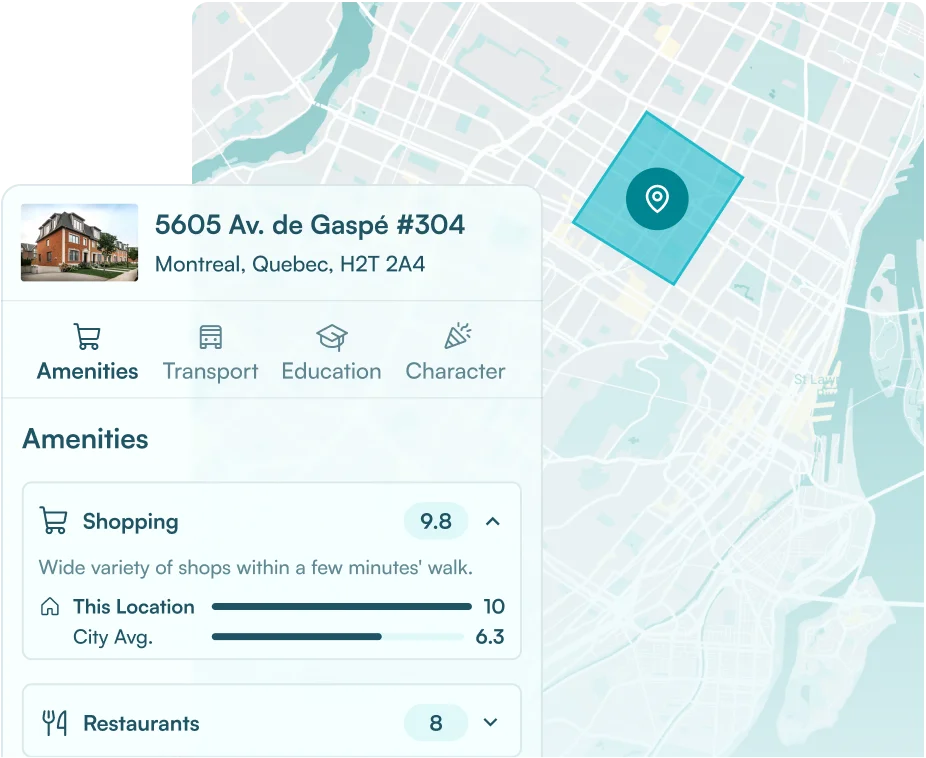
- Location Scores, which turn observed places and the street network into a 0 to 10 rating for things like walkability or transit access.
- Demographic estimates fitted to a custom neighborhood boundary that does not match the boundaries on which the counts were collected.
- Value drivers, which estimate what about a location most explains local property values.
- Neighborhood typologies, which classify places into consistent built-environment types.
- Neighborhood profiles, the narrative descriptions generated from the underlying data.
Modeled data is only as good as its inputs and its method. Done well, it answers questions observed data cannot, like whether one street is more walkable than another. You read it as a well-grounded estimate, not as a raw fact.
Inferred data
Inferred data is modeled output extended to places where direct data is sparse or missing. Some areas simply do not have enough recent activity to model directly. Rather than return nothing, an inference can be made by drawing on comparable, data-rich areas that resemble the target. For example, value-driver insights can be estimated for a neighborhood with few or no recent transactions by leaning on places that are structurally similar and well covered.
Inference is the least certain of the three, which is exactly why it has to be handled carefully. Local Logic applies confidence and explainability checks that flag when a result is inferred rather than directly modeled, and that hold back inferences that are not stable enough to stand behind. The goal is simple: never let an inference in a data-sparse area masquerade as a directly observed fact. You read inferred data as a useful, clearly labeled best estimate.
The three at a glance
| Type | What it is | Local Logic examples |
|---|---|---|
| Observed | Directly recorded fact about what exists or happened | Points of interest, transit stops and frequency, school locations and catchments, recorded home sales, census counts, the street network |
| Modeled | Computed from observed inputs using a defined method | Location Scores, demographic estimates on custom boundaries, value drivers, neighborhood typologies, profiles |
| Inferred | Extended to data-sparse places using comparable areas, with confidence flagged | Value-driver insights estimated for neighborhoods with few or no recent transactions |
How Local Logic keeps the line clear
Two practices keep these honest. The first is provenance: observed inputs come from public sources, licensed partners, and proprietary collection, and they are cleaned and refreshed rather than assumed. The second is restraint on inference: where the data thins out, confidence checks decide whether an inference is solid enough to publish, so coverage never comes at the cost of credibility. Being willing to say where an answer is an estimate, or to withhold one, is part of what makes the rest trustworthy.

Why it matters for the people building on it
If you are putting this data in front of home consumers or into a model of your own, knowing which type you are using changes how you use it. Observed data anchors the facts on a listing or a market report. Modeled data powers search, scoring, and discovery. Inferred data extends coverage into places that would otherwise be blank, as long as it is read for what it is. A provider that tells you which is which lets you build with confidence instead of guessing where the ground is solid.
Frequently asked questions
What is the difference between observed and modeled data?
Observed data is directly recorded fact, like a recorded home sale or a store that exists at an address. Modeled data is computed from observed inputs using a defined method, like a walkability score built from nearby places and the street network. Observed is collected; modeled is produced.
What is inferred data?
Inferred data is modeled output extended to places where direct data is sparse or missing, by drawing on comparable, well-covered areas. It is the least certain type, so it should always be flagged as an estimate rather than treated as fact.
Is a location score observed or modeled?
Modeled. A location score is computed from observed inputs, such as nearby points of interest and the street network, using a defined method. It is a well-grounded estimate of a characteristic, not a directly recorded fact.
How does Local Logic prevent inference from being misleading?
It applies confidence and explainability checks that flag when a result is inferred rather than directly modeled, and that hold back inferences that are not stable enough to publish, so an estimate in a data-sparse area is never presented as observed fact.